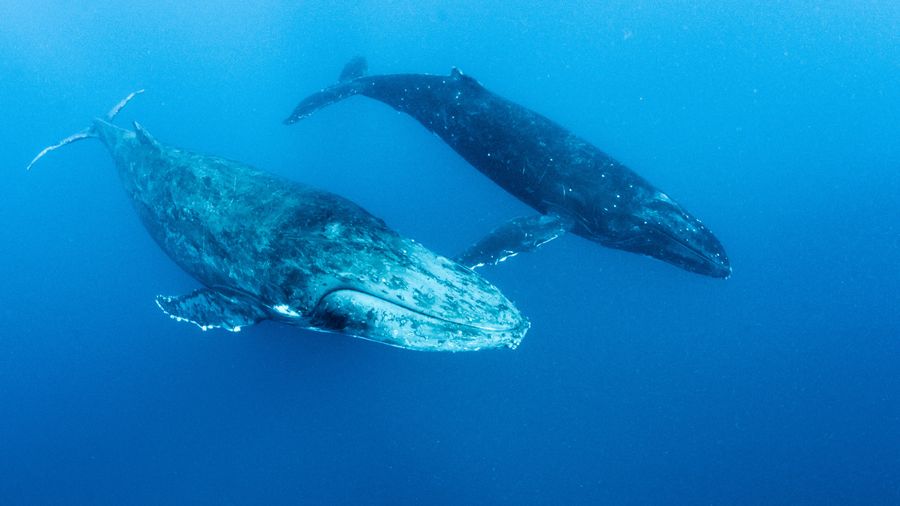
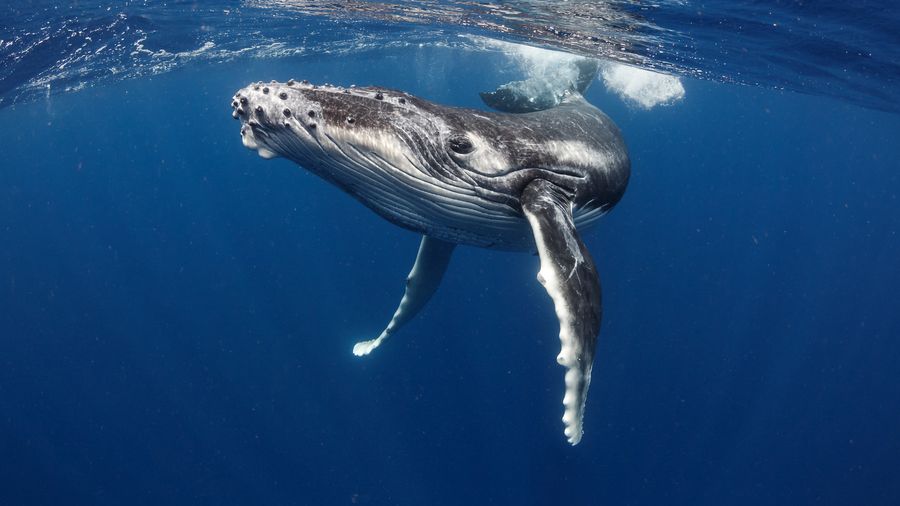
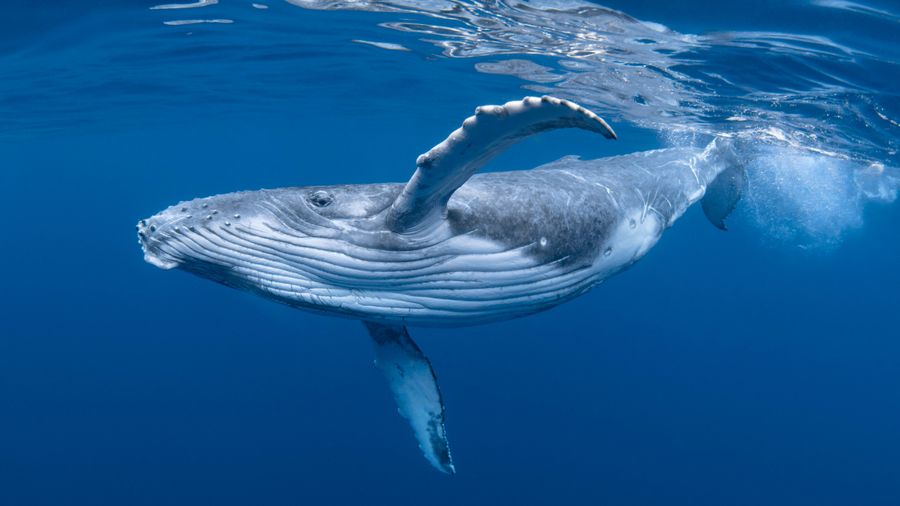
Marine Biology
Whales
Whales for divers and snorkellers — marine mammals, baleen versus toothed whales, song and echolocation, migration, encounter ethics, and the humpback season at Tofo.
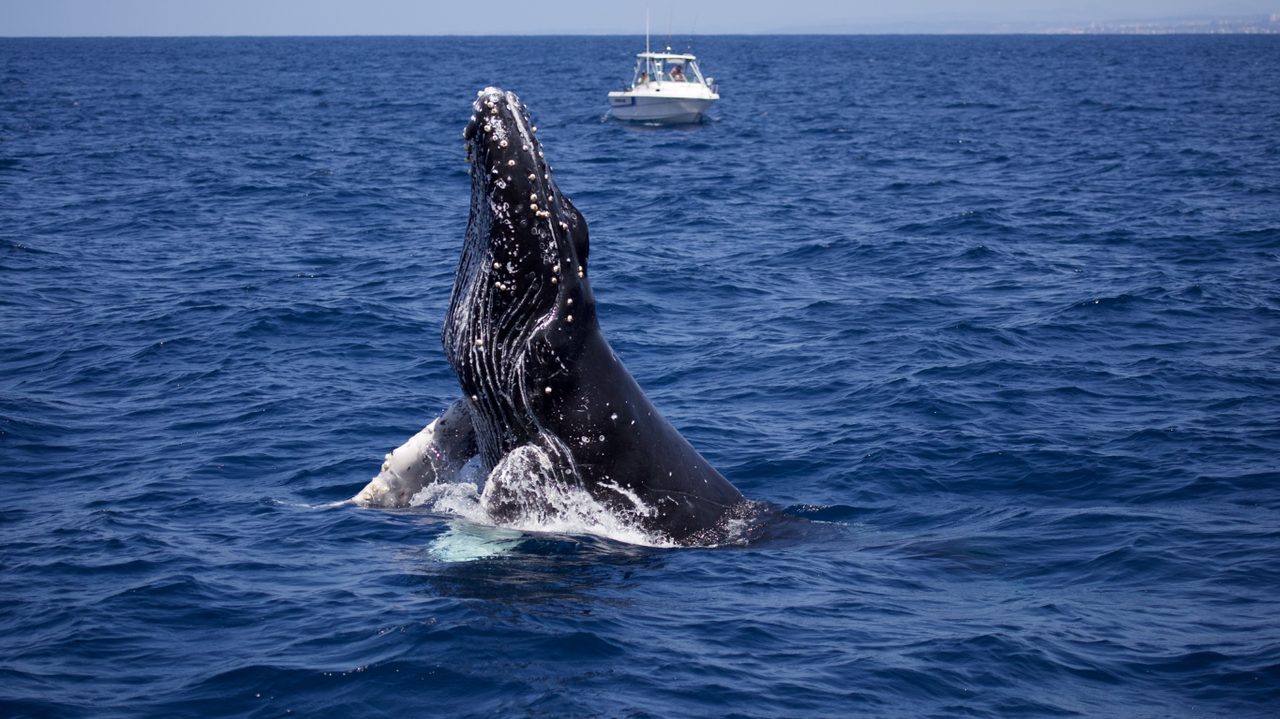
Whales are the largest animals that have ever lived on Earth, and they are mammals like us: they breathe air, are warm-blooded, nurse their young and live in complex social groups. Hearing a whale sing or seeing one up close is, for many divers, the experience of a lifetime. Unlike the whale shark (a separate topic), which despite its name is a fish, the whales in this topic are marine mammals. At Tofo, the humpback passes each year (roughly June to October), so this topic touches your region.
Of all animals in the sea, whales perhaps capture the imagination most. They are enormous (the blue whale is the largest animal that has ever existed, larger than any dinosaur), they travel thousands of kilometres a year, they "sing" songs that spread across whole ocean basins, and they are intelligent and social. And most surprising: they are family of ours. Whales are mammals that moved into the sea millions of years ago; their flippers are reshaped legs, and deep in their anatomy remain the vestiges of hip bones.
For divers and snorkellers, a whale encounter is special and rare. Unlike with sharks or turtles, most interaction happens at or near the surface, often snorkelling rather than on scuba, and always under strict rules to avoid disturbing the animals. But even at a distance, hearing a whale sing through your dive, or seeing a humpback breach from the boat, is an experience that stays with you.
A mammal in the sea: warm-blooded and air-breathing. Like the turtle (a reptile), the whale is not a fish but an air-breathing animal that must surface. But the whale is also warm-blooded (with a thick blubber layer as insulation), nurses its young with milk, and breathes through one or two blowholes on top of its head. Remember this, and much of their behaviour (blowing at the surface, social care for calves) follows logically.
Key concepts
| Term | Short definition | Why it matters |
|---|---|---|
| Marine mammal | Warm-blooded, air-breathing, nursing animal in the sea | Distinguishes whale from fish |
| Blowhole | Nostril(s) on top of the head | Breathing at the surface; the "blow" |
| Baleen whale | Whale with baleen instead of teeth | Filters small food (krill, small fish) |
| Toothed whale | Whale with teeth | Hunts fish/squid; uses echolocation |
| Baleen | Horn plates that sieve food from water | The filter mechanism of baleen whales |
| Echolocation | Orienting/hunting with sound (toothed whales) | Seeing with sound in dark/murky water |
| Song | Complex sound patterns (humpback) | Communication, reproduction |
| Breaching | Leaping out of the water | Communication, play, shedding parasites |
| Migration | Seasonal travel between feeding and breeding grounds | Determines when you see them |
| Blubber | Thick fat layer | Insulation (warm-blooded in cold water) |
Understanding whales
What a whale is: a mammal that returned to the sea
Whales (the group of cetaceans, which also includes dolphins and porpoises) are marine mammals: warm-blooded, air-breathing, and they nurse their young with milk. Their ancestors were land animals that moved into the sea millions of years ago; their fore-flippers are reshaped "hands", and they still have vestigial hip bones deep in their bodies. Because they are warm-blooded, they have a thick blubber layer as insulation against the cold water (the same heat physics as for the diver, but solved with fat). Because they breathe air, they come to the surface regularly to exhale through their blowhole (the visible "blow", a fountain of water vapour) and inhale again. Some species can then dive remarkably deep and long (the sperm whale dives kilometres deep, hunting squid), their bodies adapting physiologically in ways that fascinate dive researchers.
A whale is like a warm-blooded freediver of enormous size: it takes a deep breath at the surface, dives on one breath, hunts or travels for minutes to sometimes over an hour underwater, and returns to "blow" and breathe again, exactly like you. Its blubber is its wetsuit, its blowhole its snorkel at the surface.
Baleen whales versus toothed whales
The biggest division in the whale world: baleen whales (filter feeders) have baleen instead of teeth: rows of horn plates that work like a sieve. They take an enormous mouthful of water with food, force the water out through the baleen, and keep krill, small schooling fish or plankton. To this group belong the giants: the blue whale, the humpback, the fin whale, the minke and the Bryde's whale. Like the other big filter feeders, they follow the food: krill- and plankton-rich areas. Toothed whales (hunters) have teeth and actively hunt fish and squid, using echolocation: they emit clicking sounds and "see" their surroundings and prey from the echoes, exactly what they need in dark or murky water. To this group belong the sperm whale, the orca (technically the largest dolphin), and all dolphins and porpoises. They are often highly social and intelligent, with complex group behaviour.
The species relevant to divers and snorkellers
| Species | Group | For the diver/snorkeller |
|---|---|---|
| Humpback | Baleen | The star: song, breaching, migration along coasts (incl. Mozambique) |
| Minke | Baleen | Curious on some sites, snorkel encounters |
| Bryde's whale | Baleen | Warm waters, hunts fish schools |
| Blue whale | Baleen | Largest animal ever; rare, usually only from the boat |
| Sperm whale | Toothed | Deep diver, hunts squid; rare and impressive |
| Orca | Toothed | Top predator, very social; spectacular, rare |
| Dolphins | Toothed | Often curious, social; regularly with divers |
The humpback is the best-known for many coastal dive regions: it migrates along the coasts, "sings" complex songs (which you sometimes sit in the middle of underwater), and is known for spectacular behaviour such as breaching and slapping with its pectoral fins and tail.
Communication: song and echolocation
Whales are masters of sound, which makes sense because sound carries far underwater. Two forms. Song (mainly baleen whales): male humpbacks sing long, complex, repeated songs, probably to impress and find mates during the breeding season. These songs can last minutes to hours and evolve from year to year; whole populations "sing" the same, changing song. As a diver you can sometimes literally feel that song resonate through your chest. Echolocation (toothed whales): sperm whales, orcas and dolphins emit clicks and interpret the echoes to "see" their surroundings and prey, even in total darkness or deep in murky water. They also use whistles and calls for social communication, some dolphins even with individual "names" (signature whistles).
Did you know? A humpback population's song changes over the years like a kind of cultural fashion: a new "melody" can spread from one population to another across a whole ocean basin. It is one of the few examples of cultural transmission (learned, not innate, behaviour) outside humans.
Migration: why you see them in a certain season
Many baleen whales, and the humpback in particular, make enormous annual migrations between cold, nutrient-rich waters (where they gorge on krill/fish) and warm, sheltered waters (where they mate and calve). They travel thousands of kilometres along coasts. That explains why you see them at a certain place only in a certain season: they are passing through or there to calve. For the travelling diver/snorkeller this means: choose your destination and your month. On the migration route the chance in season is high, outside it virtually nil.
Scenario. A snorkeller visits Tofo (Mozambique) in August, in the middle of the humpback season. From the boat the group repeatedly sees humpbacks blow and breach, and underwater during a dive they feel and hear the song of a distant male humpback resonate through the water. Had they come in January, outside the season, the whales would not have been there. Timing (the migration season) is everything with whales.
Ethics and rules of an encounter
Whales are large, sensitive and protected, and encounters are strictly regulated. Most interaction is snorkelling at the surface or watching from the boat, not on scuba at depth. General principles (the exact rules vary by country and are legally set): keep the prescribed distance and never actively approach a whale; let the animal decide whether it comes closer. Never block the route, don't come between a mother and her calf, and don't approach head-on or from behind but stay predictably to the side. No touching, no chasing, no noise; a calm, passive presence. Limited group size and time at the animal, per local rules. Choose a certified, responsible operator that follows the rules. These rules exist not only for the animal but also for safety: a whale is enormous, and a startled reaction or tail slap from such an animal can be dangerous, certainly with a mother and calf.
Threats and conservation
Whales were hunted on a large scale by commercial whaling into the twentieth century, driving some species almost to extinction. Since that hunting largely stopped, many populations are recovering, but there are modern threats: ship strikes (large ships hit whales, often fatally), entanglement in fishing nets and lines, underwater noise (shipping, sonar and industry disturb their communication and orientation, which relies entirely on sound), plastic and pollution, and climate change that shifts their feeding grounds, and limited remaining hunting in a few countries. Protection works: the recovery of humpbacks after whaling is one of the success stories of nature conservation. Responsible whale watching contributes by making whales economically valuable as a living animal.
Real-world examples
The Netherlands. The North Sea has porpoises (small toothed cetaceans), and occasionally a larger whale strays in. Rare for divers, but it shows that cetaceans also live in cold, shallow seas.
Egypt (Red Sea). Dolphins are the best-known cetaceans here (spinner and bottlenose, e.g. at dolphin reefs); large baleen whales are rare. A good place to snorkel responsibly with dolphins.
Indonesia. On some sites (e.g. around Komodo, the Banda Sea) sperm whales and other whales pass through; in parts of the eastern archipelago there is historical whaling. Dolphins are common.
Maldives. Dolphins are numerous; larger whales (including sperm whales) are seen on deep sites and from boats.
Mozambique (Tofo and Vilanculos). Tofo lies on the migration route of the humpback, which passes each year in the southern winter season (roughly June to October) to mate and calve in the warmer waters. In that season humpbacks are regularly seen (blowing, breaching) from the boats that take divers to the manta and whale shark sites, and their song is sometimes audible underwater. At Vilanculos and the sheltered Bazaruto waters, cetaceans and dolphins occur too. For both: the humpback season sets the chance, and encounters happen under local rules with responsible operators.
Common mistakes
| Mistake | What goes wrong | How to avoid it |
|---|---|---|
| Actively swimming/sailing towards a whale | Disturbance, possibly dangerous, often illegal | Keep your distance; let the animal decide |
| Coming between mother and calf | Serious disturbance, danger | Stay predictably to the side; never between |
| Touching or chasing | Stress, harm, often illegal | Passive, calm presence |
| Expecting whales out of season | No whales (not migrating) | Choose destination and month on the migration |
| Choosing an irresponsible operator | Rule-breaking, animal disturbance | Choose a certified, responsible operator |
| Making noise/chasing with engines | Disturbs their sound-based world | Keep it calm; follow operator instructions |
| Treating a whale as a "fish" | Wrong understanding of behaviour | Remember: mammal, must breathe, social, sound-sensitive |
Pro tips
- Choose your destination and season on the migration; on the route the chance in season is high, outside it nil.
- Let the whale decide: keep your distance, never approach actively, and never come between mother and calf.
- Stay calm and passive; whales live in a world of sound, so avoid noise and sudden movement.
- Choose a certified, responsible operator that follows the local rules.
- Listen for the song underwater; in the humpback season you can sometimes feel it resonate through your chest.
- Support conservation: responsible whale watching makes a live whale worth more than a dead one.
Frequently asked questions
Why is a whale not a fish, and what are the consequences? A whale is a marine mammal: warm-blooded, air-breathing (via the blowhole) and nursing. Consequences: it must surface to breathe, has a blubber layer as insulation, and cares socially for its calves.
What is the difference between baleen whales and toothed whales? Baleen whales filter small food (krill, plankton, small fish) with baleen and communicate mainly with song; toothed whales have teeth, hunt fish and squid, and use echolocation.
What is echolocation and which group uses it? Emitting clicking sounds and interpreting the echoes to "see" the surroundings and prey, even in dark or murky water. Toothed whales (sperm whale, orca, dolphins) use it.
Why do you see humpbacks at a certain place only in a certain season? Humpbacks migrate each year between cold, nutrient-rich waters and warm breeding waters; they pass a place only during that migration. Outside the season they are not there.
What general rules apply in a whale encounter? Keep the prescribed distance, never approach actively (let the animal decide), never come between mother and calf, don't touch, don't chase, make no noise, and choose a responsible operator that follows the local rules.
Summary
Whales are marine mammals, not fish: warm-blooded, air-breathing through a blowhole, and they nurse their young; their ancestors moved from land into the sea. A thick blubber layer insulates them against the cold, and they must surface to breathe, after which some species dive remarkably deep and long. The biggest division is between baleen whales and toothed whales: baleen whales such as the humpback and blue whale filter small food with baleen and communicate mainly with song, while toothed whales such as the sperm whale, orca and dolphins have teeth, hunt fish and squid, and "see" with echolocation. Whales live in a world of sound: humpbacks sing complex, year-to-year changing songs, and toothed whales orient with clicks. Many baleen whales migrate thousands of kilometres each year between feeding and breeding grounds, which explains why you see them at a place only in a certain season. Encounters happen mostly snorkelling at the surface or watching from the boat, under strict rules: keep your distance, let the animal decide, never between mother and calf, don't touch and make no noise. After near-extinction by whaling, many populations are recovering, though ship strikes, nets, noise and climate still threaten them. Tofo lies on the humpback route (roughly June to October), making Mozambique a special whale destination in that season.
The 10 things every diver should know by heart
- Whales are marine mammals: warm-blooded, air-breathing (blowhole), nursing.
- Baleen versus toothed: baleen whales filter and sing, toothed whales hunt with echolocation.
- The humpback is the star for coastal encounters: song, breaching, migration.
- Whales live in a world of sound; noise and sonar disturb them.
- Many baleen whales migrate thousands of kilometres; you see them only in season.
- Encounters are mostly snorkelling/at the surface and strictly regulated.
- Never approach actively; let the animal decide and stay away from mother-calf pairs.
- Don't touch, don't chase, make no noise; choose a responsible operator.
- Populations are recovering after whaling, but ship strikes, nets, noise and climate threaten them.
- Tofo lies on the humpback route (roughly June to October); choose destination and season.
Gallery