
Marine Biology
Marine Biology
A diver's map of the underwater world — ecosystems, the food chain and trophic levels, symbiosis, coral and bleaching, the day and night reef, and responsible diving.
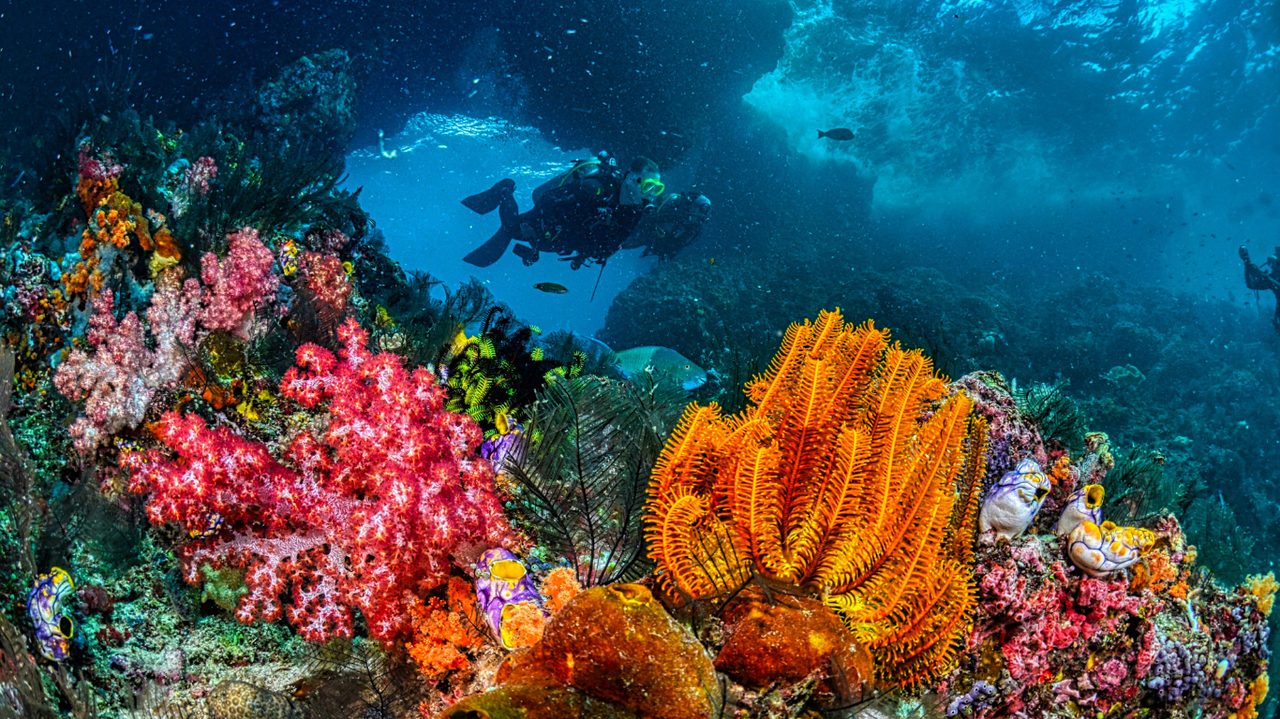
Why do we dive at all? For almost everyone the answer is: the life. This topic is the map of the underwater world. It teaches you not only what you see, but how everything connects, so that every dive turns from "pretty fish" into a story you can read.
A reef looks at first like a colourful chaos of fish, coral and movement. But it is one of the best-organised systems on Earth: every animal has a role, every relationship a reason, and every spot on the reef a resident that fits it exactly. Once you learn to see that order, diving changes fundamentally. You no longer look at separate animals but at a living network, and you understand why the manta hangs at that one point, why that clownfish never leaves its anemone, and why the reef has a completely different face at night.
Marine biology also makes you a better and more responsible diver. Whoever understands how fragile a coral polyp is, does not touch the reef. Whoever knows a cleaning station is a kind of "doctor's surgery", hovers calmly beside it instead of ploughing through. And whoever knows the food chain understands why current and plankton bring the big animals, and can predict where and when they will see them.
Looking versus seeing. A beginner "looks" at the reef and sees colour and movement. A biologically informed diver "sees" a system: who eats whom, who helps whom, who lives where. This topic teaches you to see. It is the difference between a tourist walking through a city and a guide who knows the story of every street.
Key concepts
| Term | Short definition | Why it matters |
|---|---|---|
| Ecosystem | A coherent whole of organisms and their environment | Determines what you see where |
| Coral polyp | The animal that builds coral | The basis of the tropical reef |
| Zooxanthellae | Algae living in coral that feed it | Engine of reef growth; core of bleaching |
| Coral bleaching | Coral expels its algae under stress | Sign of threatened reefs |
| Food chain / trophic level | Who eats whom, in layers | Explains the structure of life |
| Plankton | Floating micro-life (animal and plant) | Base of the chain; brings big filter feeders |
| Upwelling | Rising nutrient-rich deep water | Feeds reefs, attracts big animals |
| Symbiosis | A long-term relationship between two species | Explains much reef behaviour |
| Cleaning station | Place where cleaner fish/shrimp clean others | Classic symbiosis scene |
| Muck diving | Diving on sand/mud bottoms full of unusual life | A different kind of richness |
Understanding marine biology
The main ecosystems
The underwater world is not uniform; each ecosystem has its own residents and logic. The main ones you meet as a diver: the coral reef (shallow, clear, warm, sunlit — the highest biodiversity, with coral, reef fish and hunters); the seagrass meadow (shallow sandy bottom with seagrass — a nursery for turtles, seahorses and juvenile fish); the mangrove (tidal forest at the coast — a nursery for young fish, filters sediment); blue water (pelagic) (open sea, no bottom in sight — big travellers: sharks, mantas, tuna, whale sharks); muck / sand flat (sand or mud bottom — bizarre macro: octopus, seahorses, nudibranchs); and the wreck (an artificial reef on the bottom — growth plus sheltering and hunting fish). These systems connect: mangroves and seagrass are the nurseries that populate the coral reef, and the blue water brings the big travellers past the reefs. A healthy coastal system has all three.
Did you know? Coral reefs cover less than one percent of the sea floor but are home to an estimated quarter of all marine species. They are the "rainforests of the sea": a tiny area with enormous richness. That is why every bit of damage is such a loss, and every healthy reef so special.
The food chain and trophic levels
All life in the sea hangs on one beginning: plankton. Phytoplankton (plant-like floating micro-life) turns sunlight into energy, just like plants on land. Zooplankton (animal) eats phytoplankton. Small fish eat zooplankton, larger fish eat small fish, and top predators (sharks, large predatory fish) eat those. These are the trophic levels: layers in the chain, from producer to top predator.
Two insights follow. First: there are always far more "small" than "big" animals, because each layer passes on only part of its energy. Second, and most important for the diver: where there is much plankton, there is much life, all the way to the top. Nutrient-rich, upwelling water feeds the whole chain and thus attracts the big filter feeders (mantas, whale sharks) and hunters. This is exactly why sites with current and upwelling are the famous big-animal spots.
The big filter feeders: small food, big animal
A beautifully counter-intuitive fact: some of the largest animals in the sea eat the smallest food. Mantas and whale sharks, giants of many metres, live on plankton they filter from the water. So they follow the plankton bloom, and that follows the upwelling and the tide. See a manta hanging at a certain point, and there is almost certainly a plankton-rich current there. The biggest life follows the smallest food; whoever understands the plankton knows where the giants are.
Symbiosis: the relationships on the reef
Much of the finest behaviour on the reef is symbiosis: long-term relationships between two species. There are three forms.
Mutualism (both win). The classic example: the anemonefish (clownfish) and the sea anemone. The anemone protects the clownfish with its stinging cells; the clownfish (immune thanks to a mucus layer) chases off anemone-eaters and brings food scraps. Both benefit. Also cleaner fish/shrimp and their clients: the cleaner eats parasites and dead tissue from larger fish, which let themselves be cleaned, at fixed cleaning stations — a kind of underwater surgery where even predators wait patiently and don't eat the cleaner. Commensalism (one wins, the other doesn't notice). For example the remora hitching a ride on a shark or turtle: it gets transport and scraps, the host is little bothered. Parasitism (one wins, the other suffers). For example isopods ("fish lice") that attach to a fish and feed on its blood/tissue.
A cleaning station is like a car wash where even the biggest cars queue neatly. The big fish (the car) stops voluntarily, the cleaner fish (the wash) does its work, and nobody drives through or eats the other, because both benefit from the arrangement. Disturb such a station by swimming through it, and the "wash" closes and the client flees.
Scenario. A diver in Egypt sees a large Napoleon wrasse hanging still above a coral head while small striped cleaner wrasse swim in and around its gills. Instead of ploughing closer, they hover calmly at a distance (good buoyancy). The wrasse stays, and they watch the whole cleaning ritual. Had they disturbed the station, the scene would have ended at once. Understanding symbiosis earned them the better sighting.
The coral itself: the living foundation
The tropical reef is built by a tiny animal: the coral polyp, a relative of the jellyfish and anemone, with a soft body and tentacles, that secretes a limestone skeleton. Millions of polyps together, generation upon generation, build the reef you see. The key to reef growth is a symbiosis (again mutualism): in the polyp's tissue live microscopic algae, the zooxanthellae. These algae photosynthesise and provide the polyp with much of its energy (and its colour); the polyp gives the algae a safe home and nutrients. That is why reef-building coral grows only in shallow, clear, sunlit water: the algae need light. Coral bleaching is what happens when the coral is stressed, especially by water that is too warm: the polyp expels its zooxanthellae, loses its colour (the white limestone skeleton shows through) and its main food source. Bleached coral is not immediately dead, but weakened, and dies if the stress persists. Bleaching is therefore the visible alarm signal of threatened reefs, and a reason why climate and temperature changes directly affect the diving world.
Did you know? Coral is therefore animal, plant and stone at once: an animal polyp, with plant-like algae inside, that builds a stone skeleton. That three-in-one makes it unique, and fragile: touch or break it, and you damage a living, slow-growing organism that took years to build.
Day and night: two reefs in one
The reef you see by day is only half the story. At nightfall everything changes: the day fish tuck into the coral, and the night shift emerges. Hunting moray eels, octopuses, crabs, lobsters and sleepy parrotfish (which wrap themselves in a mucus cocoon) take over. Coral polyps themselves often extend their tentacles at night to catch plankton. One reef, two totally different communities: that makes a night dive on the same site a completely different experience.
Responsible diving: you are the guest
All of this leads to one practical attitude: on the reef you are the guest, and the life is the host. Responsible behaviour is not moralism but respect for a fragile system. Touch nothing. Coral is alive and breaks easily; many animals have a protective mucus layer that your touch disturbs or damages. Hover, don't plough. Good buoyancy and trim prevent you from hitting the reef or stirring up sand. Feed nothing and don't chase. Feeding disturbs natural behaviour and can make animals dependent or aggressive. Keep your distance from cleaning stations and shelters; watching is fine, disturbing is not. Take only photos, leave only bubbles. Take nothing (not even an "empty" shell — often still a home). This attitude makes you not only a better conservationist but a better observer: calm, respectful divers see more, because the animals don't flee.
Real-world examples
The Netherlands (cold, temperate). A different ecosystem: no tropical coral, but rich life such as sea anemones, crabs, lobsters, nudibranchs and schools of fish in the Oosterschelde. It shows that "marine biology" is not only the tropics; cold water too has its own fascinating symbiosis and macro life.
Egypt (Red Sea, coral reef). A textbook healthy coral reef: high biodiversity, clear cleaning stations (Napoleon wrasse, cleaner wrasse), anemonefish, and rich reef structure. Ideal for learning to really see ecosystem, symbiosis and coral.
Indonesia (Coral Triangle, Lembeh muck). The epicentre of marine biodiversity on Earth. Lembeh is the mecca of muck diving: the strangest animals live on bare sand bottoms (mimic octopus, seahorses, nudibranchs). Proof that richness is not only on colourful coral.
Maldives (atoll, plankton). Atoll ecosystems that run on tide and plankton: the channels bring nutrient-rich water that attracts mantas and whale sharks. A clear example of "the biggest life follows the smallest food".
Mozambique (Tofo and Vilanculos). At Tofo the food chain comes alive: the warm Agulhas Current and upwelling bring plankton-rich water, and with it the manta rays and whale sharks Tofo is world-famous for, plus cleaning stations where mantas are cleaned. At Vilanculos and the Bazaruto Archipelago, seagrass and sandbank ecosystems dominate — nurseries full of young life and one of the last strongholds of the dugong (sea cow). Together they show two sides of biology: the pelagic, plankton-driven life at Tofo and the coastal/seagrass systems at Vilanculos.
Common mistakes
| Mistake | What goes wrong | How to avoid it |
|---|---|---|
| Touching or grabbing coral | Damages a living, slow-growing organism | Touch nothing; use good buoyancy |
| Ploughing through cleaning stations | Disturbs the scene, animals flee | Hover calmly at a distance and watch |
| Feeding or petting animals | Disturbs behaviour, can be dangerous/harmful | Don't feed, don't touch, only observe |
| Stirring up sand with poor trim | Ruins visibility, buries coral/macro life | Improve trim and fin technique |
| Taking shells/"souvenirs" | Removes homes/material from the ecosystem | Take nothing, only photos |
| Only looking for "big animals" | Missing the richness of macro and symbiosis | Look small too; learn to see stations and relationships |
| Skipping the night reef | Missing half the life | Do a night dive on a familiar site |
Pro tips
- Learn to "read" the reef as a system: who eats whom, who helps whom, who lives where. Every dive gets richer.
- Follow the plankton to the giants: where upwelling and current bring nutrient-rich water, the big filter feeders hang.
- Recognise cleaning stations and hover calmly beside them; you see the finest behaviour there, provided you don't disturb it.
- Look small too: half the wonders (nudibranchs, shrimp, seahorses) are missed if you only seek big animals.
- Do a night dive on a familiar site to discover the second, nocturnal community.
- Be the guest: touch nothing, feed nothing, take only photos; calm divers see the most.
Frequently asked questions
Why does reef-building coral grow only in shallow, clear, sunlit water? Because algae (zooxanthellae) live in the coral tissue and provide much of the polyp's energy through photosynthesis. Those algae need light, so the coral depends on shallow, clear, sunlit water.
What is coral bleaching and what causes it? Under stress (especially water that is too warm), the coral expels its zooxanthellae, loses its colour (the white skeleton shows through) and its main food source. It is weakened and dies if the stress persists; it is an alarm signal of threatened reefs.
Name the three forms of symbiosis with an example. Mutualism (both win), e.g. clownfish and anemone or cleaner fish and client; commensalism (one wins, the other unaffected), e.g. the remora on a shark; parasitism (one wins, the other suffers), e.g. an isopod on a fish.
Why do the biggest filter feeders (mantas, whale sharks) hang at plankton and upwelling areas? Because they live on plankton; where upwelling and current bring nutrient-rich water, there is much plankton, and there the big filter feeders gather. The biggest life follows the smallest food.
What is a cleaning station and how do you behave there? A fixed place where cleaner fish or shrimp remove parasites and dead tissue from larger fish (mutualism). You hover calmly at a distance and watch, without disturbing, or the "client" flees.
Summary
A reef is not chaos but a tightly organised system, and marine biology teaches you to read it. The underwater world consists of several ecosystems (coral reef, seagrass, mangrove, blue water, muck and wreck) that connect: mangroves and seagrass are the nurseries that populate the coral reef, and the blue water brings the big travellers past. Everything hangs on the plankton: phytoplankton captures sunlight, and through trophic levels that energy rises to the top predators, with always far more small than large life. The key insight for the diver is that the biggest life follows the smallest food: where upwelling and current bring plankton, the big filter feeders hang. Much reef behaviour is symbiosis in three forms (mutualism, commensalism, parasitism), with the clownfish-anemone and the cleaning stations as classics. The tropical reef itself is built by coral polyps that, thanks to their symbiosis with zooxanthellae, grow only in shallow, clear, sunlit water; coral bleaching is the alarm signal when that relationship breaks under heat stress. By day and by night two totally different communities live on the same site. All this leads to one attitude: you are the guest, so touch nothing, feed nothing and take only photos, which also makes you a better observer.
The 10 things every diver should know by heart
- A reef is an organised system; learn to read it (who eats, helps, lives where).
- There are several ecosystems (reef, seagrass, mangrove, blue water, muck, wreck) that connect.
- Everything hangs on the plankton; through trophic levels energy rises to the top predators.
- The biggest life follows the smallest food: big filter feeders at plankton/upwelling.
- Symbiosis has three forms: mutualism, commensalism, parasitism.
- Coral is animal, plant and stone: polyp + zooxanthellae + limestone skeleton, only in clear sunlight.
- Bleaching is the alarm signal of heat-stressed reefs.
- By day and by night two different communities live on the same site.
- Look small too: macro and symbiosis are half the wonders.
- You are the guest: touch nothing, feed nothing, take only photos; then you also see the most.