Marine Biology
Reef Fish of East Africa
Learn the reef fish families of East Africa and the Indian Ocean — parrotfish, surgeonfish, butterflyfish, angelfish, wrasses, damsels, groupers and the schooling fish of Tofo and Bazaruto.
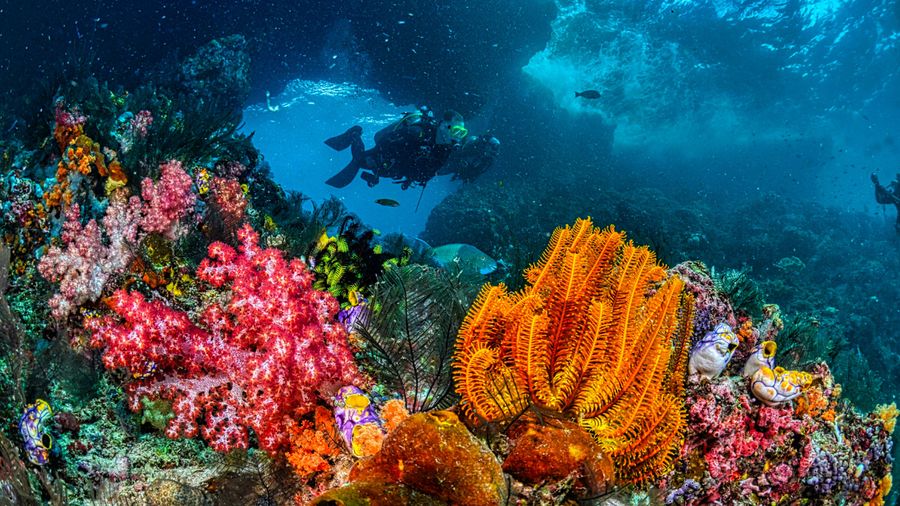
Between the big stars (sharks, mantas, whale sharks) unfolds the real, daily life of the reef: a world of colourful reef fish, each with its own role, behaviour and story. Whoever learns to recognise them suddenly sees the reef full of characters instead of "little fish". This is the everyday, ordinary reef life that gives the reef its colour, and East Africa, with the coast of Mozambique in particular, is one of the finest stages to get to know it.
The big animals make the headlines, but the reef itself lives on its fish. On a single Mozambican reef dive you see more species of colourful reef fish within an hour than most people encounter in animal species in a lifetime on land. To illustrate: a study on the reefs at Praia do Tofo and Praia da Barra counted over three hundred fish species from nearly eighty families on just a handful of small reefs. East Africa stretches from South Africa and Mozambique in the south, via Tanzania (with Zanzibar and Mafia) and Kenya, to the island worlds of Madagascar, the Comoros, Mayotte and the Seychelles. This whole coast sits at the western edge of the rich Indo-Pacific reef world (the Western Indian Ocean).
Think in families, not species. There are thousands of reef fish species, and learning them all is impossible. But there are only a handful of large families that dominate the reef, and you recognise those by shape, behaviour and location. Learn the families (parrotfish, surgeonfish, butterflyfish, angelfish, wrasses, damsels, groupers), and you "read" any reef in the world, and certainly East Africa's.
Key concepts
| Family (common / Latin) | Recognise by | Role on the reef |
|---|---|---|
| Parrotfish (Scaridae) | Parrot-like beak, bright colours, grazing coral | Graze algae, produce sand |
| Surgeonfish (Acanthuridae) | "Scalpel" at the tail base, disc shape | Graze algae |
| Butterflyfish (Chaetodontidae) | Flat, round, often in pairs, eyespot | Eat coral polyps/small invertebrates |
| Angelfish (Pomacanthidae) | Elegant, colour change juvenile/adult | Eat sponges/algae; colourful |
| Wrasses (Labridae) | Very diverse; cleaner wrasse, Napoleon | Cleaning (symbiosis), diverse diets |
| Damsels/clownfish (Pomacentridae) | Small, bright, territorial; clownfish in anemone | Abundant; symbiosis with anemone |
| Groupers (Serranidae) | Robust, large mouth, "rock cod" | Predator; ambush hunter |
| Anthias (Anthiadinae) | Small orange/pink clouds above the reef | Plankton feeders; colour the reef |
| Fusiliers (Caesionidae) | Slender, fast schools in the blue | Plankton feeders, prey for hunters |
| Snappers (Lutjanidae) | Schools above/around the reef | Predator, scavenger |
Understanding reef fish families
Parrotfish (Scaridae): the sand makers
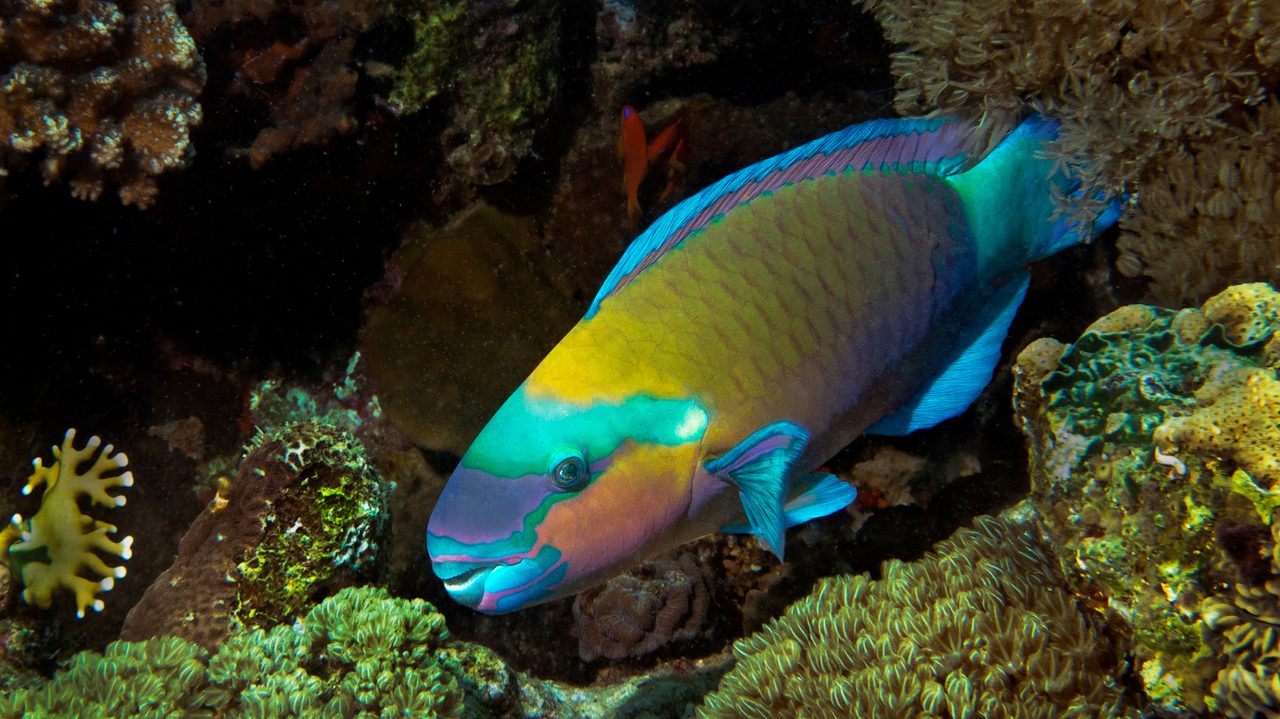
The parrotfish gets its name from its fused teeth that form a "beak", with which it nibbles at the coral and algae, a sound you often hear underwater. It grazes the algae that would otherwise overgrow the coral, keeping the reef healthy. But most surprising: while nibbling, it also eats limestone, digests the algae, and excretes the finely ground limestone as sand. A large part of white tropical beach sand is, literally, parrotfish excrement. A single large parrotfish produces hundreds of kilos of sand per year. Many parrotfish also spin a mucus cocoon around themselves at night, probably to mask their scent from hunters like moray eels; you sometimes see them sleeping in such a transparent bag. Many species also change colour and sex during their lives.
A parrotfish is the lawnmower and sand factory of the reef in one: it keeps the "lawn" (the algae) short so the coral keeps space, and delivers, as a by-product, the sand for the beach you later lie on. The beach you enjoy is partly made by these fish.
Surgeonfish (Acanthuridae): the scalpel bearers
The surgeonfish gets its name from a sharp, scalpel-like spine at the base of its tail, which it can extend as a defence (so take care, but it doesn't attack). They are disc-shaped, often in schools, and graze the algae just like the parrotfish, making them important "reef gardeners". The family also includes the elegant sailfin tangs and the well-known blue tang. On East African reefs you often see large grazing schools moving over the reef like a wave.
Butterflyfish (Chaetodontidae): the faithful pairs
Butterflyfish are flat, round, and usually beautifully marked in yellow-white-black, often with an eyespot at the rear that misleads hunters (they snap at the "wrong" end, and the fish darts the other way). Notably, many species live in faithful pairs that swim over the reef together, and they eat coral polyps or small invertebrates. Because some species depend specifically on healthy coral, butterflyfish are considered an indicator of reef health: many butterflyfish often mean a healthy reef.
Angelfish (Pomacanthidae): the colour changers
Angelfish are among the most elegant reef fish, with stunning colours and patterns. Their greatest trick: many species look completely different as a juvenile than as an adult, with an entirely different colour pattern. A young angelfish with blue-white rings can grow into a yellow-blue striped adult, so you easily mistake them for two species. They often eat sponges and algae. On the reefs of Tofo and Bazaruto, the larger angelfish are beautiful, relatively shy sightings.
Wrasses (Labridae): the versatile family
The wrasses are one of the largest and most diverse reef fish families, from tiny to metre-sized. Two extremes you see in East Africa: the cleaner wrasse (a small, striped fish that removes parasites and dead tissue from larger fish at cleaning stations, mutualism in action — even predators let themselves be cleaned calmly) and the Napoleon wrasse (humphead wrasse) (one of the largest reef fish, with a bump on its head, curious and impressive, sadly also overfished and protected). Many wrasses can also change sex: often an individual starts as a female and later becomes a (dominant) male, depending on the social structure of the group. That makes the family a living example of how flexible reproduction in the sea can be.
Did you know? In many wrasses (and parrotfish) the social situation determines the sex: if the dominant male disappears, the largest female changes into a male within a few days and takes over the role. The group's hierarchy therefore literally steers who is which sex, one of the most surprising phenomena on the reef.
Damsels and clownfish (Pomacentridae): small and fierce
The damselfish are small, brightly coloured, often very territorial fish you see everywhere on the reef. Some even "farm" their own algae patch, which they fiercely defend against intruders (sometimes even snapping at a diver who gets too close, harmless but amusing). The family also includes the famous anemonefish (clownfish), which lives in mutualism with the sea anemone. On East African reefs you see several anemonefish species nestled in their anemone. Closely related and visually spectacular are the anthias: small orange-pink fish that hover in clouds above the coral heads and pick plankton from the water. They give a healthy reef much of its "bustling" appearance.
Groupers and rock cod (Serranidae): the ambush hunters
The groupers, including the "rock cod" (as they are often called in East Africa), are robust predators with a large mouth that stay close to structure. They hunt from ambush: they "suck" prey in with a sudden gulp. Some grow large and old, and they keep the populations of smaller fish in balance. They are vulnerable to overfishing because they grow slowly and gather at fixed spots to spawn. On the reefs of Tofo and Bazaruto, various rock cod species keep close to the coral and overhangs.
The schooling families: fusiliers, snappers and more
Above and around the reef swim the schooling fish: fusiliers (slender, fast, often blue-yellow fish that eat plankton in the open water above the reef, and are themselves important prey), snappers (sturdy schools that hang around the reef by day and hunt at night), and beyond them barracuda (sometimes in impressive schools), trevally (hunting silver predators), pufferfish and porcupinefish (that inflate with water/air as a defence) and triggerfish (that fiercely defend their nest around spawning time, sometimes against divers, so give them space). These families connect the reef with the open water: they bring the energy of the plankton up the food chain to the big hunters.
Real-world examples (from south to north along the Western Indian Ocean)
Mozambique (Tofo and Vilanculos). At Tofo the reefs (Manta Reef, Giant's Castle and the shallower reefs) show a rich East African reef fish community: parrotfish and surgeonfish grazing the algae, butterflyfish in pairs, angelfish, cleaner wrasse at the cleaning stations (where the mantas also come), rock cod at the overhangs, and schools of fusiliers, snappers and barracuda in the blue. Scientific research counted over three hundred fish species from nearly eighty families on a few small reefs. At Vilanculos and the Bazaruto Archipelago you find a rich reef fish community on the colourful coral and seagrass areas too.
South Africa (Sodwana Bay, KwaZulu-Natal). The southernmost tropical reefs of East Africa, fed by the warm Agulhas Current. Sodwana has a surprisingly rich reef fish community (butterflyfish, angelfish, parrotfish and surgeonfish, anthias) at the edge of the tropical range.
Tanzania (Zanzibar, Mafia, Pemba). Some of the richest reefs of the region. Mafia Island (a marine park) and Pemba are known for healthy coral reefs with large schools of fusiliers and snappers, butterflyfish, angelfish and grouper; Zanzibar offers accessible reefs full of damsels, wrasses and parrotfish.
Kenya (Watamu, Malindi, Diani). Protected marine parks along the coast with colourful reefs: parrotfish and surgeonfish grazing, butterflyfish in pairs, angelfish and anthias clouds. A classic place to learn the "big seven".
Madagascar, the Comoros/Mayotte and the Seychelles. Isolated island reefs with high diversity and some local (endemic) species. The lagoon of Mayotte is one of the largest in the world with a very rich reef fish community; the Seychelles offer tame, abundant reef fish among the famous granite underwater scenery.
For comparison, outside East Africa. In Egypt (Red Sea) you find virtually the same families, as the Red Sea borders the same Indo-Pacific system. Indonesia (Coral Triangle) is the world centre of reef fish diversity with all families in abundance, and the Maldives show the same families in large, plankton-rich schools.
Common mistakes
| Mistake | What goes wrong | How to avoid it |
|---|---|---|
| Only looking for big animals | Missing the richness of reef life | Learn the families; watch reef fish deliberately |
| Trying to learn every species separately | Unachievable, frustrating | Think in families (the "big seven"), not species |
| Mistaking a juvenile for another species | Wrong identification | Know that angels/wrasses colour differently when young |
| Provoking territorial fish | Damsels/triggerfish snap at you | Give them space, especially triggerfish at spawning time |
| Ignoring the surgeonfish "scalpel" | A cut when touching | Touch nothing; only look |
| Disturbing a cleaning station | Cleaner wrasse and client flee | Hover calmly at a distance |
| Poor buoyancy while "fish watching" | Reef damage, stirred-up sand | Stay neutral and horizontal |
Pro tips
- Learn the "big seven" families; with them you recognise most of any East African reef.
- Listen for the parrotfish; you often hear their nibbling on the coral before you see them.
- Look for butterflyfish in pairs and anthias clouds; they are a sign of a healthy, bustling reef.
- Remember that angelfish and wrasses colour differently when young; don't mistake juveniles for separate species.
- Stay calm at cleaning stations; you see the finest behaviour there (cleaner wrasse, grouper, and sometimes mantas).
- Look at the "ordinary" reef life too, not only the big animals; recognising families makes every dive rich.
Frequently asked questions
Why is it useful to learn reef fish in families rather than by species? There are thousands of species, but only a handful of dominant families that you recognise by shape, behaviour and location. Know those families (the "big seven"), and you "read" almost any reef, whereas learning all species separately is unachievable.
How does a parrotfish make sand, and why is it important for the reef? It nibbles algae and limestone off the coral with its beak, digests the algae and excretes the finely ground limestone as sand. By grazing the algae it keeps the reef healthy (algae would otherwise overgrow the coral), and it produces much of the tropical beach sand.
How do you recognise a surgeonfish, and what should you watch for? By the disc shape and the sharp, scalpel-like spine at the base of the tail. It doesn't attack, but you never touch it; it grazes the reef's algae like the parrotfish.
Why do young angelfish often look like a different species than the adults? Many angelfish (and wrasses) have a completely different colour pattern as a juvenile than as an adult, so you easily mistake them for two species. It is the same species in a different life stage.
What does a cleaner wrasse do, and which family does it belong to? The cleaner wrasse (family Labridae, wrasses) removes parasites and dead tissue from larger fish at cleaning stations (mutualism); even predators let themselves be cleaned calmly.
Summary
Between the big animals the reef lives on its fish, and East Africa, with Mozambique in the lead, is one of the richest stages to get to know them (on a few small reefs at Tofo over three hundred species from nearly eighty families have been counted). The key is thinking in families rather than species: learn the "big seven" (parrotfish, surgeonfish, butterflyfish, angelfish, wrasses, damsels, groupers) and you recognise most of any reef. Parrotfish graze algae and make sand; surgeonfish carry a scalpel and graze too; butterflyfish live in faithful pairs and indicate reef health; angelfish colour completely differently when young; wrasses are an enormously diverse family with cleaner wrasse (cleaning stations), the large Napoleon wrasse and the ability to change sex; damsels and clownfish are small, fierce and territorial, with the anemonefish as the symbiosis star; and groupers (rock cod) are ambush hunters that keep the smaller fish in balance. Around them, schooling fusiliers, snappers, barracuda and trevally bring the energy of the plankton up to the big hunters. Together these families keep the reef healthy, and whoever learns to recognise them turns every East African dive into a rich story, even without a manta or whale shark passing by.
The 10 things every diver should know by heart
- Think in families, not species; learn the "big seven".
- Parrotfish graze algae and make sand; much of the beach sand comes from them.
- Surgeonfish carry a "scalpel" at the tail and graze too; don't touch them.
- Butterflyfish live in faithful pairs and indicate reef health.
- Angelfish and wrasses colour differently when young; don't confuse them.
- Cleaner wrasse staff the cleaning stations (mutualism); hover calmly beside them.
- Many wrasses and parrotfish can change sex, steered by the group.
- Damsels/clownfish are small, fierce and territorial; groupers are ambush hunters.
- Fusiliers, snappers, barracuda and trevally connect the reef and open water.
- Learn the families and every East African dive becomes rich, even without big animals.
Gallery