Marine Biology
Rays & Manta Rays
Rays explained for divers — the flattened cousins of sharks, the manta ray and cleaning stations, filter feeders versus bottom feeders, stingray safety, and manta conservation at Tofo.
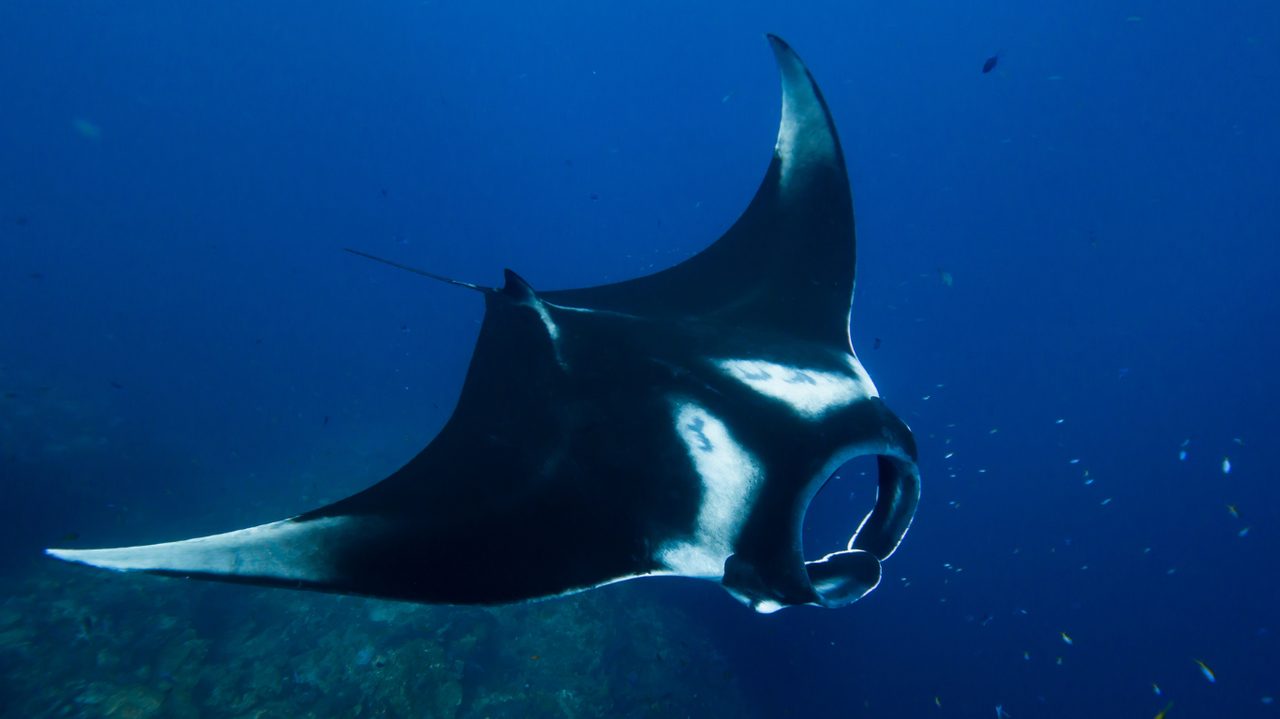
Rays are the "flattened cousins" of the shark: the same cartilage family, but a completely different body and life. From the graceful manta ray, metres wide, gliding past like an underwater bird, to the stingray hidden in the sand, rays are among the most beloved encounters underwater. And Tofo (Mozambique) is one of the manta capitals of the world, so this topic touches your region directly.
If you flattened a shark and stretched its pectoral fins into wings, you would get roughly a ray. Rays are cartilaginous fish, like sharks, but their body is adapted to a very different life: flattened, with enormous pectoral fins that form the body as wings. Some live on the bottom, dug into the sand hunting shellfish; others, like the manta, "fly" through open water and filter plankton, exactly like the whale shark but in the shape of a graceful giant.
For divers, rays are among the finest encounters there are. A manta ray circling slowly above a cleaning station is one of the most hypnotic sights underwater: an animal metres wide, surprisingly curious, with the largest brain of any fish. And the smaller stingrays, half-hidden in the sand, teach you to look carefully, as they are masters of camouflage.
Ray and shark: one family, two body plans. Rays and sharks share the cartilage skeleton, the multiple gill slits, electroreception and slow reproduction. The big difference is shape: in rays the gill slits are on the underside, the pectoral fins are fused into a flat "disc" or "wings", and bottom rays breathe through a spiracle behind the eye, so they don't inhale sand while lying on the bottom.
Key concepts
| Term | Short definition | Why it matters |
|---|---|---|
| Cartilaginous fish | Skeleton of cartilage | Rays are related to sharks |
| Wing-like pectoral fins | The large side fins forming the "disc" | Define the ray shape and movement |
| Spiracle | Breathing opening behind the eye | Lets bottom rays breathe without sand |
| Gills underneath | Gill slits under the body | Distinguishes ray from shark |
| Cephalic fins | The "head fins" of the manta | Steer plankton to the mouth |
| Filter feeder vs bottom feeder | Filtering plankton vs finding shellfish | Two totally different ways of life |
| Barb | Barbed spine on the tail of many rays | Defence; a safety point |
| Cleaning station | Place where mantas are cleaned | A reliable manta spot |
| Gill rakers/plates | The manta's filter plates | Target of harmful trade |
| Shuffle | Shuffling in shallow water | Prevents stepping on a bottom ray |
Understanding rays
What a ray is: the flattened body plan
Rays are evolutionarily "flattened" sharks. Their pectoral fins have grown enormously and fused with the body into a flat disc (in bottom rays) or broad wings (in mantas and eagle rays). Because they are flat, their breathing differs from sharks: the gill slits are on the underside, and bottom rays breathe in water through the spiracle behind the eye, so they take in no sand while lying dug into the bottom. Mantas, which do not lie on the bottom, breathe through the mouth while moving. The eyes are often on top (to look up from the sand), while the mouth, nostrils and gills are underneath. For bottom rays this means they find their prey (shellfish, worms, small fish) largely by touch and electroreception beneath them.
A manta ray "flying" through the water with undulating wings looks strikingly like a large bird or even a cloak flapping in the wind (hence "manta", Spanish for blanket/cloak). A bottom ray, by contrast, is like a pancake hiding under a layer of sand: you only see it when you look carefully, or when it flies off.
The species divers meet
| Species | Shape/life | For the diver |
|---|---|---|
| Manta ray (reef and oceanic) | Huge, plankton filter feeder, "flies" | A highlight; curious, harmless, no barb threat |
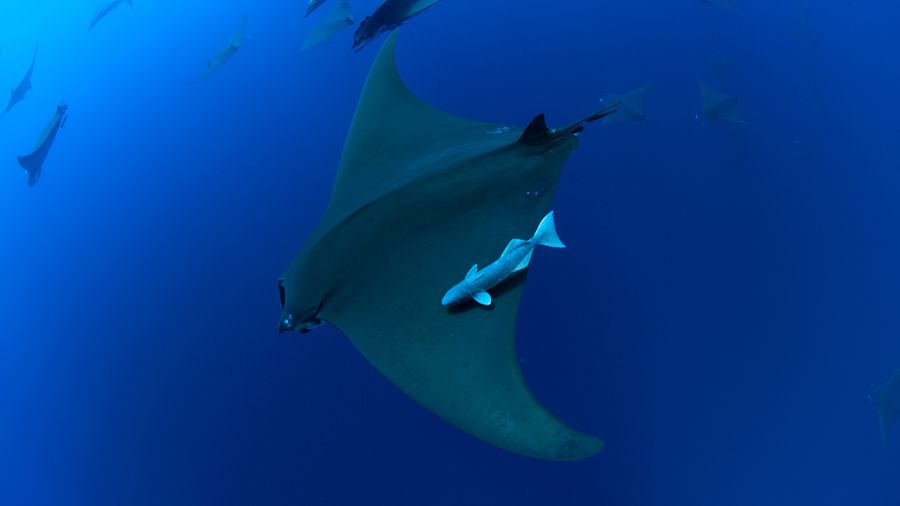
| Devil ray (mobula) | Smaller relative of the manta, in schools | Spectacular in large groups |
| Stingray | Bottom-dweller, disc-shaped, with a barb | In the sand; leave it be, mind the barb |
| Eagle ray | Graceful, spotted, "flies" in open water | Elegant, shy, often in the water column |
| Electric/torpedo ray | Can deliver an electric shock | Don't touch; a rare problem |
| Guitarfish | Shark/ray intermediate, elongated | Unusual, on sand bottoms |
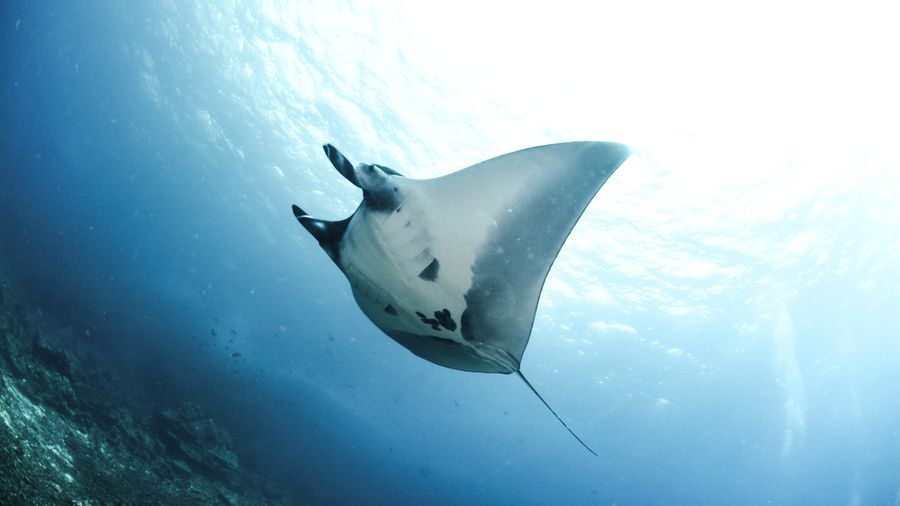
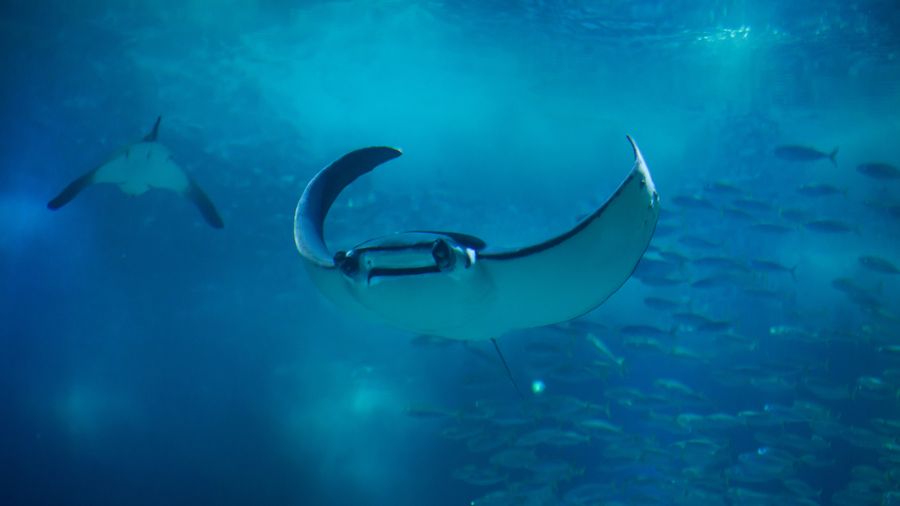
The manta ray is the star. There is a reef manta and a larger oceanic manta; both are gentle filter feeders without a dangerous barb, steering plankton to their mouth with their cephalic fins (the two "horns" in front of the head). Mantas have the largest brain of any fish relative to their body, are curious, and individuals are recognisable by their unique belly pattern (with which researchers photograph and track them).
Feeding: filter feeders versus bottom feeders
Rays live in two very different ways. Filter feeders (mantas, mobulas) swim with an open mouth through plankton-rich water and filter the micro-life out with gill plates. They follow the plankton bloom, which in turn follows the current and upwelling. A manta at a certain point almost always means plankton-rich water there. Bottom feeders (stingrays, eagle rays) search on and in the sandy bottom for shellfish, worms, crabs and small fish, which they crush with flat plates or suck up. They find their prey by touch and electroreception. This explains where you find them: mantas in or along plankton-rich currents and at cleaning stations, bottom rays on sand and seagrass flats.
Cleaning stations: where you reliably see the manta
Mantas visit fixed cleaning stations: spots on the reef where cleaner fish remove parasites and dead tissue from their skin and gills. A manta sometimes circles there for a long time, calmly, which makes it the most reliable and respectful place to admire them. The golden rule: stay low, stay still, and don't disturb the station. Swim through it or up towards the manta, and it flees and the "cleaning surgery" closes. Stay calmly at the edge (good buoyancy), and the mantas often stay for minutes and sometimes even come curiously closer.
Scenario. At Manta Reef in Tofo (Mozambique) a group descends calmly to a cleaning station and lies low by the reef, without swimming up. A reef manta circles above them, lets itself be cleaned, and eventually makes a curious pass just over the divers. Those who stayed still got the whole spectacle; those who had sprinted up would have scared the manta off. With mantas, patience always beats chasing.
Reproduction and safety
Like sharks, rays reproduce slowly: they mature late and have few young (mantas often only one pup at a time, with long intervals). Most rays are ovoviviparous or viviparous (live-bearing). This slow reproduction makes rays too, and mantas in particular, vulnerable to overfishing. Safety: mantas and mobulas have no dangerous barb; they are entirely harmless to divers. Many bottom rays (stingrays), however, have one or more barbed spines on the tail, purely for defence. A ray never stings out of aggression, but reflexively when it feels threatened or is stepped on. In practice: never step on a bottom ray. In shallow sandy water use the shuffle (shuffling rather than stepping, so you push a hidden ray away instead of stepping on it — the "stingray shuffle"). Don't hover directly above a bottom ray. And never touch. The famous fatal sting of TV personality Steve Irwin (2006) was an extremely rare accident where the barb struck the heart; it is an exception, not a rule, but a reminder to give rays their space. A stingray sting is painful but rarely fatal; treatment is soaking in water as hot as tolerable (the venom is heat-sensitive) and medical help. But the best approach is prevention: don't touch and don't step on them.
Real-world examples
The Netherlands. Rays occur in the North Sea (such as the thornback ray and relatives), though they have become locally rare through fishing. It shows that rays are not only tropical, and that European species need protection too.
Egypt (Red Sea). Stingrays and eagle rays on sand and reef flats, and on some sites passing rays in the blue. A good place to learn the difference between bottom and swimming rays.
Indonesia (Raja Ampat, Nusa Penida, Komodo). Nusa Penida (Bali) is famous for its manta cleaning stations and manta aggregations; Raja Ampat and Komodo have both reef and oceanic mantas. Strong examples of manta tourism and protection.
Maldives. World-famous for its manta aggregations in plankton-rich lagoons (e.g. Hanifaru Bay), where in the right tide and plankton conditions dozens of mantas filter at once. A classic example of "mantas follow the plankton".
Mozambique (Tofo and Vilanculos). Tofo is one of the manta capitals of the world: the offshore reefs (notably Manta Reef and Giant's Castle) hold reliable cleaning stations where reef mantas are cleaned, fed by the plankton-rich waters driven by the Agulhas Current and upwelling. Tofo is also an important manta research and conservation centre (individuals are identified by their belly pattern and tracked). At Vilanculos and the Bazaruto sandbanks you sooner see bottom and eagle rays on the sand and seagrass flats. Together they show both worlds of the ray: the filtering giant at Tofo, the bottom-dweller at Vilanculos.
Common mistakes
| Mistake | What goes wrong | How to avoid it |
|---|---|---|
| Swimming towards/chasing a manta | The manta flees, station disturbed | Stay low and still; let the manta come |
| Hovering above a cleaning station | Scares the manta, disturbs the cleaners | Stay below/beside the station, not above |
| Stepping on a bottom ray | A reflexive sting | Shuffle in shallow sand; watch where you step |
| Hovering just above a bottom ray | It feels threatened, may sting | Give space; don't hang above it |
| Touching a ray (even a manta) | Disturbance, damaged mucus layer, possible sting | Never touch, however tempting |
| Seeing mantas as "dangerous" via the barb myth | Needless fear | Mantas have no dangerous barb; they are harmless |
| Ignoring manta conservation | Unknowingly supporting harmful trade | Choose responsible tourism, support protection |
Pro tips
- With mantas, patience wins: stay low, still and horizontal, let them come, and never chase; they then stay longer and often come closer.
- Stay below or beside a cleaning station, never above; otherwise you scare the manta and the cleaner fish.
- Use the shuffle in shallow sandy water so you never step on a hidden bottom ray.
- Never touch a ray, manta or bottom ray; it disturbs, damages the mucus layer and can provoke a sting.
- Remember: mantas are harmless (no dangerous barb); only bottom rays have a defensive barb.
- Support manta research and responsible tourism; a live manta is worth more than a dead one.
Frequently asked questions
How do you tell a ray from a shark? By the flattened body with pectoral fins fused into wings/a disc, the gill slits on the underside, and (in bottom rays) a spiracle behind the eye.
What does the spiracle do in bottom rays? It lets the ray breathe in water through an opening behind the eye, so it takes in no sand while lying dug into the bottom.
How do filter feeders and bottom feeders among rays differ? Filter feeders (mantas, mobulas) swim with an open mouth through plankton-rich water and filter micro-life; they follow the plankton bloom. Bottom feeders (stingrays, eagle rays) search the sandy bottom for shellfish and worms, found by touch and electroreception.
How do you behave at a manta on a cleaning station? Stay low, still and horizontal below or beside the station (never above), and don't swim towards the manta. It then stays calm, lets itself be cleaned and often comes curiously closer.
Why and how do you prevent a stingray sting? A bottom ray stings reflexively if you step on it or threaten it. Prevent it by shuffling in shallow sandy water, not hovering just above a ray, and never touching. Mantas have no dangerous barb.
Summary
Rays are cartilaginous fish and the flattened relatives of sharks: their pectoral fins are fused into a disc or wings, their gills are on the underside, and bottom rays breathe through a spiracle behind the eye so they don't inhale sand. They live in two ways: filter feeders like the manta ray "fly" through plankton-rich water and filter micro-life, while bottom feeders like the stingray search the sandy bottom for shellfish. The manta is the star: a gentle, curious giant with the largest brain of any fish, without a dangerous barb, steering plankton to its mouth with its cephalic fins and reliably seen at cleaning stations, provided you stay low and still and don't chase it. Rays reproduce slowly and are therefore, like sharks, vulnerable to overfishing, with mantas under extra pressure from the trade in their gill plates. Safety turns on the defensive barb of bottom rays: never step on them (use the shuffle), don't hover above them, and never touch. Mantas are entirely harmless. Tofo (Mozambique) is one of the manta capitals of the world and an important research and conservation centre, while the sandbanks of Vilanculos are home to the bottom rays.
The 10 things every diver should know by heart
- Rays are cartilaginous fish, the flattened relatives of the shark.
- Bottom rays breathe through the spiracle behind the eye, so they inhale no sand.
- Mantas are filter feeders that follow the plankton; bottom rays hunt shellfish on the sand.
- The manta ray is harmless, curious, and has the largest brain of any fish.
- See mantas reliably at cleaning stations; stay low, still and below/beside, never above.
- Never chase mantas; patience gives the finest and longest encounters.
- Bottom rays have a defensive barb; use the shuffle and never step on them.
- Never touch a ray (manta or bottom ray); it disturbs and can provoke a sting.
- Rays reproduce slowly; mantas are vulnerable, e.g. to the gill-plate trade.
- Tofo is a manta capital and conservation centre; support responsible tourism and research.
Gallery