Marine Biology
Sea Turtles
Sea turtles for divers — an air-breathing reptile, the species and their diets, the life cycle and natal homing, encounter etiquette, and the threats they face.
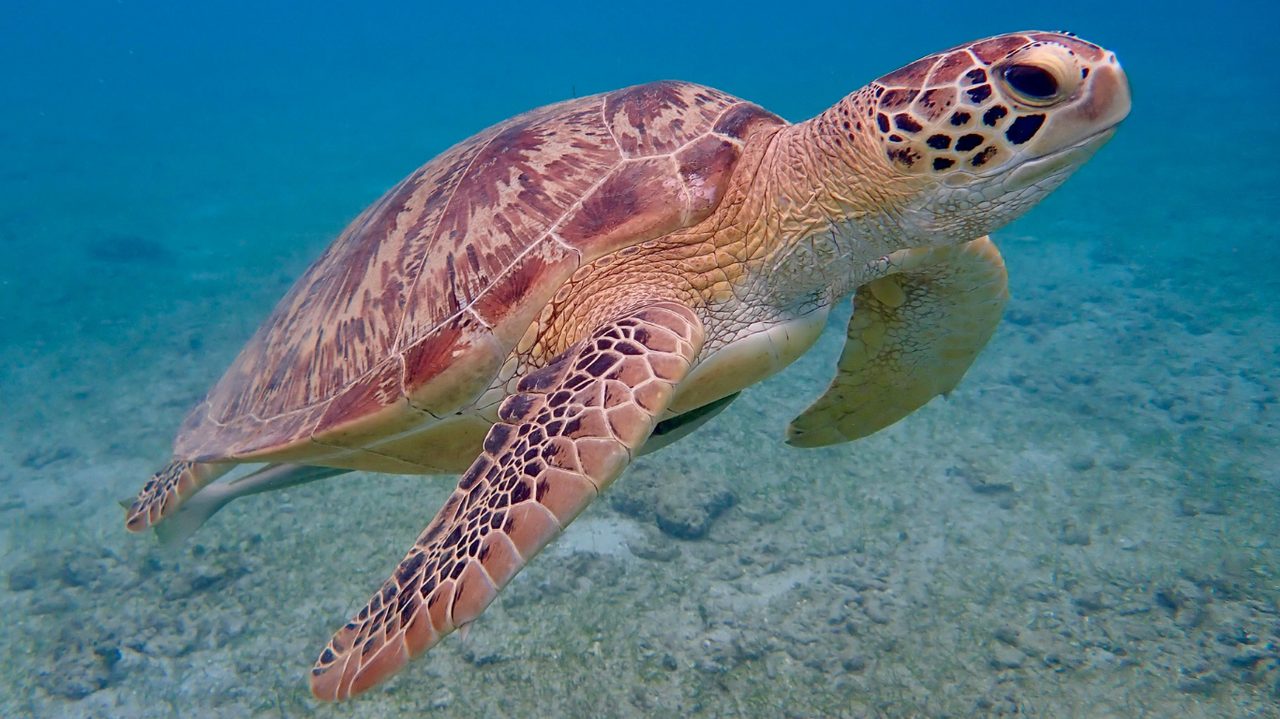
Sea turtles are living fossils: their body plan has existed for over a hundred million years, from the time of the dinosaurs. They are reptiles, not fish, and that one fact explains almost everything that makes them special. They breathe air, so they must surface; they lay eggs on the beach where they were born; and their sex is set by the temperature of the sand, not by genes. For an animal that spends its whole life at sea, that bond with the land is surprising and moving.
For divers, a turtle encounter is almost always calm and peaceful. Unlike most fish, a foraging turtle rarely flees at once; it keeps nibbling at its sponge or seagrass, or rests under an overhang, and lets itself be admired at a respectful distance. It is exactly that calm that makes turtles so beloved, and exactly why it is tempting to get too close or, worse, to touch them or "ride" them, which you must never do.
A reptile in the sea: that changes everything. Because the turtle is an air-breathing reptile, it must surface to breathe (so it "dives" like you, on a lung-full of air), it is more cold-blooded and slower in cool water, and it is bound to the land for its reproduction. Remember this one fact, and the rest of the topic follows logically.
Key concepts
| Term | Short definition | Why it matters |
|---|---|---|
| Reptile | Air-breathing, egg-laying vertebrate | Sets breathing and reproduction |
| Shell (carapace/plastron) | Upper and lower shell, part of the skeleton | Protection; the turtle can't withdraw into it |
| Salt glands | Glands that excrete excess salt | The "crying" turtle; living in salt water |
| Natal homing | Return to the birth beach to nest | Explains loyalty to specific beaches |
| Temperature-dependent sex | Sand temperature sets male/female | Climate-sensitive; warmer = more females |
| Foraging | Searching for food (seagrass, sponges, jellyfish) | Determines where you see which species |
| Bycatch | Getting caught unintentionally in nets | A major threat to turtles |
| Cleaning station | Place where turtles are cleaned | A reliable encounter spot |
Understanding sea turtles
What a sea turtle is: an air-breathing reptile
The sea turtle is a reptile: it breathes air with lungs, is cold-blooded, and lays eggs. Its shell (the upper part is the carapace, the lower the plastron) is fused with its skeleton and provides protection. Unlike a land tortoise, a sea turtle cannot withdraw its head and legs into the shell: its body is fully streamlined for swimming, with the forelimbs reshaped into powerful "wings" with which it, in effect, flies through the water. Because it lives in salt water but needs fresh water in its body, the turtle has salt glands by the eyes that excrete the excess salt. That gives the image of a "crying" turtle on the beach: not sorrow, but a physiological way to shed salt. And because it breathes air, the turtle must surface regularly. Resting or sleeping, it can hold its breath for a very long time (long enough to stay down for minutes to sometimes much longer), but actively foraging it surfaces more often. For the diver this means: never block a turtle's route to the surface; it must be able to breathe.
A sea turtle is like a diver with a built-in air supply: it "dives" from the surface, stays down a while, and must come up again to breathe, exactly like you. The big difference is that it carries its "tank" (its lungs) with it always and is very economical with it.
The species divers meet
There are seven species of sea turtle worldwide; a handful you realistically meet as a diver, each with its own diet and head shape:
| Species | Recognition | Diet | Where |
|---|---|---|---|
| Green turtle | Large, round head, smooth shell | Mostly seagrass and algae (herbivore as adult) | Seagrass meadows, reefs |
| Hawksbill turtle | Pointed, "hawk-beak" snout | Mostly sponges | Coral reefs |
| Loggerhead turtle | Large, broad head, powerful jaws | Shellfish, crabs | Reefs, sand bottoms |
| Leatherback turtle | Enormous, leathery shell (no plates) | Jellyfish | Open ocean; rarely seen by divers |
| Olive ridley | Smaller, olive-coloured | Omnivore (crustaceans, jellyfish) | Various |
The green and the hawksbill are by far the most seen on tropical reefs. A handy tip: recognise the green by its round head and the fact that it grazes seagrass/algae, the hawksbill by its pointed "hawk-beak" with which it picks sponges from crevices. That difference in diet also explains where you find them: the green on seagrass meadows, the hawksbill on the coral reef.
The life cycle: from beach to sea and back
A sea turtle's life is one of the most impressive stories in nature. A female crawls up the beach at night, digs a nest, lays dozens to over a hundred eggs, covers it and returns to sea. After weeks the young hatch at night and race to the water, guided by the light of the horizon above the sea (artificial light on beaches confuses them). The first years, the "lost years", they spend largely on the open ocean. When a turtle matures after many years, it returns, via natal homing, to the exact beach where it was born to nest there, probably using the Earth's magnetic field as a compass.
A fascinating and worrying detail: the sex is set by the temperature of the sand during incubation. Warmer sand gives more females, cooler sand more males (remembered as "hot chicks, cool dudes"). Through climate warming, that ratio is shifting towards almost all females on many beaches, a real threat to reproduction in the longer term.
Did you know? A sea turtle can live for decades and mature only after twenty to thirty years. Like sharks and rays, that slow life makes it vulnerable: every adult turtle lost represents decades of growth and is hard to replace.
Encounter etiquette
Turtles are calm, and that calls for calm, respectful behaviour. Keep your distance and stay low; a foraging or resting turtle often lets itself be admired beautifully as long as you don't chase it. Never block the route to the surface; it must be able to breathe. Stay below or beside it, not between it and the surface. Never touch and never "ride". Touching or grabbing a turtle is stressful, damages its protective layer, and is illegal in many places. Riding a turtle is cruel and dangerous for the animal. Don't block a cleaning station; turtles too let themselves be cleaned, and you only see that behaviour if you don't disturb it. No flash right in the face; moderate your photography. Do this, and turtle encounters are almost always long and peaceful, exactly what makes them so beloved.
Scenario. A diver in Egypt finds a green turtle calmly grazing seagrass. Instead of swimming closer and pushing their phone in its face, they hover low a few metres away (good buoyancy) and watch. The turtle keeps grazing, calmly rises after a while to breathe along a free route, and dives again. Ten minutes of beautiful observation, purely because the diver respected the distance and the breathing route.
Threats and conservation
Sea turtles are under pressure worldwide, and many threats are human-caused. Plastic: leatherbacks mistake plastic bags for jellyfish; all species can ingest plastic that blocks their gut. Bycatch: turtles drown in fishing nets and on longlines; modified gear (such as "turtle excluder devices") helps. Disturbed nesting beaches: artificial light disorients hatchlings (they walk to the town instead of the sea), and building and disturbance destroy nests. Hence "lights out" at protected beaches. Egg and meat trade: poaching of eggs and animals. Climate: warmer sand (skewed sex ratio) and sea-level rise that erodes nesting beaches. Protection works: protected nesting beaches, modified gear, reduced plastic and responsible tourism (watch, don't touch) help populations recover. As a diver you contribute through respectful behaviour and by supporting turtle conservation.
Real-world examples
The Netherlands. Sea turtles are rare vagrants here (occasionally a leatherback or a weakened, hypothermic turtle strands). It shows that turtles are tropical and subtropical animals; cold water is life-threatening for them.
Egypt (Red Sea). Green and hawksbill turtles are a classic highlight, especially on seagrass meadows (green) and reefs (hawksbill). Marsa Alam and surroundings are known for reliable, calm turtle encounters.
Indonesia (Coral Triangle). Rich in green and hawksbill turtles on the reefs; important nesting and foraging areas, with many local conservation projects.
Maldives. Green and hawksbill turtles on virtually every reef, often very used to divers; a good place to practise responsible behaviour (watch, don't touch).
Mozambique (Tofo and Vilanculos). At Vilanculos and the Bazaruto Archipelago lie important nesting and foraging areas: the vast seagrass meadows feed green turtles (and the dugong), and the beaches serve as nesting sites, making the area an important conservation zone. At Tofo you see turtles on the reefs between the manta and shark dives. For both: the combination of nesting (beaches) and foraging (seagrass/reef) makes Mozambique one of the meaningful turtle regions of East Africa, with local conservation efforts divers can support.
Common mistakes
| Mistake | What goes wrong | How to avoid it |
|---|---|---|
| Touching or grabbing a turtle | Stress, damaged protective layer, often illegal | Watch only, never touch |
| "Riding" a turtle | Cruel and dangerous for the animal | Never do this; it is abuse |
| Blocking the route to the surface | The turtle cannot breathe | Stay below/beside, never between it and the surface |
| Approaching too close while foraging | The turtle flees, stops eating | Keep your distance; let it continue |
| Flash right in the face | Disturbance, possible harm | Moderate photography; no light in the eyes |
| Leaving/using plastic | Deadly for turtles (jellyfish confusion) | Reduce plastic, leave nothing behind |
| Lighting nesting beaches at night | Disorients hatchlings | Respect "lights out" at protected beaches |
Pro tips
- Always respect the breathing route: stay below or beside a turtle, never between it and the surface.
- Keep your distance and stay low; an unchased turtle lets itself be admired far longer and more beautifully.
- Never touch and never ride; it is harmful, stressful and often illegal.
- Recognise the species by head and diet: round head + seagrass = green; pointed hawk-beak + sponges = hawksbill.
- Moderate your photography; no flash in the face, and give the animal space.
- Support conservation: reduce plastic, leave nothing behind, and respect protected nesting beaches and "lights out".
Frequently asked questions
Why is the fact that a sea turtle is a reptile so decisive? As a reptile it breathes air (must surface), lays eggs on the beach (bound to land) and is cold-blooded/temperature-sensitive. This explains its behaviour, life cycle and vulnerability.
Why can't a sea turtle withdraw into its shell, and what do its salt glands do? Its body is fully streamlined for swimming, with the forelimbs as "wings", so withdrawing is impossible. The salt glands by the eyes excrete excess salt (the "crying" turtle image), needed to live in salt water.
How do you tell a green turtle from a hawksbill, and where do you see them? The green has a round head and grazes seagrass/algae (seagrass meadows); the hawksbill has a pointed "hawk-beak" and eats sponges (coral reefs). The diet determines where you find them.
What is natal homing, and what sets the sex of the young? Natal homing is the return of an adult turtle to the exact beach where it was born to nest, probably via the Earth's magnetic field. The sex is set by the sand temperature during incubation: warmer sand gives more females.
Why must you leave the route to the surface free in a turtle encounter? Because the turtle is an air-breathing reptile and must surface to breathe; blocking the space between it and the surface can prevent it from breathing. Stay below or beside it.
Summary
Sea turtles are ancient reptiles, not fish, and that one fact explains almost everything: they breathe air and must surface, they lay eggs on the beach and are thus bound to land, and they are cold-blooded and temperature-sensitive. Their shell is fused with the skeleton and they cannot withdraw into it, because their body is streamlined for "flying" through the water; salt glands by the eyes excrete excess salt. Of the seven species, a diver mainly meets the green turtle (round head, grazes seagrass) and the hawksbill (pointed hawk-beak, eats sponges), where diet determines where you find them. Their life cycle is impressive: eggs on the beach, hatching at night guided by the light above the sea, the "lost years" on the open ocean, and after decades a return to the birth beach (natal homing) to nest, while the sand temperature sets the sex (a climate-sensitive fact). In an encounter you keep your distance, leave the breathing route free, and never touch or "ride". The main threats are plastic, bycatch, disturbed nesting beaches and climate, and protection demonstrably works. Bazaruto near Vilanculos is an important nesting and foraging area, making Mozambique a meaningful turtle region.
The 10 things every diver should know by heart
- The sea turtle is an air-breathing reptile, not a fish.
- It cannot withdraw into its shell; its body is streamlined for swimming.
- Salt glands by the eyes excrete excess salt (the "crying" turtle).
- Green = round head + seagrass; hawksbill = pointed hawk-beak + sponges.
- Always leave the breathing route free; stay below or beside, never between turtle and surface.
- Never touch and never ride; it is harmful and often illegal.
- Natal homing: adult turtles return to their birth beach to nest.
- The sand temperature sets the sex (warmer = more females); climate-sensitive.
- The main threats: plastic, bycatch, disturbed nesting beaches, climate.
- Bazaruto near Vilanculos is an important nesting and foraging area; support conservation.
Gallery