
Skills & Planning
Diving Emergencies
Self-rescue and staying calm underwater — Stop-Breathe-Think-Act, out-of-air options, free flow, entanglement, cramp, vertigo, uncontrolled ascent and surface problems.
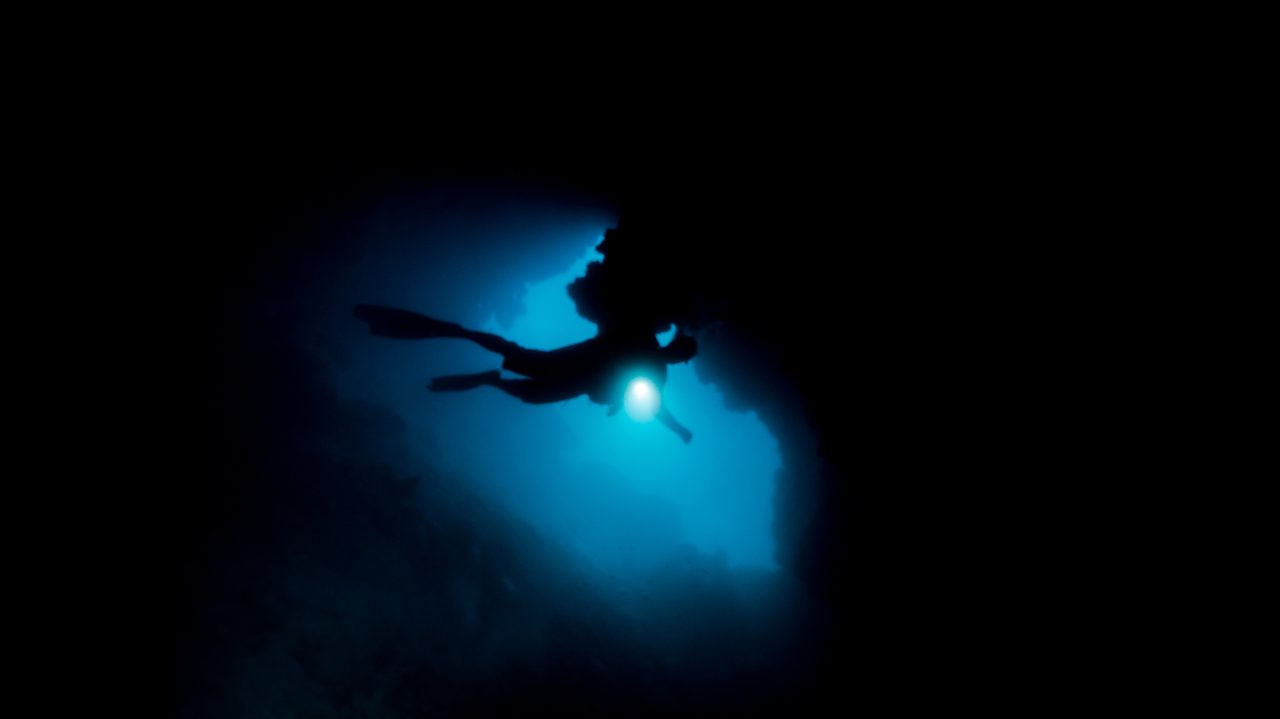
Most emergencies are manageable if you stay calm and know the right procedure. Panic, not the original problem, is the common denominator in almost every serious dive accident. A free flow, a lost mask, a cramp, even running out of air: these all have a known, practised solution. What turns a manageable problem into an accident is almost always the same thing — panic. A diver who panics holds their breath (lung over-expansion), shoots up (too-fast ascent), rips out their regulator, or exhausts themselves. The original problem was small; the reaction to it was deadly.
That is why this topic puts attitude before technique. The most important skill in any emergency is to stop, breathe, think, and only then act. Almost every underwater problem gives you a few seconds to think; those seconds are the difference. Technique comes after: every situation has a practised procedure. This topic covers self-rescue and managing your own problems. Rescuing someone else (an unconscious or panicking diver) is a separate skill.
Sensitive topic. This topic describes life-threatening situations. The information is educational and does not replace certified training or hands-on practice. Emergency skills are learned in the water under supervision, not from a text. Use this to understand and revise, not as a substitute for practice.
Key concepts
| Term | Short definition | Why it matters |
|---|---|---|
| Stop-Breathe-Think-Act | Stay-calm procedure for any problem | Prevents panic reactions |
| Out of air (OOG) | No more air from your tank | The classic emergency |
| Octopus / alternate air | Second regulator to share air | First choice at OOG with buddy near |
| CESA | Controlled Emergency Swimming Ascent | Self-rescue when no buddy is reachable |
| Buddy breathing | Sharing one regulator (outdated) | Last resort without an octopus |
| Free flow | Regulator blows uncontrollably | Loses gas fast; still breathable |
| Vertigo | Spinning dizziness underwater | Disorientation, often from ears/cold |
| Entanglement | Caught in line, net or kelp | Needs calm freeing, not pulling |
| Uncontrolled ascent | Going up too fast | Lung over-expansion and DCS risk |
| Surface exhaustion/panic | Fatigue or panic above water | Common, often underestimated |
Understanding emergencies
Prevention: the best emergency is one that doesn't happen
Most emergencies are preventable with the skills from earlier topics: gas management (calculate your reserves, turn in time, check your gauge — then you don't run out); buddy check and maintenance (well-checked gear gives fewer free flows, leaks and surprises); dive planning (a plan with "what if" turns a problem into a practised procedure); buoyancy (control over your depth prevents uncontrolled ascents and panic); and staying within your limits (most serious incidents happen outside someone's training, depth or fitness). Prevention is not exciting, but it is where the safety really sits. Everything below is the safety net when prevention falls short.
The golden attitude: Stop-Breathe-Think-Act
Before you execute a procedure, you do one thing: stop and breathe. It sounds simple, but under stress it is the hardest and most important step. Pause, take a few calm breaths, and your brain regains oxygen and overview. From that calm you execute the right procedure. Almost no underwater problem is acutely fatal in the first seconds, and you use exactly those seconds not to panic.
It is like nearly skidding in a car: your first reflex (braking hard, yanking the wheel) makes it worse, while easing off and correcting calmly saves you. Underwater, "stop and breathe" is that calm correction.
Out of air: the order of solutions
Running out of air is the classic emergency, and there is a clear order of preference, from safest to last resort. First, the octopus of your buddy (alternate air share): first choice if your buddy is near. Give the "out of air" and share-air signals, take the offered octopus, breathe, stabilise, and ascend together in a controlled way with a safety stop if possible. This is the procedure the whole buddy system exists for. Second, a CESA (Controlled Emergency Swimming Ascent): if no buddy is reachable and you are shallow enough (recreationally usually up to ~9 m, sometimes practised a little deeper), swim up slowly while continuously exhaling a long "aaah" (so your lung air can escape, Boyle), keeping your regulator in your mouth, and control your ascent rate. The exhalation is crucial: it prevents lung over-expansion as the air in your lungs expands. Third, buddy breathing (sharing one regulator): an outdated technique for when there is no octopus, error-prone and rarely taught now; only a last resort.
Why octopus comes before CESA. Sharing from an octopus is safer than swimming up yourself, because you have air and can ascend calmly with a stop. A CESA is a self-rescue for when there is nobody; it works, but only shallow and requires that you keep exhaling.
Equipment problems
Free flow. Your regulator blows uncontrollably (often from cold or a fault). Important: the air is escaping, but you can still breathe from it. No panic needed. Breathe from the free-flowing regulator (with your lips loose so you don't choke on the over-pressure) or switch to your octopus, signal your buddy, and begin a controlled ascent — your gas runs out fast now. Leak. A leaking O-ring or hose gives a bubble stream and gas loss. Make the dive safe: inform your buddy, check your pressure, and end the dive in a controlled way. As long as you have air and a working regulator, this is not acute panic but a reason to ascend calmly. Mask lost or flooded. A flooded or knocked-off mask is uncomfortable but not dangerous if you stay calm. Keep breathing through your regulator (you breathe through your mouth, not your nose), put the mask back or keep your eyes shut, and clear it with nose air. This is a basic skill you practise endlessly for exactly that reason. Regulator out of the mouth. If you lose your regulator, find it with the "sweep" (swinging your arm along the tank brings the hose forward) or via the octopus. Keep exhaling gently (small bubbles) while you find it; do not inhale until it is in your mouth.
Physical problems
Cramp. Usually in the calf or foot, from cold, exertion or tight fins. Stop kicking, grab your fin tip and pull it towards you (stretching the muscle), massage, and take it easy. A cramp is not an emergency if you respond calmly. Vertigo. Often from an ear equalising unevenly (cold water in one ear, or an equalising problem). Your world spins and you become disoriented. Grab something or hold your buddy, keep breathing, fix your eyes on a fixed point, and wait for it to pass (usually quickly). Then ascend calmly. Nitrogen narcosis. If you feel slow, over-confident or "strange" at depth, that may be narcosis. The solution is simple: go shallower, and it disappears. Make no important decisions at depth if you doubt your clarity.
Entanglement and being stuck
If you get caught in a line, net or kelp, the first rule is: do not pull and do not panic, because that tangles you further. Stop, breathe, and look (or feel) where you are caught. Free yourself calmly; use your cutting tool if truly needed (anyone diving in such environments should carry a reachable knife or cutter). Ask your buddy for help: a second pair of eyes and hands often sees at once where you are stuck. Again, calm keeps the problem small.
Uncontrolled ascent
If you shoot up unintentionally (too much air in BCD/drysuit, panic, or coming off a line), the biggest threat is lung over-expansion and a too-fast ascent. React: exhale / keep breathing (never hold your breath), dump air from your BCD and any drysuit, and try to arrest yourself (grab a line, or spread out to create resistance). If you do surface fast, report it: it is a reason to watch extra closely for DCS symptoms and, if needed, arrange oxygen and help.
Lost buddy
If you lose your buddy, follow the pre-agreed procedure: search around for about one minute (look, listen, watch for bubbles), and if you don't find them, ascend in a controlled way and reunite at the surface. You do not search endlessly at depth, because then you both end up in trouble. The agreement "one minute searching, then up" is always made before the dive.
Surface problems
Many incidents happen at the surface, not at depth. Exhaustion (swimming too far against wind/current, over-weighted, stressed) you solve by inflating your BCD so you float effortlessly, going on your back, breathing calmly and resting, and signalling for help. Panic at the surface you recognise in a diver hanging high and vertical in the water, grabbing about; the first step for that person is to create buoyancy (inflate the BCD, drop weights only in extreme need) and calm down. Rescuing a panicking or unconscious diver is a separate skill.
Real-world examples
The Netherlands (cold, poor visibility). Cold causes free flows (freezing regulators) and cramp; poor visibility increases the risk of a lost buddy and disorientation. Dutch divers therefore practise free-flow breathing, buddy contact in poor visibility and the lost-buddy procedure extra.
Egypt (clear, guided dives). Less environmental stress, but the excellent visibility tempts deeper diving (narcosis) and the ease can lead to over-confidence. Out-of-air from checking too late and uncontrolled ascents are the classics to avoid here.
Indonesia (current, entanglement). Current increases exhaustion and the risk of a lost buddy; some sites have fishing nets or lines (entanglement risk). A cutting tool and calm are important here.
Maldives (drift, surface). After a drift dive the surface problem (far from the boat, wind, waves) is real; a DSMB, floating and signalling prevent fatigue from turning into panic.
Mozambique (Tofo and Vilanculos). At Tofo the surf launch, negative entry, swell and current combine into an environment where surface problems (exhaustion, far from the RIB) and rapid pressure changes call for calm and a good DSMB/signal procedure. At Vilanculos it is calmer, but changing visibility and current around the sandbanks make the lost-buddy procedure and buddy contact important. In both cases the thread is: prevention through planning, and calm when it does go wrong.
Common mistakes
| Mistake | What goes wrong | How to avoid it |
|---|---|---|
| Panicking instead of stopping first | Small problems turn deadly | Train Stop-Breathe-Think-Act to a reflex |
| Holding your breath at OOG/CESA/ascent | Lung over-expansion injury | Always keep (ex)haling, even without air |
| Checking the gauge too late | An out-of-air situation | Fixed check rhythm; turn at turn pressure |
| Choosing CESA while the buddy is near | Unnecessary risk | Octopus before CESA if the buddy is reachable |
| Pulling at entanglement | Getting more stuck | Stop, look, free calmly, cut if needed |
| Treating a free flow as acute panic | Unnecessary panic reaction | Realise you can breathe from it; ascend in control |
| Searching for the buddy endlessly at depth | Two divers in trouble | One minute searching, then ascend (agreed) |
| Dropping weights immediately at the surface | Uncontrolled, loss of gear | Inflate the BCD first; weights only in extreme need |
Pro tips
- Train Stop-Breathe-Think-Act until it is a reflex; calm is your most important emergency skill.
- Always keep breathing, even without air: on a CESA or ascent a continuous long exhalation; never hold your breath.
- Know the OOG order: buddy octopus first, then CESA, buddy breathing last.
- Practise basic skills (mask clearing, regulator recovery) until they are boring; then they work under stress too.
- Carry a reachable cutting tool where entanglement is possible, and use it only after stopping and looking.
- Solve surface problems with buoyancy and rest: BCD up, on your back, breathe, signal.
Frequently asked questions
Why is panic more dangerous than most original problems? Because panic leads to reactions that are deadly (holding the breath, ascending uncontrolled, losing the regulator, self-exhaustion), while the original problem was usually manageable. Staying calm (Stop-Breathe-Think-Act) keeps the problem small.
What is the order of preference for out-of-air solutions? First your buddy's octopus (alternate air share) if reachable; then a CESA (controlled emergency ascent with continuous exhalation) if no buddy is available and you are shallow enough; buddy breathing (sharing one regulator) only as a last resort.
Why must you exhale continuously during a CESA? Because the air in your lungs expands on ascent (Boyle); by exhaling continuously you let that air escape and prevent lung over-expansion injury.
How do you respond to a free flow? Don't panic; you can still breathe from the free-flowing regulator (with loose lips) or switch to your octopus. Inform your buddy and begin a controlled ascent, as your gas runs out fast.
What do you do if you are caught in a line or net? Stop, keep breathing, and look or feel where you are caught; do not pull, as that tightens it. Free yourself calmly, ask your buddy for help, and use your cutting tool if needed.
Summary
Most emergencies are manageable; what makes them dangerous is panic, which leads to breath-holding, uncontrolled ascents and exhaustion. The most important emergency skill is therefore an attitude: Stop-Breathe-Think-Act — first stop and breathe, then think, then execute the practised procedure. Prevention through gas management, buddy check, planning and buoyancy prevents most emergencies; the procedures are the safety net. At out of air there is a clear order: your buddy's octopus first, then a CESA with continuous exhalation if nobody is reachable, and buddy breathing only as a last resort. Equipment problems like a free flow, a leak, a flooded or lost mask and a lost regulator are all manageable as long as you keep breathing and follow the procedure calmly. Physical problems (cramp, vertigo, narcosis) you solve by stopping, stabilising and going shallower if needed. At entanglement you do not pull but stop, look and free yourself, with a cutting tool as backup. An uncontrolled ascent you control by exhaling and dumping, and at a lost buddy you search one minute and then ascend. Many incidents happen at the surface, where creating buoyancy and resting is the key. Rescuing someone else is a separate skill.
The 10 things every diver should know by heart
- Panic is the real danger; train Stop-Breathe-Think-Act to a reflex.
- Always keep breathing, never hold your breath, even on a CESA or ascent.
- Prevention prevents most emergencies: gas plan, buddy check, planning, buoyancy.
- At out of air: buddy octopus first, then CESA, buddy breathing last.
- A free flow is breathable; ascend in a controlled way, do not panic.
- Practise mask clearing and regulator recovery until they are automatic.
- At entanglement: don't pull; stop, look, free calmly, cut if needed.
- Uncontrolled ascent: exhale and dump, then watch for DCS.
- Lost buddy: one minute searching, then ascend (agreed in advance).
- Solve surface problems with buoyancy and rest; rescuing others is a separate skill.
Sensitive topic. This information is educational and does not replace certified dive training, hands-on practice or medical/professional advice. In a real dive incident, contact professional (diving) medical help immediately, for example DAN.