
Skills & Planning
Gas Management
Gas management as planning — why you use air faster at depth, usable gas versus tank contents, rock bottom, turn pressure, the rule of thirds, team gas and redundancy.
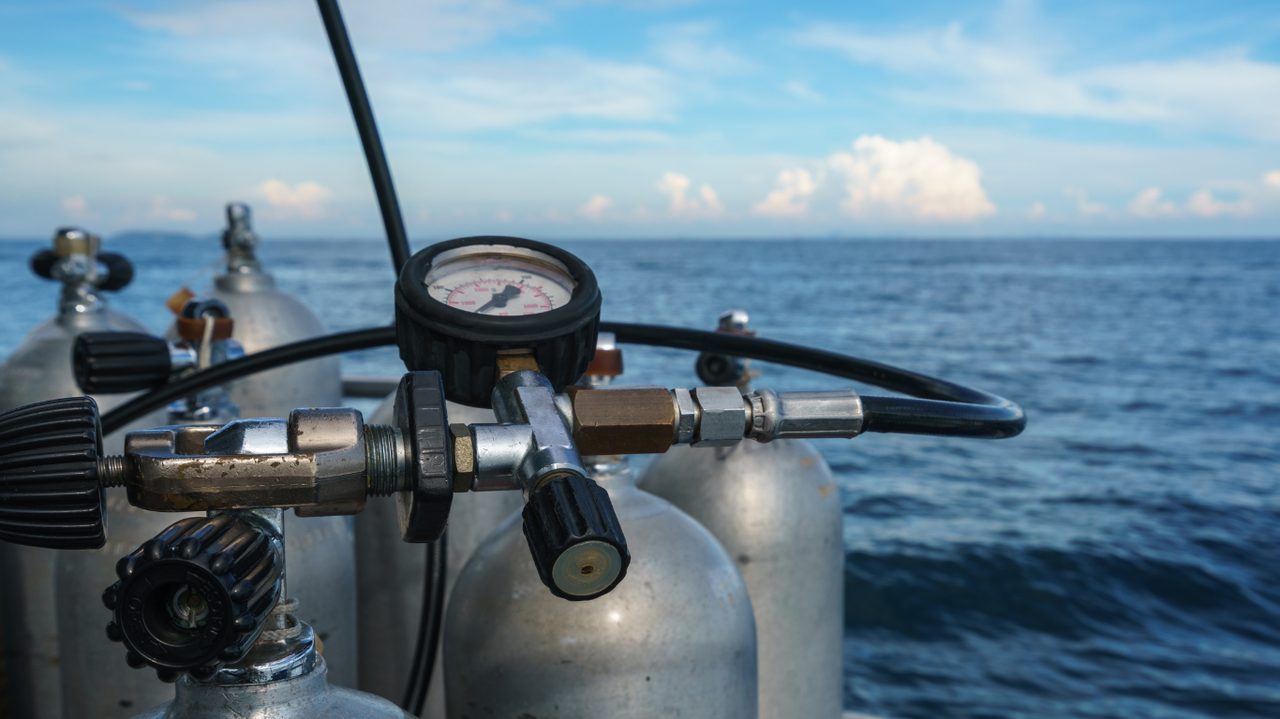
"Running out of air" is one of the most common serious dive incidents, and it is almost always preventable. The cause is rarely a fault; it is usually a planning error: pushing on too long, checking the gauge too late, or not accounting for the fact that an emergency happens exactly where you have the least reserve. Gas management is the systematic answer to that.
The difference between "keeping an eye on your air" and real gas management is thinking in reserves and scenarios. A good diver asks not only "how much air do I have left?", but "how much air do I need to bring myself and my buddy safely up, including a safety stop, if it goes wrong right now?". That number — the reserve you never touch — determines when you turn and ascend, before your gauge reaches the red.
The core question of gas management. Not "how much air do I have left?" but: "if it goes wrong now, at this deepest point, do I have enough to bring myself and my buddy safely up?" Whoever thinks in that scenario plans their reserve ahead and turns in time.
Key concepts
| Term | Short definition | Why it matters |
|---|---|---|
| SPG | Gauge showing your remaining tank pressure | Your "fuel gauge"; check it regularly |
| Tank contents | The total in the tank (litres × bar) | Rough total supply |
| Usable gas | What you may use before touching your reserve | The number that steers your dive |
| Reserve | Gas you never touch (for emergencies) | Your safety margin |
| Rock bottom / minimum gas | Minimum pressure to bring you + buddy safely up | Sets your hard turn/ascent point |
| Turn pressure | Pressure at which you turn towards the exit/ascent | Ensures you return with enough gas |
| Rule of thirds | 1/3 out, 1/3 back, 1/3 reserve | Simple planning rule (especially overhead/tech) |
| Team gas | Gas planned for you and your buddy | Needed for air sharing at out-of-air |
| Redundancy | Independent reserve source (octopus, pony, doubles) | Backup if the main source fails |
Understanding gas management
Why you use air much faster at depth
A common misconception is that you "just breathe down your tank" at a fixed rate. In reality you use air much faster at depth, and that comes straight from the gas laws. You always breathe air at ambient pressure: at 30 m that is 4 bar. Each breath therefore contains four times as many molecules as at the surface. Your lungs feel nothing unusual, but your tank empties four times as fast.
| Depth | Absolute pressure | Consumption vs. surface |
|---|---|---|
| 0 m | 1 bar | 1x |
| 10 m | 2 bar | 2x |
| 20 m | 3 bar | 3x |
| 30 m | 4 bar | 4x |
| 40 m | 5 bar | 5x |
This has a profound consequence for planning: the same tank that lasts an hour at the surface is empty in fifteen minutes at 30 m. And an emergency at depth costs your reserve extra fast, precisely because that is where you consume the most. Reserves must be calculated on that, not on your surface consumption.
Emptying your tank at depth is like driving with the accelerator pressed deeper the further you go: same tank, but consumption rises. Plan your fuel for the hardest stretch, not for easy cruising.
Tank contents versus usable gas
What is in your tank is not what you may use. A 12-litre tank at 200 bar holds roughly 2400 litres of air (12 × 200), but a good part of that is reserve you never touch. What steers your dive is the usable gas: the total minus your reserve. Thinking in litres (real volume) rather than only bar is the key. "50 bar left" means something very different in a 7-litre pony than in a 15-litre tank. For planning you therefore reckon in litres of gas (bar × tank volume), so you can compare different tanks and add them up (team gas). Plan on usable gas, not on tank pressure alone.
Reserves: rock bottom / minimum gas
The most important reserve is the gas that brings you and your buddy safely up in the worst case. This is called rock bottom or minimum gas. The scenario: at the deepest point of the dive one of you runs out of air, you share air from one tank, and ascend together with a safety stop, while both breathe more than normal under stress. The reasoning: take the deepest point of your dive, calculate how much gas two stressed divers use during a controlled ascent plus safety stop from that depth, and that number is your rock bottom — the pressure you must never go below. Reach it, and you ascend, full stop.
Rock bottom is therefore not a fixed number but depends on depth (deeper = more reserve needed) and tank size. On recreational dives many divers translate this into a rule of thumb like "surface with at least 50 bar", but that is a rough approximation that can fall short at greater depth. The real principle is scenario-based.
Did you know? The term "rock bottom" means literally "the absolute bottom": the lowest pressure still acceptable. Go below it, and in an emergency you don't have enough to bring you both up. That is why rock bottom is a hard limit, not a guideline.
Planning rules: turn pressure and rule of thirds
You set reserves in advance; during the dive you steer on two numbers. Turn pressure is the pressure at which you turn towards the exit or begin the ascent, chosen so you arrive at the surface with your reserve (rock bottom) intact. On a simple out-and-back in open water the logic is: usable gas divided by two (out and back), plus your reserve. The rule of thirds is a stricter, widely used rule (especially in overhead and technical diving, but instructive for everyone): use one third of your gas on the way out, turn around, use one third back, and keep one third as reserve. In open water with a free ascent this is conservative; in a cave or wreck, where you cannot simply go up, it is a minimum.
Scenario. Two divers plan a wreck at 28 m with the rule of thirds. They start with 210 bar usable and agree to turn at 140 bar. At 145 bar one points at their gauge and they give the turn signal, even though the wreck isn't "done". They surface comfortably with their reserve. The temptation to go on "just a little longer" is exactly the mistake the rule prevents.
Team gas and air sharing
Gas management is a team sport, because the classic emergency is that your buddy runs out and must breathe from your tank. That means your reserve is not just for you, but for both of you together. Two divers who both plan "tight but enough for myself" have too little together if one fails. Practically: calculate your rock bottom for two breathing divers, not one; know where your buddy's octopus is and they know yours; and with larger differences in consumption, the "air hog" (high consumption) partly sets the team's turn point.
Redundancy: an independent backup
Reserves in the same tank don't help if that tank or regulator fails (e.g. a free flow emptying your gas). That is why redundancy exists: an independent second gas source. The octopus is a second regulator on the same tank — it saves a buddy who is out of air, but not yourself if the tank itself is empty. A pony bottle is a small, separate tank with its own regulator; an independent backup for yourself, popular in solo or deeper recreational diving. Doubles / sidemount are two independent tanks, standard in technical and overhead diving. The further you are from a free ascent (deep, wreck, cave), the more important true, independent redundancy becomes. In shallow open water with a direct ascent, buddy + octopus often suffices.
Real-world examples
The Netherlands (cold, deeper, poor visibility). Cold raises your consumption, poor visibility raises your stress, and many sites have no easy direct ascent along a reef. Many Dutch divers therefore use a pony bottle or doubles and calculate their reserves seriously; gas management is more technical here than in warm, shallow water.
Egypt (Red Sea, warm, house reef). Warm water and a direct ascent along the reef usually make recreational gas management with buddy + octopus sufficient. Still, you consume fast on the deeper wrecks (around 30 m); plan your turn pressure on the depth, not on feel.
Indonesia (current, deep). On current sites, swimming against or across the current costs extra gas, and the depth eats your supply. Calculate your reserves at the deepest point and the hardest moment, not on an average calm dive.
Maldives (repetitive dives, drift). Multiple dives per day and drift dives demand discipline: watch the turn/end pressure and surface with enough reserve to deploy the DSMB in the current and wait for the boat.
Mozambique (Tofo and Vilanculos). At Tofo you dive offshore reefs around 20-30 m, sometimes with current and surge, which raises consumption; a negative entry and a longer search for mantas can use your gas faster than expected, so plan your turn pressure generously and keep reserve for the ascent and DSMB. At Vilanculos the dives are usually shallower, which makes your supply last longer, but the changing tide and current around the sandbanks still make a reserve for the return important. In both cases: reckon on the deepest, hardest moment.
Common mistakes
| Mistake | What goes wrong | How to avoid it |
|---|---|---|
| Only watching "bar left", not the scenario | Too little to bring you + buddy up | Think in rock bottom (two stressed divers) |
| Calculating reserve on surface consumption | Reserve far too small at depth | Calculate reserve at the depth of the deepest point |
| Checking the gauge too late | Passing your turn pressure | Fixed check rhythm; know your turn pressure in advance |
| Going on "just a bit" after turn pressure | Insufficient gas for the return | Turn at the agreed pressure, no exception |
| Planning reserve only for yourself | Too little if the buddy runs out | Plan team gas for two breathing divers |
| Thinking in bar with different tanks | Wrong comparison (7 L vs 15 L) | Reckon in litres (bar × tank volume) |
| Skipping redundancy where ascent isn't free | No backup if tank/reg fails | Pony/doubles when deep, wreck or cave |
Pro tips
- Think in scenarios, not "bar left": your turn point is the pressure that brings you and your buddy safely up from the deepest point.
- Set your turn pressure before the dive and hold to it strictly, even when "just a bit more" tempts.
- Calculate reserves at the deepest point, where you consume most and an emergency is most expensive.
- Reckon in litres with different tanks to compare like with like and add up team gas.
- Plan team gas for two breathing divers, not just yourself.
- Match redundancy to the dive: buddy + octopus in shallow open water, pony/doubles where ascent isn't free.
Frequently asked questions
Why do you consume about four times as much air at 30 m as at the surface? You breathe air at ambient pressure; at 30 m that is 4 bar absolute, so each breath contains four times as many molecules. Your tank empties about four times as fast.
What is the difference between tank contents and usable gas? Tank contents is everything in the tank (volume × pressure). Usable gas is the contents minus your reserve: the part you may use during the dive. You plan on usable gas.
What is rock bottom / minimum gas, and what does it depend on? The minimum pressure that brings you and your buddy safely up from the deepest point, sharing one tank and with a safety stop. It depends on depth (deeper = more) and tank size, and is a hard limit.
Explain the rule of thirds and when it especially applies. One third of your gas out, one third back, one third reserve. Especially important in overhead and technical diving (cave, wreck) where you cannot ascend freely; in open water it is a conservative rule.
Why plan your reserve for two divers instead of one? Because the classic emergency is your buddy running out and breathing from your tank; your reserve must then bring both up safely. Two people each planning only for themselves have too little together.
Summary
Gas management is planning, not luck: the core question is not "how much air do I have left?" but "if it goes wrong now at the deepest point, can I bring myself and my buddy safely up?". Because you always breathe at ambient pressure, you consume much faster at depth (about four times as much at 30 m), and that is exactly where an emergency is most expensive, so you calculate reserves at the deepest point. What steers your dive is not tank pressure but usable gas (contents minus reserve), preferably reckoned in litres so you can compare tanks and add up team gas. The key reserve is rock bottom (minimum gas): the pressure that brings two stressed divers, sharing one tank and with a safety stop, back up — a hard limit that sets your turn point, approaching 80 bar already on a 30 m dive. During the dive you steer on your turn pressure and optionally the rule of thirds. Reserves are planned for two breathing divers, and the degree of redundancy (octopus, pony, doubles) scales up as a free ascent becomes less certain. Recreational gas management leans on buddy and octopus with a rule of thumb; technical diving calculates everything in advance.
The 10 things every diver should know by heart
- Gas management is planning: can you bring yourself and your buddy up from the deepest point?
- You consume much faster at depth (~4x at 30 m); calculate reserves at the deepest point.
- Plan on usable gas, not tank pressure; reckon in litres.
- Rock bottom / minimum gas is a hard limit, calculated for two stressed divers.
- Set your turn pressure in advance and turn on it, no exception.
- Rule of thirds (out, back, reserve) is standard for overhead/tech, conservative in open water.
- Plan team gas for two breathing divers, not just yourself.
- The "air hog" in the team partly sets the turn point.
- Scale redundancy to the dive: octopus shallow, pony/doubles where ascent isn't free.
- Check your gauge on a fixed rhythm; a "50 bar" rule can fall short at depth.