
Skills & Planning
Air Consumption (SAC & RMV)
How to measure and use your air consumption — SAC in bar/min and RMV in litres/min, predicting consumption at depth, and calculating rock bottom with real numbers.
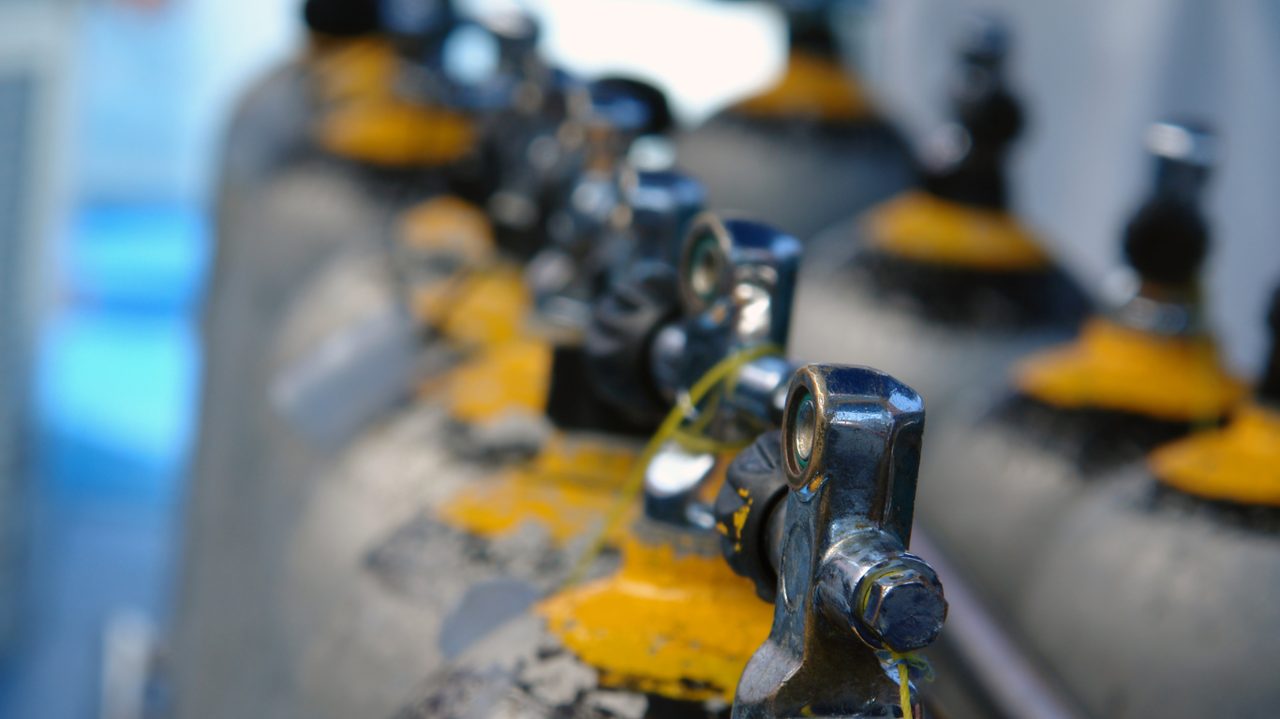
Two divers enter the water with identical tanks. One surfaces after 50 minutes with 80 bar, the other after 30 minutes with 50 bar. The difference is their air consumption, and it is a personal, measurable property. As long as you don't know your own consumption, you plan on feel and on rules of thumb that may be wrong for you. Once you do know it, gas planning turns from guessing into arithmetic.
There are two measures. SAC (Surface Air Consumption) expresses your consumption in bar per minute, referred back to the surface — handy and quick, but tied to one tank size. RMV (Respiratory Minute Volume) expresses it in litres per minute, referred to the surface — a little more abstract but far more powerful: litres are independent of the tank, so you can work out any tank, add up team gas, and set reserves with it.
Why "referred to the surface"? You consume faster at depth. To compare consumption across dives and depths, you always convert it back to what it would be at the surface (1 bar). That is your "bare" consumption, independent of depth. For a real dive you multiply it again by the absolute pressure at your depth.
Key concepts
| Term | Short definition | Unit |
|---|---|---|
| SAC | Surface Air Consumption, referred to surface | bar/min |
| RMV | Respiratory Minute Volume, referred to surface | litres/min |
| Absolute pressure | Depth ÷ 10 + 1 | bar |
| Tank volume | The water capacity of your tank (e.g. 10, 12, 15 L) | litres |
| Usable gas | Contents minus reserve | bar or litres |
| Consumption at depth | RMV × absolute pressure (÷ tank volume for bar/min) | L/min or bar/min |
| Rock bottom | Minimum reserve, calculated with RMV | litres or bar |
Understanding air consumption
The basic formula
Everything turns on one idea: your bare consumption (at the surface) × the absolute pressure = your real consumption at depth. Consumption at depth = bare consumption (SAC or RMV) × absolute pressure, where absolute pressure = depth / 10 + 1. At 30 m (4 bar) you therefore consume four times your surface consumption.
Measuring your SAC
You measure SAC with a simple test dive at a constant depth: swim a fixed time at one constant depth at your normal pace; note your start and end pressure and the time; work out consumed bar ÷ minutes = bar/min at that depth; then divide by the absolute pressure to refer it to the surface.
Worked example (SAC). You swim 10 minutes at 20 m (3 bar absolute) and your gauge drops from 200 to 140 bar. Consumed: 60 bar. At depth: 60 ÷ 10 = 6 bar/min. Referred to the surface: 6 ÷ 3 = 2 bar/min SAC. This is your SAC for this tank. Use a different tank size and this number no longer holds — which is why we move to RMV.
From SAC to RMV
You get RMV by multiplying your SAC (bar/min) by your tank volume (litres): RMV (L/min) = SAC (bar/min) × tank volume (L). With the SAC of 2 bar/min above and a 12-litre tank: RMV = 2 × 12 = 24 L/min. This number — 24 litres per minute at the surface — is now tank-independent. A relaxed, well-trimmed diver often sits lower (roughly 12-20 L/min); a stressed or hard-working diver much higher. Know your own range.
SAC is like "kilometres per tank" of your specific car: useful, but not transferable to another car. RMV is like "litres per 100 km": a universal measure with which you can work out any car (tank). That is why serious planners think in RMV.
Predicting consumption at depth
With your RMV you plan ahead. Consumption at depth in litres per minute = RMV × absolute pressure. For bar/min on your gauge, divide by your tank volume. Worked example (30 m). RMV 20 L/min, 12-litre tank, depth 30 m (4 bar): in litres 20 × 4 = 80 L/min; in bar 80 ÷ 12 = 6.67 bar/min. How long does 130 bar of usable gas last at 30 m? 130 ÷ 6.67 ≈ 19.5 minutes. So you know before the dive how long you can stay at your planned depth with your usable gas, independent of your NDL.
Total consumption of a whole profile
For a whole dive you reckon with the average depth. Worked example (whole profile). RMV 20 L/min, average depth 18 m (2.8 bar), duration 25 minutes: litres 20 × 2.8 × 25 = 1400 litres; in a 12-litre tank 1400 ÷ 12 ≈ 117 bar. You have used about 117 bar for this dive. Start at 200 bar and you surface around 83 bar, well within a normal reserve. This is how you check in advance whether a planned profile is feasible on gas.
Scenario. A diver with RMV 20 wants to explore a wreck at 30 m for 20 minutes in Egypt. They calculate: 20 × 4 × 20 = 1600 litres just for the bottom time, or 133 bar in their 12-litre tank — before descent, ascent and reserve. They see immediately that 20 minutes at 30 m on one 12-litre tank is tight and choose a larger tank or a shorter bottom time. Calculating in advance prevented a gas problem underwater.
Rock bottom with RMV
Rock bottom becomes a real number with RMV. You calculate how much gas two stressed divers need to ascend together from the deepest point with a safety stop. Worked example (rock bottom at 30 m). Assumptions: deepest point 30 m (4 bar), two stressed divers with a raised RMV of 30 L/min each (60 L/min together), 12-litre tank. Phases: (1) solve a problem on the bottom, 1 minute at 30 m (4 bar): 60 × 4 × 1 = 240 L; (2) ascend from 30 to 5 m (25 m at ~9 m/min ≈ 2.8 min, average pressure (4 + 1.5)/2 = 2.75 bar): 60 × 2.75 × 2.8 ≈ 460 L; (3) safety stop, 3 minutes at 5 m (1.5 bar): 60 × 1.5 × 3 = 270 L. Total ≈ 970 litres, or in a 12-litre tank about 81 bar.
So on this 30 m dive your rock bottom is about 80 bar, not the loose rule of thumb of 50 bar. Your turn/ascent point sits higher than many divers intuitively think. (The exact assumptions — stressed RMV, ascent rate, stop time — vary by agency and person; the method is what matters.)
Did you know? The same rock-bottom sum at 15 m gives a much lower number than at 30 m, because the pressure and ascent time are smaller. That is why rock bottom is depth-specific: the deeper the dive, the higher your reserve must be. A single "50 bar" rule can be generous shallow and too tight deep.
Factors that change your consumption
Your RMV is not a fixed constant; it rises with exertion (swimming against current, heavy gear, speed), stress and inexperience, cold (cold water raises consumption), poor trim/buoyancy (constant correcting and "hand swimming" cost air), and the effort of breathing denser air at depth. So you measure your RMV preferably several times, and for planning use a slightly conservative (higher) value, and for reserves a clearly raised (stress) value. Plan on your worse day, not your best.
Real-world examples
The Netherlands (cold, strenuous). Cold and often heavier gear (drysuit, more lead) noticeably raise the RMV. Divers who measured their consumption in warm water must use a higher value at home. Measure your RMV in the conditions you actually dive.
Egypt (Red Sea, warm, relaxed). Warm, clear and calm: often your lowest RMV. Ideal to measure your "best-case" consumption, but don't use that number as the basis for cold or current dives elsewhere.
Indonesia (current). Swimming against and across current can raise your RMV sharply. Plan your gas on the hardest, not the average, exertion of the dive.
Maldives (repetitive dives). Multiple dives per day make accurate gas planning valuable; with your RMV you know before each dive whether your profile fits on air, besides the NDL limit.
Mozambique (Tofo and Vilanculos). At Tofo the negative entry, swell and sometimes long search for mantas at 20-30 m raise your RMV; reckon your bottom time and reserve on that raised value, not on your calm house-reef number. At Vilanculos the shallower dives are more economical, but measure your RMV here too, because current around the sandbanks can raise the effort. In both cases: plan on your consumption under these specific conditions.
Common mistakes
| Mistake | What goes wrong | How to avoid it |
|---|---|---|
| Applying one tank's SAC to another | Wrong planning (bar not comparable) | Reckon in RMV (litres), tank-independent |
| Not multiplying consumption by absolute pressure | Far too little gas at depth | Always × (depth/10 + 1) |
| Measuring RMV in warm water and using it everywhere | Too little margin in cold/strenuous water | Measure in representative conditions; plan conservatively |
| Calculating reserve on normal RMV | Rock bottom too small under stress | Use a raised stress-RMV for reserves |
| One "50 bar" rule for all depths | Too tight deep, needlessly generous shallow | Calculate rock bottom depth-specifically |
| Only average depth, forgetting the deepest point | Reserve underestimated | Calculate rock bottom at the deepest point |
| Forgetting that trim/stress raise consumption | Unexpectedly fast to empty | Improve buoyancy; plan with margin |
Pro tips
- Measure your RMV several times and in different conditions; know your range from "best" to "hardest" day.
- Plan on your conservative (higher) RMV and calculate reserves on a raised stress-RMV. Plan on your worse day.
- Think in litres (RMV), not bar (SAC), as soon as you compare tanks or add up team gas.
- Always multiply by the absolute pressure to get consumption at depth; this is the most-forgotten step.
- Calculate your rock bottom depth-specifically; the "50 bar" rule is no substitute.
- Lower your RMV structurally through better trim, calm and experience; that is free bottom time and safety.
Frequently asked questions
What is the difference between SAC and RMV, and why is RMV more powerful? SAC is consumption in bar/min, tied to a specific tank size. RMV is consumption in litres/min, referred to the surface and tank-independent. RMV is more powerful because you can work out any tank with it and add up team gas and reserves in litres.
You use 60 bar in 10 minutes at 20 m (3 bar). What is your SAC? 60 ÷ 10 = 6 bar/min at depth; 6 ÷ 3 = 2 bar/min SAC (referred to the surface).
Convert that SAC to RMV with a 12-litre tank. RMV = SAC × tank volume = 2 × 12 = 24 L/min.
How much bar/min do you use at 30 m with an RMV of 20 L/min and a 12-litre tank? In litres: 20 × 4 = 80 L/min; in bar: 80 ÷ 12 ≈ 6.67 bar/min.
Why is rock bottom depth-specific and not a fixed number? It depends on the absolute pressure and the ascent time from the deepest point; both are larger deeper, so the required reserve is higher deeper. A fixed "50 bar" rule can be generous shallow and too tight deep.
Summary
SAC and RMV turn your personal air consumption into a number you can plan with. SAC (bar/min, referred to the surface) is quick but tank-bound; RMV (litres/min, referred to the surface) is tank-independent and therefore more powerful, because you can work out any tank with it and add up team gas and reserves in litres. You measure SAC at a constant depth (consumed bar ÷ minutes ÷ absolute pressure) and convert it to RMV by multiplying by your tank volume. The central formula is: consumption at depth = RMV × absolute pressure (÷ tank volume for bar/min). With it you predict how long usable gas lasts at a depth, check whether a whole profile fits on gas (RMV × average absolute pressure × duration), and calculate your rock bottom as a depth-specific number rather than a loose rule: at 30 m it already approaches 80 bar for two stressed divers. Your RMV is not a constant but rises with exertion, stress, cold and poor trim, so you measure it in representative conditions and plan on your conservative value, with reserves on a raised stress value. These numbers are the direct input for dive planning.
The 10 things every diver should know by heart
- SAC is bar/min (tank-bound); RMV is L/min (tank-free); plan in RMV.
- Always refer consumption to the surface by dividing by the absolute pressure when measuring.
- RMV = SAC × tank volume.
- Consumption at depth = RMV × absolute pressure (÷ tank volume for bar/min).
- Bottom time on gas = usable gas ÷ consumption at depth.
- Total consumption ≈ RMV × average absolute pressure × duration.
- Calculate rock bottom depth-specifically with a raised stress-RMV, for two divers.
- Your RMV rises with exertion, stress, cold and poor trim; measure in representative conditions.
- Plan on your conservative (higher) RMV; calculate reserves on your stress value.
- Better trim and calm lower your RMV: free bottom time and more safety.