
Skills & Planning
Decompression Theory
Why you ascend slowly and have a no-decompression limit — tissue compartments, M-values, the NDL, safety stops, residual nitrogen, decompression sickness and flying after diving.
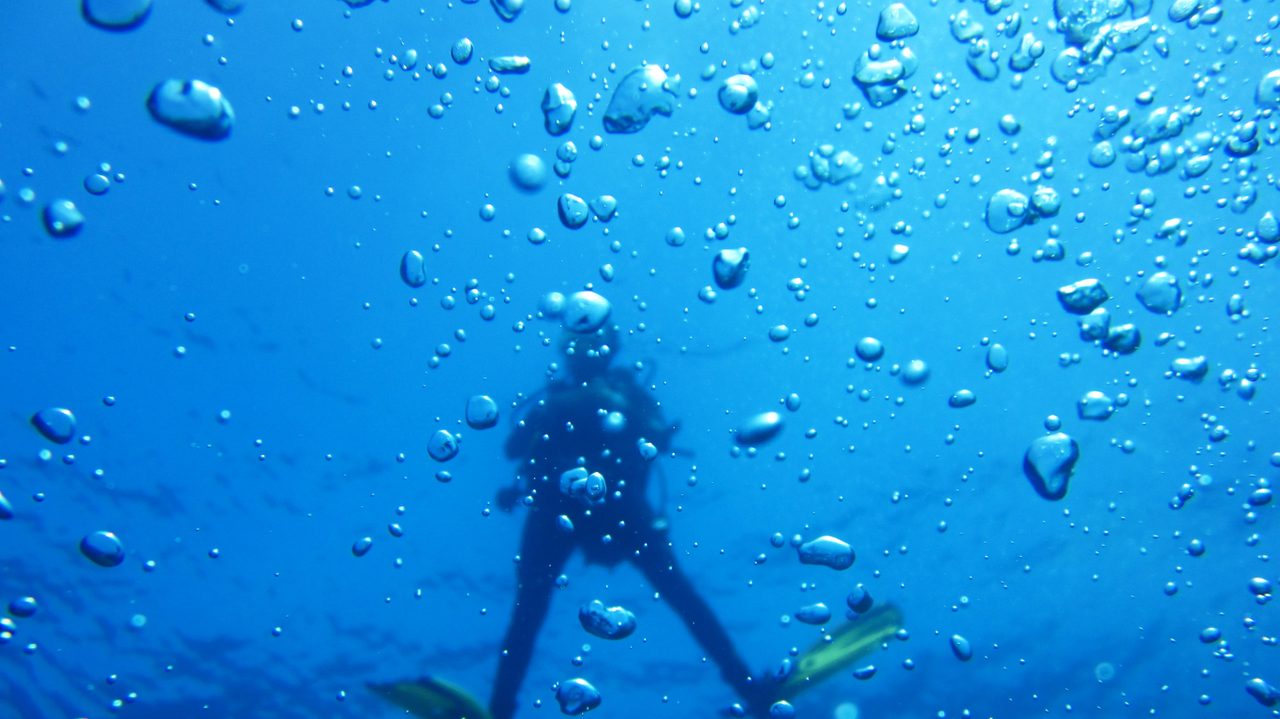
Decompression theory explains why you must ascend slowly, why you have a no-decompression limit, and why decompression sickness exists. It is the physiology behind your dive computer, and the reason diving is a time and depth sport. This topic builds fully on Henry's Law: at depth nitrogen dissolves into your tissues, and on ascent it must come back out in a controlled way, without forming bubbles.
The most important insight is that decompression is not a matter of "going up without problems", but of giving your body time to shed dissolved nitrogen in a controlled way. Do it too fast, and the nitrogen comes out as bubbles (like the opened soda bottle), causing decompression sickness. The whole theory is about controlling that process. You do not need to be able to do the maths — your computer does that — but you must understand what it does and why, so you respect its limits and know the risk factors.
Sensitive topic. This guide covers a serious dive injury. The information is educational and does not replace certified training or medical advice. If you suspect decompression sickness: give oxygen and immediately contact professional diving medical help (for example DAN).
Model, not exact truth. Decompression models are approximations of a complex body, not exact natural laws. They work statistically well, but no model guarantees zero risk. That is why margins, conservatism settings and safety stops exist, and why someone who "did everything right" can, rarely, still get DCS. Respect the limits, but understand they are probabilities, not certainties.
Key concepts
| Term | Short definition | Why it matters |
|---|---|---|
| Loading / off-gassing | Taking up nitrogen (depth) / releasing it (ascent) | The core of the whole process |
| Tissue compartment | Theoretical tissue with its own speed | Model for fast and slow tissues |
| Half-time | Time for a compartment to load/unload halfway | Sets how fast a tissue loads/unloads |
| Saturation | Tissue in equilibrium with the ambient pressure | Limit of loading at a depth |
| Over-saturation | More dissolved gas than fits the current pressure | Drives off-gassing and bubble formation |
| M-value | Maximum over-saturation a tissue safely tolerates | The limit you must not exceed |
| NDL | No-decompression limit: max time without mandatory stops | The boundary of recreational diving |
| Safety stop | 3 min around 5 m, recommended | Extra margin, lets bubbles clear |
| Residual nitrogen | Nitrogen left over after a dive | Counts on repetitive dives |
| DCS | Decompression sickness from bubble formation | The risk the theory prevents |
| Gradient factor | Conservatism setting relative to the M-value | How strict your computer calculates |
Understanding decompression
From Henry to tissues
Henry: the amount of dissolved gas is proportional to the partial pressure. At depth the nitrogen is under higher partial pressure, so more dissolves into your blood and tissues; on ascent the partial pressure drops and it wants to come out. But your body is not one liquid: different tissues take up and release nitrogen at very different speeds. Fast tissues (well-perfused: blood, brain, spinal cord) saturate and off-gas quickly; slow tissues (poorly perfused or fatty: joints, fat, cartilage) take much longer. Because you can't know what happens in each real tissue, scientists model the body as a set of theoretical compartments, each with its own speed. That is the core of every decompression model.
Haldane, Bühlmann and half-times
The British physiologist John Scott Haldane laid the basis around 1908: he modelled the body as several compartments and proposed that each tolerates a certain over-saturation. Later the Swiss Albert Bühlmann refined this into the models (ZH-L16) in virtually every modern dive computer. Each compartment has a half-time: the time it takes to cover half the way to full saturation (or off-gassing). A fast compartment has a short half-time (say 5 minutes), a slow one a long half-time (several hours). Models use a series of compartments (for example 16), so together they describe both short deep dives and long repetitive dives.
Think of a row of glasses under taps of different flow rates. The high-flow tap (fast tissue) fills its glass quickly and empties it quickly; the low-flow tap (slow tissue) takes a long time, both ways. Your "total loading" is the sum of all the glasses, each at its own pace.
M-values and over-saturation
A compartment can tolerate a certain over-saturation: more dissolved nitrogen than "fits" the current pressure, without bubbles forming. The limit of that is the M-value: exceed it, and bubble formation becomes likely. Each compartment has its own M-value. Decompression is essentially controlling your ascent so that no compartment exceeds its M-value. Stay within the limits and you off-gas in a controlled way. Go too fast and a compartment (usually a fast one) shoots past its M-value and DCS risk appears. Gradient factors are a modern way to set conservatism: you dive not to 100% of the M-value but to a chosen percentage (say 85%), with a margin. Many computers let you set this "conservative" or "aggressive". Conservative = safer, but shorter times.
The no-decompression limit (NDL)
The no-decompression limit is the maximum time you may stay at a given depth so that you can still ascend directly (with a normal ascent and possibly a safety stop) without mandatory decompression stops. Stay longer, and you have loaded so much nitrogen that you must make mandatory stops to off-gas safely. The NDL shrinks with depth, because you load faster deeper (higher partial pressure).
| Depth | Indicative NDL (first dive, air) |
|---|---|
| 12 m | ~2.5 hours (often "unlimited" in practice) |
| 18 m | ~50-60 min |
| 24 m | ~25-30 min |
| 30 m | ~18-20 min |
| 40 m | ~8-10 min |
These numbers are approximations; your computer calculates your NDL continuously based on your whole profile, not just your current depth. Trust the computer, not a memorised table.
Did you know? Because the NDL at 40 m is only around 8-10 minutes, deep recreational diving is mostly a matter of very short bottom time. Depth "costs" your NDL rapidly. This is one reason 40 m is the recreational limit: deeper, the bottom time becomes so short and the risk so great that you enter the technical domain.
Ascent rate and the safety stop
Two habits protect you on every ascent. Ascend slowly: at most about 9-10 m/min (some computers 10, others stricter on the last metres). Ascending too fast gives the fast tissues no time to off-gas and drives their over-saturation past the M-value. Safety stop: about 3 minutes around 5 m, recommended on virtually every dive deeper than ~10-12 m. The stop is not mandatory within the NDL, but gives your fast tissues extra time to off-gas and lets micro-bubbles clear before you cover the last, most pressure-sensitive metres. The last metres are the most important: that is where the pressure changes most in relative terms, so that is where you ascend slowest and make your stop.
Repetitive dives and residual nitrogen
After a dive, residual nitrogen remains in your tissues, especially in the slow compartments that keep "dripping". Dive again before it has fully cleared, and you start with a head-start of nitrogen, so your NDL for the next dive is shorter. Your computer tracks this automatically; with tables you use "group letters" and tables for the surface interval. A longer surface interval means more off-gassed and a longer NDL on the next dive; multiple dives per day stack residual nitrogen, so the third and fourth dives have the shortest NDLs; and the recommended order is deepest dive first, from deep to shallow over the day.
Scenario. A group in the Maldives does four dives in one day and ignores that their surface intervals are getting shorter. Their computers give a much shorter NDL on the fourth dive due to the stacked residual nitrogen. Those who follow the computer stay safe; those who dive "on feel" as if it were the first dive risk DCS. Residual nitrogen is invisible but real.
Decompression stops (the recreational limit)
Exceed the NDL, and you must make mandatory decompression stops: waiting a prescribed time at prescribed depths to let your compartments off-gas below their M-value before ascending further. This is the essence of technical diving, where you work with extra gases and tight planning. Recreational diving deliberately stays within the NDL, so you can always ascend directly. The reason: a mandatory deco stop means you cannot simply go up if something goes wrong (your "ceiling" is underwater), and that demands extra gas, training and equipment. The transition from "safety stop recommended" to "deco stop mandatory" is the boundary between recreational and technical diving.
Decompression sickness (DCS): what it is and how to recognise it
DCS arises when nitrogen bubbles form in blood and tissues. The severity varies widely: mild forms ("the bends") include joint pain (often shoulder, elbow), fatigue, skin rash/itch and a general "off" feeling; severe forms include neurological symptoms (tingling, numbness, weakness, paralysis), dizziness, and breathing and consciousness problems. Symptoms usually appear within minutes to a few hours after the dive. First aid is 100% oxygen, keeping the diver flat and calm, hydrating if conscious, and immediate medical help (DAN, dive doctor, hyperbaric chamber). Do not dismiss vague symptoms after a dive; when in doubt, always treat as possible DCS.
Lung over-expansion versus DCS. Do not confuse the two. Lung over-expansion injury / arterial gas embolism comes from held breath and expanding lung air, arises almost immediately on ascent, and is a Boyle problem. DCS comes from dissolved nitrogen forming bubbles, arises after the dive, and is a Henry problem. Both are serious; the causes and timelines differ.
Risk factors and flying after diving
Even within the limits, some factors raise your DCS risk: dehydration (thick blood carries nitrogen less well — drink well, no alcohol before diving); cold and exertion during or just after the dive; fast or yo-yo profiles; age, overweight, fatigue; and a PFO (patent foramen ovale, a small opening in the heart that in some people lets bubbles cross from the venous to the arterial side, raising the risk of certain DCS forms). Flying after diving: in the aircraft the cabin pressure drops, so residual nitrogen wants to off-gas further and can form bubbles. Hold the recommended wait: as a rule of thumb at least 12 hours after a single dive and 18 hours (or more) after multiple dives or multiple days. Mountain roads after diving fall under the same logic.
Did you know? The wait for flying is exactly the same Henry logic as the decompression itself: you lower the ambient pressure (now by altitude instead of ascent), so residual nitrogen wants out. Boarding a flight too soon is like a second, slow "ascent" on top of your dive.
Real-world examples
The Netherlands (cold, deeper). Cold is a DCS risk factor, and deeper diving in cold water with exertion calls for conservative profiles. Many Dutch divers set their computer more conservatively and take generous safety stops.
Egypt (Red Sea, wrecks around 30 m). On wrecks like the Thistlegorm the NDL is around 18-20 minutes; the bottom time is soon used up. Nitrox is popular here to get more bottom time within the NDL. Multiple dives per day on liveaboards make residual nitrogen a daily theme.
Indonesia (deep, repetitive). Deep walls and multiple dives per day; discipline with surface intervals and the deep-to-shallow order are important here.
Maldives (3-4 dives/day). The classic residual-nitrogen scenario: stacked nitrogen over the day makes the later dives limiting. Follow the computer, don't dive on feel.
Mozambique (Tofo and Vilanculos). At Tofo the reefs often sit around 20-30 m, which with multiple dives per day and sometimes strenuous, colder upwelling conditions gives a real nitrogen load; conservative planning and good hydration are wise. Important for both places: after the last dive the flying wait applies, and many divers fly home from these remote destinations, so plan your last dive day around the flight date. At Vilanculos the dives are shallower and the nitrogen load lower, but the same flying wait applies.
Common mistakes
| Mistake | What goes wrong | How to avoid it |
|---|---|---|
| Ascending too fast | Fast tissues past the M-value, DCS risk | Max ~9-10 m/min; the last metres extra slowly |
| Skipping the safety stop | Less margin, more micro-bubbles | Standard 3 min at 5 m on dives deeper than ~10-12 m |
| Using a memorised NDL instead of the computer | Wrong limit (profile counts) | Follow your computer, which calculates your whole profile |
| Ignoring residual nitrogen on a repeat dive | Exceeding the safe limit | Follow the computer; longer intervals, deep first |
| Flying too soon after diving | DCS from the pressure drop in the cabin | Min. 12 h after one dive, 18 h+ after several |
| Dehydration/alcohol before diving | Poorer nitrogen off-gassing, higher risk | Drink well, no alcohol beforehand |
| Dismissing vague post-dive symptoms as tiredness | Untreated DCS worsens | Treat as DCS when in doubt: oxygen + help |
Pro tips
- Follow your computer, not your memory: it accounts for your whole profile and residual nitrogen; table numbers are rough approximations.
- Ascend slowly and always make your safety stop; the last metres are the most pressure-sensitive.
- Plan deep-to-shallow over the day and give yourself generous surface intervals on multi-dive days.
- Set your computer more conservatively (gradient factors) with cold, fatigue, dehydration or age.
- Hydrate well and avoid alcohol before diving; this lowers your DCS risk for free.
- Respect the flying wait (12 h after one dive, 18 h+ after several) and plan your last dive day around your flight.
Frequently asked questions
Why do decompression models model the body as several tissue compartments? Because different tissues take up and release nitrogen at very different speeds (fast, well-perfused versus slow, fatty). Several compartments with different half-times together describe both short deep and long repetitive dives.
What is a half-time? The time it takes a compartment to cover half the way to full saturation (or full off-gassing). Fast tissues have short half-times, slow tissues long ones.
What is the NDL and why does it shrink with depth? The no-decompression limit is the maximum time at a depth after which you can still ascend without mandatory decompression stops. It shrinks with depth because you take up nitrogen faster there due to the higher partial pressure.
What is the point of a safety stop, even though it is not mandatory within the NDL? It gives the fast tissues extra time to off-gas and lets micro-bubbles clear before you cover the last, most pressure-sensitive metres, providing an extra margin of safety.
What is the difference between DCS and lung over-expansion injury in cause and timeline? DCS comes from dissolved nitrogen forming bubbles after the dive (Henry). Lung over-expansion comes from held, expanding lung air and arises almost immediately on ascent (Boyle). Both are serious, but cause and timing differ.
Summary
Decompression theory is the development of Henry's Law: at depth nitrogen dissolves into your tissues, and on ascent it must come out in a controlled way without forming bubbles. Because tissues differ greatly in speed, scientists (Haldane, later Bühlmann) model the body as a series of compartments with their own half-times: fast tissues load and unload quickly, slow tissues slowly. Each compartment tolerates a certain over-saturation up to its M-value; decompression is controlling the ascent so no compartment exceeds it, with gradient factors as a conservatism control. The no-decompression limit is the maximum time at a depth after which you can still ascend directly, and it shrinks with depth. You ascend slowly (max ~9-10 m/min) and make a 3-minute safety stop around 5 m, because the last metres are the most pressure-sensitive. Residual nitrogen remains after a dive and shortens the NDL of repetitive dives, so you take generous surface intervals and dive deep-to-shallow. Exceed the NDL and mandatory decompression stops follow, marking the boundary to technical diving. Decompression sickness arises from bubble formation and ranges from joint pain and fatigue to neurological symptoms; first aid is 100% oxygen and immediate medical help. Risk factors like dehydration, cold, exertion and PFO raise the risk, and after diving you hold the flying wait (12 hours after one dive, 18 or more after several), because the falling cabin pressure acts like a second ascent.
The 10 things every diver should know by heart
- DCS comes from dissolved nitrogen forming bubbles (Henry); slow ascent prevents it.
- The body is modelled as tissue compartments with their own half-times: fast and slow.
- Each compartment has an M-value; decompression keeps all compartments below it.
- The NDL is the max time without mandatory stops and shrinks with depth.
- Ascend at max ~9-10 m/min; the last metres the slowest.
- Always make a safety stop of 3 min around 5 m.
- Residual nitrogen shortens the NDL of repeat dives; generous intervals, deep-to-shallow.
- Follow your computer, not your memory; it calculates your whole profile.
- Recognise DCS (joint pain, fatigue, neurological signs); give 100% oxygen and seek help immediately.
- Respect the flying wait (12 h after one dive, 18 h+ after several) and hydrate well.
Sensitive topic. This information is educational and does not replace certified dive training, hands-on practice or medical advice. In case of a suspected decompression injury: give oxygen and contact professional diving medical services immediately (for example DAN).