
The Environment
Waves & Surf
How waves form, the difference between wind waves and swell, why waves break, surge underwater, and the go/no-go judgement for safe entries and exits.
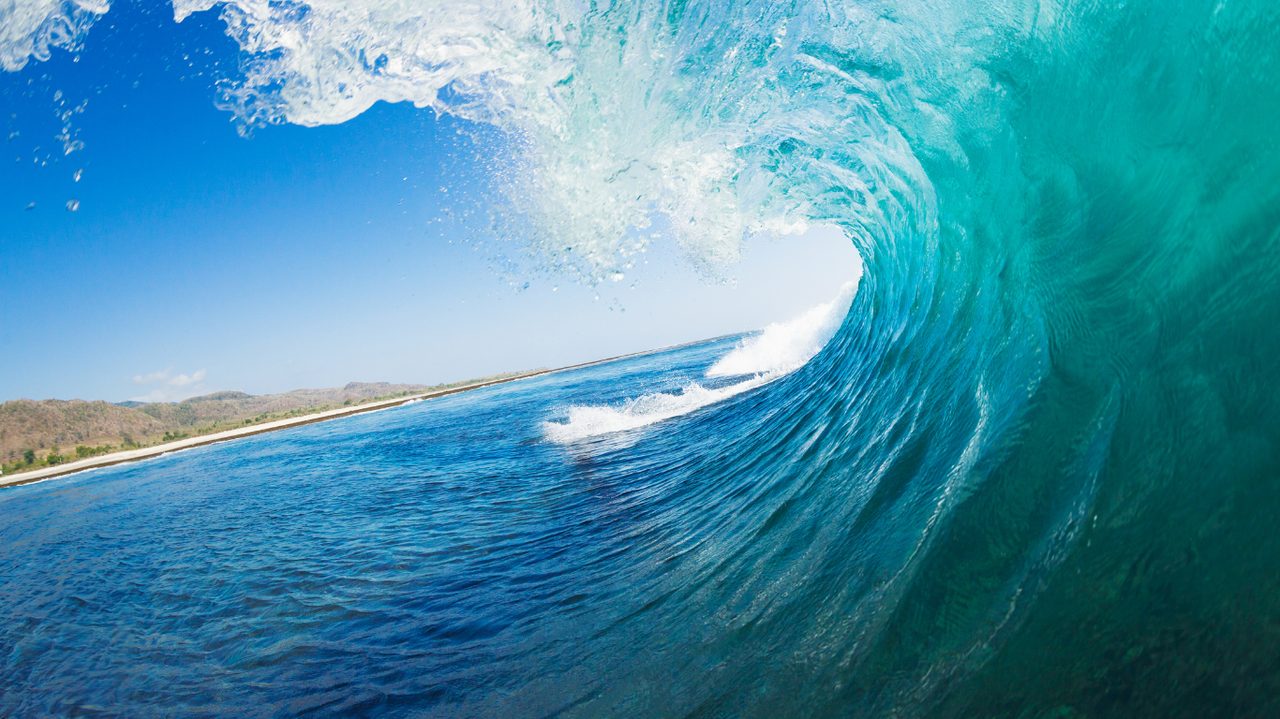
Most dive incidents happen not at depth, but at the surface: during entries and exits, in the surf, or on a tiring swim back to shore. Waves are almost always the lead actor. A dive that was calm and beautiful underwater can still end dangerously in a steep shore break where you must land on a slick rock ledge carrying a weight belt and tank.
Waves look random, but they follow clear rules. They are created by wind, their size depends on three factors, they sometimes travel thousands of kilometres as swell, and they change behaviour the moment they reach shallow water. That last part — waves "building up" and breaking over a reef or beach — is exactly what the diver deals with. And underwater, waves translate into surge: the back-and-forth rocking you feel on shallow reef dives.
Waves versus current. Waves (this topic) are the up-and-down, back-and-forth motion at and just below the surface, driven by wind. Current (a separate topic) is a net transport of water mass, driven by tide, wind and density differences. They are related (surf feeds rip currents), but they are different phenomena. Do not confuse them.
Key concepts
| Term | Short definition | Why it matters |
|---|---|---|
| Wave height | Vertical distance from trough to crest | Determines force and risk during entries/exits |
| Wavelength | Horizontal distance between two crests | Distinguishes short choppy sea from long swell |
| Wave period | Time between two crests (seconds) | Long period = powerful swell |
| Fetch | Distance over which the wind blows across water | More fetch = bigger waves |
| Wind waves (sea) | Fresh, short, choppy waves raised by local wind | Rough surface, poor surface visibility |
| Swell | Long, ordered waves from a distant storm | Powerful, breaks heavily in shallow water |
| Surf / shore break | Zone where waves break at the coast | Most dangerous zone for entries/exits |
| Breaking (shoaling) | Wave grows too steep in shallow water and topples | Determines where and how hard water lands on you |
| Surge | Back-and-forth water motion underwater from waves | Affects buoyancy, navigation, photography |
| Set | Group of larger waves with calmer lulls between | Timing of entries/exits |
| Rip current | Return flow of broken water through a channel | Can drag you out; a consequence of surf |
Understanding waves
How waves form
Almost all waves a diver sees are wind waves. Wind rubs across the water and transfers energy. How big the waves get depends on three things together: wind strength (harder wind, more energy, higher waves), fetch (the distance the wind blows uninterrupted across open water — an ocean storm has thousands of kilometres of fetch, a lake only a few), and duration (the longer the wind persists, the more the waves can build). While the wind blows and the sea is short and choppy, you have wind waves (in English forecasts, "sea"): a chaotic surface with waves of different directions and lengths. This gives poor surface visibility, seasickness on the boat and awkward entries.
Blow across a cup of tea: near your mouth small ripples form (little fetch). Blow across a long bath and the ripples grow larger at the far end (more fetch). The ocean does exactly the same, only on the scale of thousands of kilometres.
Swell: waves on a journey
When waves leave the storm zone they sort themselves out on the way. The longer, faster waves run ahead and the sea becomes ordered: long, smooth, parallel waves with a large period. This is swell. Swell can cross half an ocean and arrive at a coast that has been windless for days — "waves out of nowhere". The treacherous thing about swell is that it looks calm at the surface (smooth, slow) but carries a lot of energy. Those long, energy-rich waves build up high and break heavily as soon as they reach shallow water. A mirror-calm-looking morning can therefore still produce a dangerous shore break on the reef.
| Feature | Wind waves (sea) | Swell |
|---|---|---|
| Origin | Local wind, now | Distant storm, days ago |
| Shape | Short, steep, choppy, messy | Long, smooth, ordered |
| Period | Short (2-6 s) | Long (8-20 s) |
| Surface visibility | Poor, messy | Often good |
| Danger at the coast | Unpleasant, splashy | Heavy breaking, powerful |
Why waves break
In deep water the water in a wave mostly moves in circles; the wave travels, but the water stays more or less in place. As soon as the wave reaches shallow water (roughly when the depth becomes less than about half the wavelength), the sea bed slows the wave's base. The bottom slows, the crest keeps going, the wave steepens and grows, and eventually the crest topples forward: the wave breaks.
The bottom shape determines how a wave breaks. Over a steep reef or steep shore the wave breaks abruptly and powerfully (a plunging "dumper"): dangerous. Over a gently sloping sandy beach it breaks rolling and foaming (spilling): milder. For the diver this is crucial: the same swell is life-threatening over a steep edge and manageable over a shallow sandy beach.
Did you know? Waves "feel" the bottom before they visibly break. That is why wave directions bend (refract) towards shallows and wave energy concentrates on projecting points and reefs, while bays offer shelter. A dive site in a bay is almost always calmer than on a headland.
Surge: waves underwater
Underwater you feel waves as surge: a rhythmic back-and-forth motion of the water in the direction of the waves. The shallower you are and the more powerful the waves, the stronger the surge. At 3-6 m by a reef front, surge can push you a metre back and forth; at 25 m you often feel little of the same waves. Surge is tiring and awkward: it disturbs your buoyancy and trim, throws you towards coral or rock, makes it impossible to focus for photos, and worsens visibility by stirring up sand. The trick is not to fight but to move with it: stay low and streamline your body, hold on to dead substrate (never living coral) when the surge pushes against you, and swim with it when it helps.
Scenario. You make a shallow reef dive in Tofo (Mozambique) at about 6 m while a long swell is running. Every few seconds you are rocked back and forth. A student tries to swim against it, exhausts himself and burns through his air. The lesson: work with the rhythm of the surge (rest when it pushes against you, move when it helps) and stay low near the bottom where the motion is smaller.
Waves and rip currents
All that water the surf pushes onto the beach has to return to the sea somewhere. It collects and flows out through a channel in a narrow, powerful return flow: a rip current. Rip currents are therefore a direct consequence of waves. You recognise one by a strip of calmer, often murkier water running out through the surf, with fewer breaking waves. Never swim against a rip; swim out of it parallel to the shore. Currents as a whole are covered in a separate topic; here it is enough to know that waves cause them.
Deciding: go or no-go?
The most important skill here is a go/no-go judgement at the water's edge. Waves are rarely an absolute "no", but always a weighing of height, period, break point, your own level and your exit. The key questions, in order: Are the waves breaking heavily/dumping on the entry point? If yes, find a sheltered spot or call the dive. Can you see and time the set lulls (calmer periods)? If not, watch for 10 minutes; when in doubt, don't go. Will your exit point still be safe at the changed tide? If not, choose another exit or call the dive. Do your fitness, experience and equipment match these waves? If not, don't go. Only when all answers are favourable do you go, during a set lull, quickly and low.
Real-world examples
The Netherlands (North Sea coast, Oosterschelde mouth). The North Sea builds substantial wind waves in persistent north-westerly wind; shore diving is then discouraged. Inside the Oosterschelde the fetch is limited and waves are usually mild, but in a storm and unfavourable wind the entry by a dike can become slick and choppy.
Egypt (Red Sea). Mostly sheltered and wave-poor, but with offshore wind the shore entry at sites like the Blue Hole or house reefs can still get messy, with surge on the shallow reef plateaus. Boat diving largely avoids the surf.
Indonesia (Bali, south coast). Exposed to Indian Ocean swell. Southern sites see heavy swell; many a shore dive depends on the swell forecast. Shallow reefs get strong surge.
Maldives. Atolls break the ocean swell on the outside; inside the atolls it is calmer. The outer reefs can break dangerously in heavy swell while the inside stays diveable.
Mozambique (Tofo and Vilanculos). Tofo is famous for its surf launch: you take a RIB from the beach straight through the surf, which in big swell is a real art (and sometimes a no-go). Underwater, the Indian Ocean swell produces noticeable surge on the shallow parts of Manta Reef. Vilanculos lies more sheltered behind the Bazaruto islands and sandbanks, so the waves are usually far milder — ideal when Tofo is too rough. The contrast is a textbook example of how shelter (islands, bays) blocks wave energy.
Common mistakes
| Mistake | What goes wrong | How to avoid it |
|---|---|---|
| Underestimating swell because it looks smooth | Heavy break on the reef/coast | Judge period and break zone, not just smoothness |
| Not waiting for a set lull | Entry in the biggest waves | Observe for 5-10 min first; count the sets |
| Swimming against the surge | Exhaustion, air use up | Move with it, stay low, rest on the counter-phase |
| Holding living coral in surge | Reef damage and cuts/stings | Only grab dead substrate, or streamline |
| Not checking the exit point in advance | Getting stuck in worsened surf | Plan entry and exit, expect tide change |
| Removing mask/fins too early on exit | A wave knocks you over without sight/propulsion | Keep mask on and breathe from the reg until safely standing |
| Mistaking a rip for "calm water" | Being dragged out from shore | Recognise the smooth channel; use or avoid it deliberately |
Pro tips
- Observe first, plan then. Watch the surf for at least five to ten minutes before going: how high, what period, where it breaks, how big the sets and lulls are.
- Time your entry and exit on a set lull. Go during the calmer periods, quickly and low, mask on and reg in.
- Know your exit point in advance and expect a rougher sea and changed tide on return. Choose a second, more sheltered exit if needed.
- In surge, stay low near the bottom where the motion is smaller, and work with the rhythm rather than against it.
- Use a swell forecast (swell height and period, not just wind strength). Long period = more powerful than the height alone suggests.
- When in doubt, don't go. Waves are the easiest reason to call a dive and rarely a cause for regret.
Frequently asked questions
Which three factors determine the size of wind waves? Wind strength, fetch (the distance the wind blows), and duration.
What is the difference between wind waves and swell? Wind waves are fresh, short, choppy waves raised by local wind; swell is long, ordered waves with a large period from a distant storm. Swell looks calm but carries a lot of energy and breaks heavily in shallow water.
Why do waves break as they approach a reef or beach? In shallow water (depth less than about half the wavelength) the sea bed slows the wave's base while the crest keeps going. The wave steepens and grows until the crest topples and breaks.
What is surge and how do you deal with it underwater? The back-and-forth motion of water under the waves, stronger in shallow water. You do not fight it; you move with the rhythm, stay low near the bottom and grab dead substrate if needed.
How does a rip current form and how do you respond? Water pushed onto the beach by the surf returns through a channel in a narrow, powerful outflow. Never swim against it; swim out parallel to the shore (or use it deliberately to get past the surf).
Summary
Waves are created by wind and grow with more wind strength, more fetch and longer duration. Fresh, locally raised waves form a short, choppy sea; waves that leave a distant storm sort themselves into long, ordered swell with a large period. Swell looks calm but carries much energy and breaks heavily once it reaches shallow water, because the bottom slows its base so the crest topples. Steep reefs and coasts give dangerous dumping breakers; gentle sandy beaches give milder, rolling ones. Underwater, waves become surge, strongest in shallow water; you move with it and stay low rather than fighting. The water the surf pushes ashore returns as a rip current, a direct consequence of waves. The core skill is a go/no-go judgement: observe the surf, recognise the sets, plan both entry and exit with the tide in mind, and call the dive when in doubt.
The 10 things every diver should know by heart
- Waves grow with wind strength, fetch and duration.
- Wind waves are short and choppy; swell is long and energy-rich despite a smooth surface.
- Waves break because the bottom slows their base in shallow water.
- Steep reefs/coasts give dangerous dumpers; gentle beaches give milder breakers.
- Wave energy concentrates on points and reefs; bays give shelter.
- Surge is waves underwater, strongest shallow; move with it, stay low.
- Never fight surge; rest on the counter-phase, work with the rhythm.
- Rip currents are a consequence of surf; swim out parallel to shore, never against.
- Observe the surf and time entry/exit on a set lull.
- Plan both entry and exit with the tide, and call the dive when in doubt.