
The Environment
Currents & Drift Diving
The four drivers of ocean current, how to read current above and below water, up- and downcurrents, drift diving, DSMB use and the lost-in-current procedure.
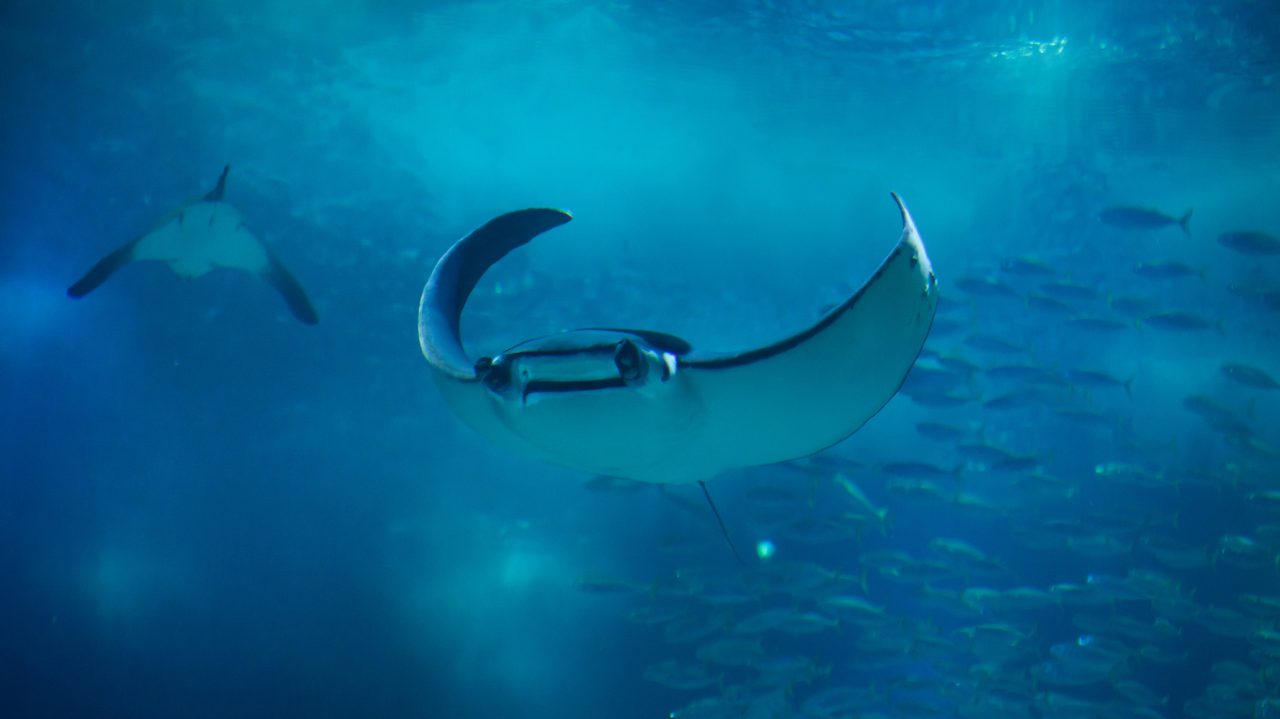
Many of the most beautiful dive sites in the world are beautiful because there is current. Current brings food, oxygen and plankton past the reef, and with it the schools of fish, the manta rays, the sharks and the whale sharks that divers travel far to see. The downside: current is also the environmental factor that most often catches divers out. It is not always visible underwater, it can reverse or accelerate with the tide in minutes, and it can carry you away from your boat, your buddy or the reef.
The difference between a relaxed drift dive and an exhausting struggle almost never lies in the current itself, but in whether the diver had assessed it and had a plan. You cannot swim against even one knot of current for long; you always lose that fight. The whole art is therefore not "swim harder" but understanding, using and, at the right moments, avoiding the current.
Current versus waves. Waves are an oscillation: water moves up-and-down and back-and-forth but transports little net. Current is net transport: water goes somewhere. Surge (waves underwater) changes direction every few seconds; current holds the same direction for minutes to hours. That distinction fully determines your approach.
Key concepts
| Term | Short definition | Why it matters |
|---|---|---|
| Knot | Speed unit, 1 nautical mile per hour (~1.85 km/h) | Standard measure for current speed |
| Tidal current | Current from the rising and falling tide | Predictable; reverses around high/low water |
| Slack water | Moment when the tidal current nearly stops | Safest time to enter on current sites |
| Wind-driven current | Surface current raised by persistent wind | Less predictable; adds to or opposes tide |
| Ocean current | Large, permanent flows (e.g. Agulhas) | Sets water temperature, life and drift over distance |
| Thermohaline current | Driven by temperature and salinity (density) | Deep circulation; thermoclines underwater |
| Rip current | Return flow of broken water through a channel | Pulls you offshore |
| Upcurrent / downcurrent | Current pushing you up / down | Downcurrent is one of the most dangerous situations |
| (D)SMB | (Delayed) Surface Marker Buoy | Marks your position for the boat in current |
| Negative entry | Going straight down without a surface pause | Prevents drifting off in strong current |
Understanding current
Where current comes from
Four main drivers, each with its own character. Tide: the rise and fall of the sea (driven by Moon and Sun) pushes enormous water masses back and forth, especially through constrictions: channels between islands, atoll passes, reefs and inlets. Tidal current is the most predictable: it reverses and briefly stops around high and low water (slack), and is strongest halfway between. This makes it plannable, and that is the core of safe current diving. Wind: persistent wind drags the surface layer along; wind-driven current is shallow and less predictable, and can reinforce or oppose the tidal current. Ocean circulation: large, semi-permanent flows such as the Agulhas Current along East Africa transport heat and life over thousands of kilometres, setting the water temperature, visibility and which animals pass by. Density (thermohaline): differences in temperature and salinity make water heavier or lighter, driving slow, deep circulation — noticeable to divers mainly as thermoclines, sharp boundaries where the water suddenly turns colder.
Tidal current through an atoll pass is like water squeezed through a garden hose: the same amount of water must pass through a narrower opening, so it accelerates. That is why the strongest current sits in the constrictions, not on the open reef beside them.
Reading current above and below water
You assess current before and during the dive. At the surface, before the dive: look at the anchor line or a buoy — does it pull taut with a "rooster tail" wake? Then there is current, and its direction shows in the way the water bends off. Watch drifting material: which way and how fast? Ask the guide or check a tide/current forecast and plan around slack. Underwater: look at the reef — do soft corals, fans and fish all bend the same way? That shows the current direction. Watch your own bubbles and drifting material. Feel it: if you must "lean" to hold your place, you are in current.
A simple rule of thumb for speed: if you barely make progress swimming flat out, there is roughly a knot or more, and a prolonged swim against it is a fight you will lose.
| Current speed (indicative) | Effect on the diver |
|---|---|
| < 0.5 knot | Barely noticeable, normal diving |
| 0.5 - 1 knot | Noticeable; swimming against it tires you quickly |
| 1 - 2 knots | Strong; drift diving only, not against it |
| > 2 knots | Very strong; only for experienced divers with a firm plan |
The most dangerous kinds: up- and downcurrents
Most horizontal current is manageable with a drift plan. The truly dangerous current is vertical. Downcurrent: at steep reef walls or atoll corners, water flowing along the reef can be pulled downward, and you with it. You notice you are sinking while doing nothing, or that you keep descending despite adding air. This is life-threatening: you can go deeper than planned faster than expected (narcosis, air use, decompression). React by swimming away from the wall into open water, where the down-flow is weaker; add air to your BCD if needed, and swim horizontally, not straight up against the current.
Upcurrent: water forced up along a wall can lift you unintentionally, risking a too-fast ascent (Boyle, Henry). React by releasing air from your BCD, swimming away from the wall, and actively controlling your ascent rate; grab dead substrate if necessary.
Scenario. On an atoll corner in the Maldives a diver notices they are inexplicably sinking at the reef point, from 20 to 28 m, despite adding air — a downcurrent. Instead of trapping upward (hopeless against the current), they swim horizontally away from the wall into the blue. Ten metres off the reef the down-flow vanishes and they recover buoyancy. The lesson: in a downcurrent, escape horizontally, do not fight vertically.
Drift diving in brief
On a drift dive you use the current: you let it carry you along the reef while the boat follows or picks you up at the end. It is relaxing and efficient, provided it is organised. The whole group does a negative entry, going straight down together so nobody drifts off at the surface before the dive starts. You drift as a team, with the guide downstream or in front. At the end you shoot a (D)SMB so the boat finds you in the current. And you do not try to go against the current: you go with it, and do not turn back halfway. The full technique, including deploying a DSMB and group management, is a topic of its own; remember here the principle: on a drift you work with the current.
Equipment and procedures for current
Current calls for extra gear and agreements: a DSMB and spool to make yourself visible to the boat when you surface downstream; a whistle and/or surface signal (mirror, light, electronic device), because a head among the waves is nearly invisible from a boat; a reef hook on strong sites (a hook with a line to anchor yourself to dead substrate and watch the fish schools without effort, popular in the Maldives and Indonesia — only on dead substrate, never living coral); and clear buddy/group agreements about who leads, the turn or end signal, and where the boat picks up.
Lost in current, procedure: if you lose your buddy, search about one minute, then ascend (agreed beforehand). Ascend in a controlled way with a safety stop if possible. Shoot your DSMB at or after the stop to become visible. At the surface, inflate your BCD, do not drop your weights unless in an emergency, and signal the boat (whistle, high buoy, mirror/light). Keep floating and conserve energy; do NOT swim against the current towards the boat.
Did you know? From a boat, a drifting diver with no buoy is practically invisible at a hundred metres in waves. A deployed DSMB stands a metre or more above the water and is visible. That is why a DSMB on current sites is not a luxury but standard equipment.
Real-world examples
The Netherlands (Oosterschelde). A classic tidal-current area. Divers plan rigorously around slack ("stroomstilte"), because during the tide a current runs through the inlets and along the dikes that you cannot swim against. The tide table is your most important dive instrument here.
Egypt (Red Sea). Mostly calm, but on northern reef points (Ras Mohammed, the Brothers) strong currents run that bring the sharks and schools. Drift diving along the wall with a DSMB is standard.
Indonesia (Nusa Penida, Komodo, Raja Ampat). Notorious for powerful, sometimes vertical currents. Nusa Penida (mola mola) and Komodo have downcurrents; reef hooks and experienced guides are the norm. Only for divers who master drift.
Maldives. Channel and atoll passes ("thilas" and "kandus") live on the tidal current that attracts the manta rays and sharks. Reef hook, DSMB and negative entry are standard.
Mozambique (Tofo and Vilanculos). Along Tofo runs the influence of the warm Agulhas Current, which brings the plankton-rich water and with it the manta rays and whale sharks; on the offshore reefs the current can be strong, with a negative entry from the RIB and a DSMB at the end. At Vilanculos and the Bazaruto Archipelago the tidal current dominates around the sandbanks and channels, changing strongly with ebb and flow; planning around slack matters there. Both illustrate two different drivers: at Tofo mainly ocean circulation, at Vilanculos mainly tide.
Common mistakes
| Mistake | What goes wrong | How to avoid it |
|---|---|---|
| Trying to swim against the current | Exhaustion, air use up, loss | Go with it (drift) or turn in time; plan around slack |
| Not planning around slack | Entry in the strongest current | Use a tide/current forecast; dive at slack |
| No DSMB | Unfindable for the boat after a drift | DSMB + spool standard on current sites |
| Fighting a downcurrent vertically | Hopeless, further exhaustion/descent | Swim horizontally away from the wall |
| Swimming to the boat in a surface drift | Exhaustion against the current | Float, signal, let the boat come |
| Reef hook in living coral | Reef damage | Only dead substrate |
| Losing buddy/group in a drift | Lost diver | Negative entry, tight group, clear signals |
Pro tips
- Plan current sites around slack. That is the calmest, safest moment; the strongest current sits halfway between high and low water.
- Never swim against the current for long. You lose that fight; go with it, turn in time, or hold onto dead substrate.
- Read the reef: the way corals, fans and fish bend shows the current direction.
- Always carry a DSMB and whistle on current sites; your surface visibility is a safety matter, not an extra.
- In a downcurrent: horizontal, away from the wall, never vertical against it.
- On a fixed site, start into the current so you return with it, air in hand — "out against, back with".
Frequently asked questions
What are the four main drivers of current? Tide, wind, ocean circulation and density differences (thermohaline).
Why plan a current dive around slack water? Around high and low water the tidal current nearly stops; that is the safest, calmest moment to enter. The current is strongest halfway between high and low water.
How do you respond to a downcurrent? Do not fight it vertically; swim horizontally away from the wall into open water where the down-flow is weaker, and actively control your buoyancy.
Why is a DSMB essential on a drift dive? After a drift you often surface far from the boat; a deployed DSMB makes you visible so the boat can find you in the current.
How do you plan a dive on a fixed site with noticeable current? Start the dive into the current so that at the end, with less air, you return with the current — "out against, back with". Keep a generous turn point and plan around slack if possible.
Summary
Current is the net movement of water mass, driven by four forces: tide, wind, ocean circulation and density differences. Tidal current is the most predictable; it briefly stops around slack and is strongest halfway between high and low water, which makes planning around slack the core of safe current diving. You assess current at the surface (anchor line, drifting material, forecast) and underwater (the way corals and fish bend, your bubbles, the feeling of "leaning"). You cannot swim against a knot or more, so you go with it, turn in time, or hold on — but you do not fight it. The most dangerous form is vertical: in a downcurrent you swim horizontally away from the wall, not vertically against it. On current sites a DSMB with spool, a whistle and sometimes a reef hook are standard equipment, together with a negative entry, tight group agreements and a known lost-diver procedure. Drift diving uses the current deliberately and is a topic of its own.
The 10 things every diver should know by heart
- Current has four drivers: Tide, Wind, Ocean, Density.
- Tidal current is predictable; plan around slack, the strongest flow sits in between.
- You cannot swim against a knot or more; go with it, turn, or hold on, do not fight.
- Read the current direction from bending corals, fans and fish.
- On a fixed site: out against the current, back with it (return with air in hand).
- Downcurrent: horizontal, away from the wall, never vertical against it.
- Upcurrent: release air, control your ascent rate, away from the wall.
- DSMB + spool and a whistle are standard on current sites.
- Use a negative entry and tight group agreements in strong current.
- Know the lost-in-current procedure: ascend, DSMB, signal, float, let the boat come.