
The Environment
Tides
What causes the tide, spring versus neap, the daily cycle, slack water, the rule of twelfths, and how to read a tide table to plan safe dives.
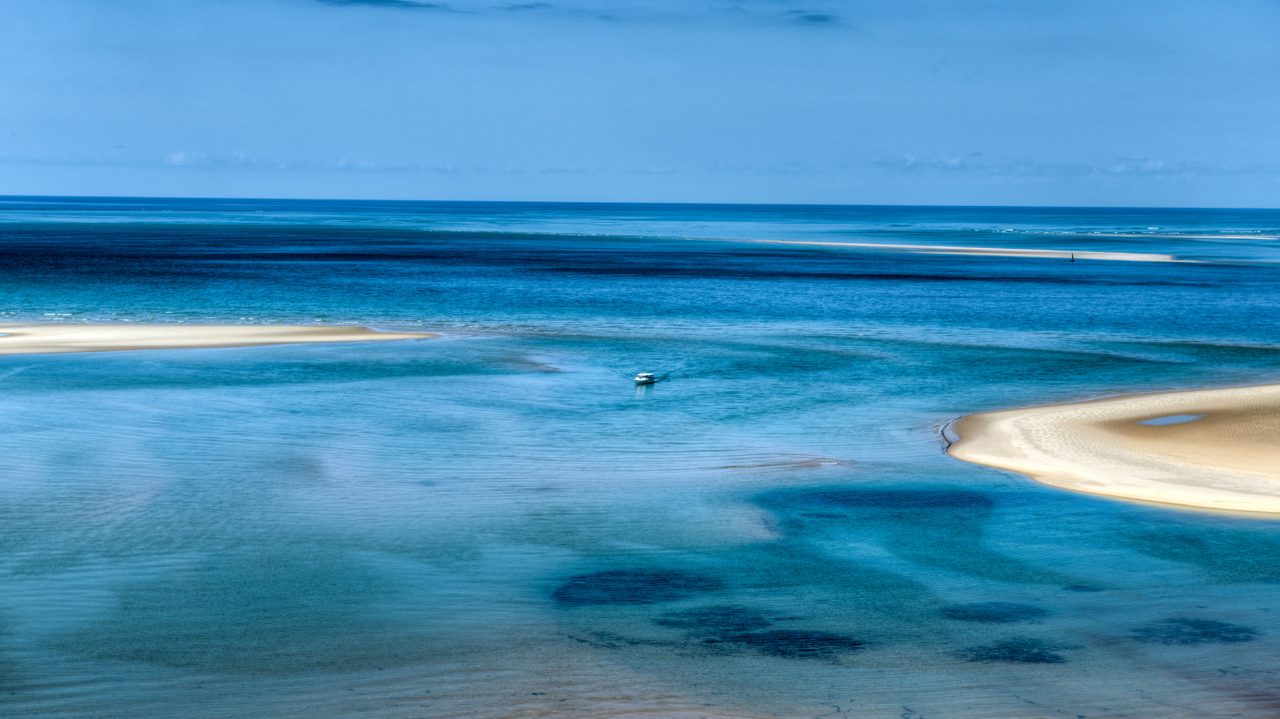
The tide is the heartbeat of the sea: a slow, predictable breathing of rising and falling water, driven by the Moon and the Sun. Whoever understands the tide plans their dive at the right moment and in the right place. This topic explains the cause behind the tidal current, and gives you the skill to read tide tables and use them to plan.
For the diver, the tide matters for three reasons. First, it drives the current: around slack the tidal current stops, and in between it is strongest. Second, it sets water depth and access: at low water an entry can dry out, a reef become too shallow, or a boat passage become impossible. Third, it affects visibility: incoming water from the open sea is often clearer than outgoing water that carries coastal sediment. The beauty of the tide is that it is almost entirely predictable — unlike wind or waves, it is listed to the minute in tables, years ahead. That makes it one of the few environmental factors you fully control, provided you can read the table.
Tide is cause, current is effect. The tide is the vertical motion: the water rises and falls. The tidal current is the horizontal motion that results: the water that must flow to and fro to achieve that level change. High and low water therefore coincide with slack; the strongest flow sits between them.
Key concepts
| Term | Short definition | Why it matters |
|---|---|---|
| High water (HW) | Highest level in the cycle | Often best visibility; marks a slack point |
| Low water (LW) | Lowest level | Access/depth may be limited; another slack point |
| Flood | Phase when water rises (LW to HW) | Inflow, often clearer water |
| Ebb | Phase when water falls (HW to LW) | Outflow, often murkier |
| Tidal range | Height difference between HW and LW | Larger range = stronger current |
| Spring tide | Large range at new/full moon | Strongest currents |
| Neap tide | Small range at half moon | Weakest currents |
| Slack water | Moment the tidal current nearly stops | Safest time to dive on current sites |
| Tide table | Times and heights of HW/LW per location | Your key planning instrument |
| Tidal cycle | About 12 h 25 min between two high waters | Explains the daily ~50-min shift |
Understanding the tide
Why there is a tide: the Moon pulls
The tide arises mainly from the Moon's gravity. The Moon pulls on all the water on Earth, but strongest on the water nearest to it. That water is "bulged" towards the Moon: on the side of the Earth facing the Moon a water bulge forms, and therefore high water. The surprising part is that a second bulge forms at the same time on the other side of the Earth. This happens because the Earth as a whole is pulled towards the Moon slightly more than the water on the far side; that far water "lags behind" and forms the second bulge. So at any moment there are two high waters (the two bulges) and two low waters (in between, at right angles).
As the Earth rotates on its axis in about 24 hours, you rotate through both bulges: twice high water and twice low water per day. Because the Moon has meanwhile moved a little in its orbit, it takes not exactly 24 hours but about 24 hours and 50 minutes to return to the same point in the cycle. That is why the tide shifts about 50 minutes later each day: today's 8:00 high water is around 8:50 tomorrow.
Think of water in a spinning bucket with a magnet on one side pulling the water towards it. Spin the bucket, and you pass the "bulged" side repeatedly. The Earth rotates through the bulges raised by the Moon, and you experience that as ebb and flow.
Spring and neap tides: the Sun joins in
The Sun also exerts a tidal force, about half that of the Moon (the Sun is vastly heavier, but also much further away). The alignment of Sun and Moon determines whether their forces add or oppose. At new moon and full moon, Sun, Earth and Moon line up. The tidal forces add: extra-high high water, extra-low low water, a large range and the strongest currents — this is spring tide, occurring about twice a month. At the half moon (first and last quarter), Sun and Moon are at right angles as seen from Earth. Their forces partly oppose: a small range, weak currents — neap tide, also about twice a month.
Did you know? "Spring tide" has nothing to do with the season. It comes from the water "springing" up. And "neap tide" refers to the "dead", barely moving water. For the diver: on current sites, neap tide can give a calmer, more accessible dive, while spring tide brings the most life (but also the most risk).
The tidal cycle over the day
Most coastal areas have a semi-diurnal tide: two high waters and two low waters per day, with about 6 hours 12 minutes between each high and low. Some parts of the world have a diurnal tide (one high, one low per day) or a mixed tide (two unequal high waters). Where you dive determines the pattern; the tide table of that location tells you.
Reading tide tables
A tide table gives the times and heights of each high and low water for a specific location (a "tidal station"). Use it like this: choose the right location (tide varies strongly by place); read the HW and LW times and heights for your dive day; determine the slack points (roughly around HW and LW — your ideal entry time on current sites); check the tidal range (larger range means stronger current); and consider access and depth (low water can dry out an entry or passage).
The rule of twelfths. The tide does not rise/fall evenly. Roughly, over six hours the water moves: 1/12 in the first hour, 2/12 in the second, 3/12 in the third, 3/12 in the fourth, 2/12 in the fifth, 1/12 in the sixth. The current is therefore strongest in the third and fourth hours (midway between HW and LW) and weakest near HW and LW (slack). This explains why slack is the calmest.
Tide and the dive: links to current, visibility and access
The tide touches almost every aspect of the dive. Current: plan current sites around slack; expect the strongest flow halfway, and strongest at spring tide. Visibility: incoming (flood) water from the open sea is often clearer; outgoing (ebb) water carries coastal sediment and is often murkier — on many sites "dive on incoming water" is a good rule for visibility. Waves: the tide changes the water depth over a reef or sandbank, and therefore where and how waves break. An entry that is calm at high water can be in the surf at low water. Access and safety: low water can dry out an entry, make an exit impossible, or block a boat passage over a reef. Always plan both entry and exit for a workable water level.
Scenario. A diver plans a shore dive in Zeeland and only checks the weather, not the tide. On arrival it is low water: the entry is dry and the current in the inlet runs hard because they are mid-ebb. Had they read the tide table and dived around high-water slack, the entry would have been submerged and the current minimal. Ignoring the tide is the classic planner's mistake in tidal areas.
Real-world examples
The Netherlands (Oosterschelde, Wadden Sea). Large tidal range and strong tidal currents. The tide table is the dive instrument here: divers plan tightly around slack and account for entries drying out at low water. Spring tide gives currents in the inlets you cannot swim against.
Egypt (Red Sea). Small tidal range (often tens of centimetres). The tide plays a limited role for depth and access, but on northern reef points even a small tide can give noticeable current around slack.
Indonesia (Nusa Penida, Komodo). Large tidal range and powerful, tide-driven currents through the many passages. Spring versus neap makes a big difference to diveability; experienced guides plan on slack.
Maldives. The tide drives the current through the atoll channels (kandus) that attract mantas and sharks. Whether you dive "inflow" or "outflow" (flood or ebb) often decides which site is best and where the life gathers.
Mozambique (Tofo and Vilanculos). At Tofo the tidal range is considerable (several metres), affecting beach access for the surf launch and the current on the reefs; launch timing depends partly on the tide. At Vilanculos and the Bazaruto Archipelago the tide dominates: around the vast sandbanks and channels, ebb and flow strongly set depth, current and access, so almost every dive and boat trip is planned on the tide table.
Common mistakes
| Mistake | What goes wrong | How to avoid it |
|---|---|---|
| Ignoring the tide entirely | Dry entry, hard current, blocked exit | Always read the tide table for the right location |
| Using the wrong location's table | Wrong times/heights | Choose the nearest relevant tidal station |
| Only noting HW/LW, not the range | Underestimating current at spring tide | Check the tidal range and moon phase |
| Assuming the tide rises evenly | Misjudging slack and current strength | Use the rule of twelfths; slack around HW/LW |
| Planning only the entry, not the exit | Getting stuck at a changed tide | Plan entry and exit for a workable level |
| Expecting ebb murk to be clear | Disappointing visibility | Dive on incoming water where possible |
Pro tips
- Always read the tide table for the right location and note HW, LW and the slack points for your dive day.
- Plan current sites around slack, close to HW or LW; avoid the third and fourth tidal hours if you don't want a drift.
- Check the moon phase: full or new moon means spring tide and strong current; half moon means neap tide and calm.
- Dive on incoming water where possible for better visibility (clear seawater comes in).
- Plan both entry and exit for a workable level; the tide changes during the dive.
- Use the rule of twelfths to quickly estimate when the current peaks and when it is calm.
Frequently asked questions
Why are there usually two high waters per day? The Moon pulls the water on the nearest side into a bulge (HW), and a second bulge forms on the far side because the Earth itself is pulled towards the Moon more than that far water. The Earth rotates through both bulges in ~24 h 50 min, giving two HW and two LW.
What is the difference between spring and neap tides, and when do they occur? Spring tide (at full and new moon) gives a large range and strong current, because Sun and Moon align and their forces add. Neap tide (at half moon) gives a small range and weak current, because they are at right angles and partly oppose.
Why does the tide shift about 50 minutes later each day? The Moon moves a little in its orbit during one Earth rotation, so the Earth must turn ~50 minutes longer to reach the same point in the cycle (~24 h 50 min per cycle).
When is the tidal current weakest, and what is that moment called? Around high and low water; that moment is called slack. The current is strongest halfway between (the third and fourth tidal hours).
Why is incoming water often clearer than outgoing water? Flood brings clear water from the open sea, while ebb carries coastal sediment out and makes the water murkier.
Summary
The tide arises mainly from the Moon's gravity, which bulges the water on the nearest side of the Earth into a high-water bulge, while a second bulge forms on the far side. The Earth rotates through both bulges in about 24 hours and 50 minutes, giving most areas two high and two low waters per day and explaining the daily ~50-minute shift. The Sun reinforces or weakens the lunar tide: at full and new moon the forces add into spring tide (large range, strong current); at half moon they partly oppose into neap tide (small range, weak current). The water does not rise and fall evenly (rule of twelfths), so the current is strongest halfway and weakest around slack. For the diver, the tide sets the current, the visibility (incoming water is often clearer), the waves over shallow areas and the access at entries and exits. Because it is almost fully predictable in tables, it is one of the few environmental factors you fully control by reading well: plan around slack, check the moon phase, and plan both entry and exit for a workable water level.
The 10 things every diver should know by heart
- The Moon is the main cause of the tide; the Sun reinforces or weakens it.
- There are two tidal bulges, so usually two high and two low waters per day.
- The tide shifts ~50 minutes later each day (cycle ~24 h 50 min).
- Spring tide at full/new moon (large range, strong current); neap tide at half moon (small range, weak current).
- The water moves fastest halfway (rule of twelfths), slowest around HW/LW.
- Slack around HW and LW is the safest entry time on current sites.
- Always read the tide table for the right location; note HW, LW and slack.
- Incoming water (flood) often gives better visibility than outgoing (ebb).
- Tide changes depth, access and waves; plan both entry and exit.
- Tide is predictable: it is the environmental factor you fully control with good planning.