
Orientation & Team
Underwater Communication
Hand signals, the OK principle, emergency signals, light signals at night, attention sounds and surface signals — how divers communicate clearly and confirm every message.
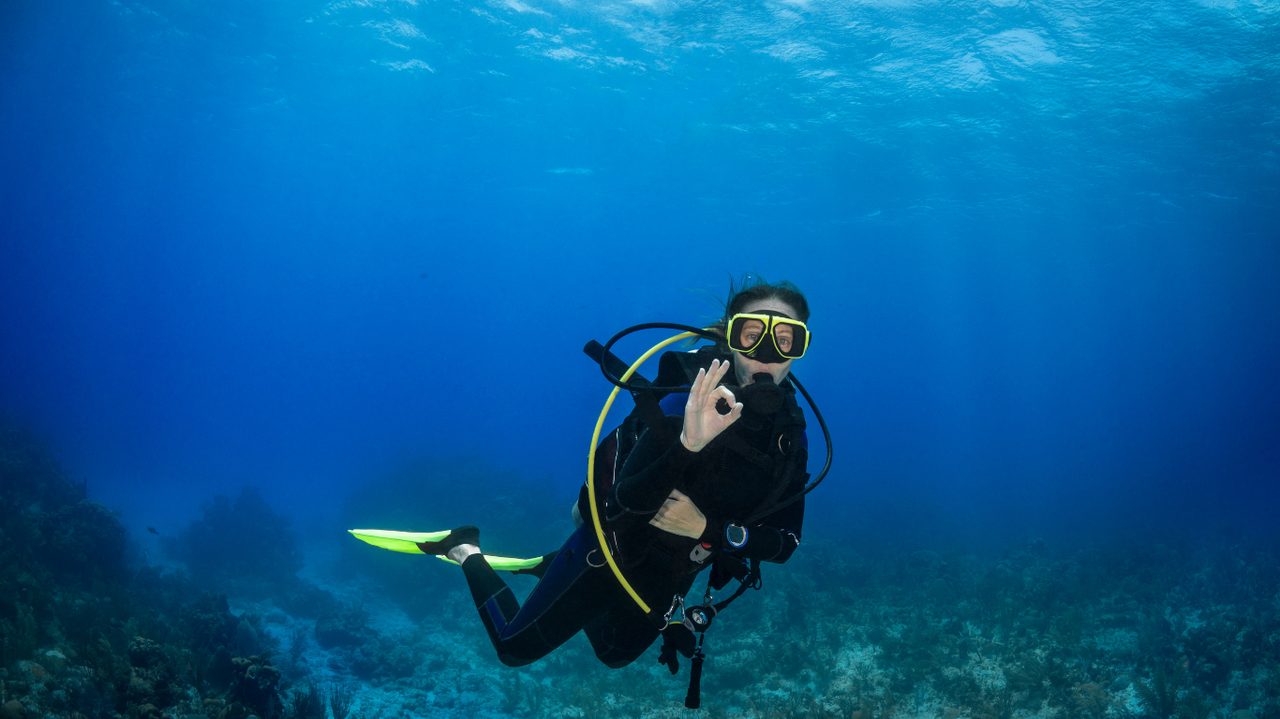
You cannot talk underwater. Your mouth is around a regulator, sound carries direction poorly, and you have no facial expression behind your mask. Yet communication between buddies is essential: for safety, for sharing what you see, and for making decisions together. The solution is a set of agreed signals, supplemented by light, sound and, at the surface, gestures visible from afar.
The most important principle is not "know many signals", but master a small number crystal-clearly and agree them beforehand. Most communication errors underwater come not from someone not knowing an exotic signal, but from two divers using the same basic signal slightly differently, or from a signal not being confirmed. Communication is two-way by definition: a signal that is not confirmed has not arrived.
The OK principle: question and answer. The "OK" signal (thumb and index finger forming a ring) means both the question "are you OK?" and the answer "yes, I'm OK". If you get no OK back, something is wrong. "No answer" is itself a signal. This is the core of all underwater communication: signal and confirm.
Key concepts
| Term | Short definition | Why it matters |
|---|---|---|
| Hand signal | Agreed hand gesture with a fixed meaning | The basis of underwater communication |
| OK signal | Thumb-finger ring: question and answer | Most-used signal; requires confirmation |
| "Something's not OK" | Flat hand, wobbling (so-so) | Reports a problem needing attention |
| Emergency signal | Signal for an acute problem (e.g. out of air) | Demands an immediate response |
| Confirmation | Echoing a signal back | Proves the message arrived |
| Light signal | Communication with a dive light in the dark | Replaces hand signals on night dives |
| Attention signal | Tank tap, tank banger, or voice sound | Draws your buddy's gaze |
| Surface signal | Gesture visible from the boat (OK arm, help) | Communication with the crew at the surface |
| Briefing | Agreements before the dive | Ensures everyone uses the same signals |
Understanding communication
The standard hand signals
The following set is broadly shared internationally. Learn it until it is automatic.
| Signal | Gesture | Meaning |
|---|---|---|
| OK | Thumb and index finger in a ring | "Are you OK?" / "I'm OK" |
| OK (far away) | Both arms overhead in a big O, or one hand on head | OK at distance / at the surface |
| Something's not OK | Flat hand, wobbling (so-so) | "There's something, pay attention" |
| Up / ascend | Thumb up | "We're going up / ascend" |
| Down / descend | Thumb down | "We're going down / descend" |
| Stop | Flat hand, palm forward (or fist) | "Stop, stay here" |
| Level off | Flat hand horizontal, sweeping | "Stay at this depth" |
| Low on air | Fist against the chest | "I'm on my reserve pressure" |
| Out of air | Flat hand slicing across the throat | Emergency: "I have no air" |
| Share air / octopus | Hand to the mouthpiece, then to the buddy | "Give me your alternate air" |
| Buddy / stay together | Two index fingers side by side | "We two, together" |
| Look / there | Point (to the eyes, then to the object) | "Look there" |
Did you know? The "out of air" signal (slicing hand across the throat) means literally "I have no air left" underwater, while the exact same gesture on land often means "stop/enough/done". This kind of double meaning is precisely why you drill the diving meaning separately and don't rely on your land instinct.
Communicating numbers and pressure
You must also be able to pass on numbers, such as your remaining tank pressure. There are various conventions, so agree in the briefing which you use. Because there is no single worldwide system, the agreement beforehand matters more than the system itself. Simpler and safer on many dives: give a clear sign at an agreed threshold (e.g. 100 and 50 bar) rather than "spelling" precise numbers.
Emergency signals: small and crystal clear
In an emergency, simplicity counts. The two most important: low on air (fist against the chest) — you are nearing your reserve; a warning, not panic, and the team begins the ascent/return. Out of air (slicing hand across the throat), often followed by the share-air signal (hand to mouthpiece, then to buddy) — you need air acutely, and the buddy responds immediately by offering their octopus. These signals must be so ingrained that they are given and recognised without thinking.
Scenario. At 18 m a diver taps their buddy and gives the "out of air" signal, then the share-air signal. Because both had practised this beforehand, the buddy offers the octopus within two seconds, they hold each other and ascend calmly together. No panic, no surprise. The whole situation was manageable because the signal was recognised and answered immediately.
Communicating in the dark: light signals
On a night dive your buddies cannot see your hands, but they can see your light beam. Light signals are then the language. Circling the beam on the bottom or a wall = "OK / all good". Sweeping the beam side to side (large) = "attention / something's up / come here". Never shine into someone's eyes/mask: it blinds them and destroys their dark-adapted vision. Shine on your own hand if you want to show a hand signal, not into your buddy's face. Combine light signals (for rough contact) with lit hand signals (for details).
Sound: drawing attention
Hand signals only work if your buddy is looking. To draw their gaze you use sound, which carries well underwater: tapping on the tank with a hard object or a "tank banger"; voice sound through the regulator (calling/humming) for close range; a rattle or shaker on a hose. Sound only says "look at me"; the message itself you then give with a hand signal. Agree which sound you use so a tap isn't taken for something else.
Communicating at distance and to the surface
The DSMB is itself a message to the boat ("here we are, coming up"). An agreed colour can carry extra meaning (on some technical dives a second, different colour means "problem, send help"). Line signals (in cave, low-visibility or technical diving) use agreed tugs: one tug = "OK?", answered with one tug = "OK" — specialised and requiring training. At the surface, hand signals look different because the boat watches from afar. OK at the surface: both arms overhead in a big O, or one arm with the hand on the head — "I'm OK". Help needed: one arm waved high repeatedly — the international "come help me" signal, which you never use if you are OK. A whistle, high buoy, mirror or light draws the boat's attention over distance.
Recreational versus technical communication. Recreational communication is relatively informal: a core set of signals, agreed in the briefing. Technical training (such as GUE) uses a tighter, standardised, more active system, with continuous "OK" exchange in the team, explicit light protocols and fixed gas-sharing procedures. The underlying idea is the same: signal and confirm, leave nothing to chance. The deeper and more formal the dive, the tighter the communication.
Real-world examples
The Netherlands (poor visibility). In murky water you can barely see hand signals; buddies stay close, use touch contact, and sometimes line or light signals even by day. Communication here is about proximity and simplicity.
Egypt (clear water, guided dives). Excellent visibility makes hand signals over a few metres easy. Guides use an extensive set to point out animals (specific gestures for shark, turtle, moray). Agree these in the briefing, as they vary by guide and centre.
Indonesia (muck diving, macro). Photographers and guides point out tiny creatures to each other; precise "look there" signals and pointers are common. Patience and clear pointing are key.
Maldives (drift, groups). In current and larger groups, clear, large signals and a tight group formation are essential; the guide uses attention signals (tank banger) to show the whole group something, such as an approaching manta.
Mozambique (Tofo and Vilanculos). At Tofo guides point out the big animals (mantas, whale sharks) with prominent, far-visible gestures, because the group can spread out in the current and swell; a tank banger draws everyone's gaze to a passing whale shark. At Vilanculos, with sometimes changing visibility around the sandbanks, simplicity and proximity win over subtlety: core signals and staying close together. In both cases, the animal and emergency signal set is reviewed beforehand in the briefing.
Common mistakes
| Mistake | What goes wrong | How to avoid it |
|---|---|---|
| Signalling without waiting for confirmation | You don't know if it arrived | Always wait for the echo; no answer = problem |
| Meaning thumb-up as "good" | Buddy starts to ascend | Use the OK ring for "good"; thumb = ascend |
| Not agreeing signals beforehand | Confusion over animal/number signals | Review the set in the briefing |
| Shining a light in the buddy's face | Blinding, loss of night vision | Shine on your hand or the bottom, never the mask |
| Accidental "help" signal at the surface | Unnecessary rescue, or missed | Know OK arm vs. waving; use deliberately |
| Only hand signals, no attention signal | Buddy isn't looking and misses it | Draw the gaze with sound first, then signal |
| Too many or too complex signals | Nobody remembers them, errors | Keep the set small and crystal clear |
Pro tips
- Always wait for confirmation. A signal without an echo has not arrived; no answer is itself information.
- Keep your signal set small and rock-solid; master the core perfectly rather than many signals half.
- Review the signals in the briefing, especially animal, number and emergency signals, as they vary by centre and guide.
- Draw the gaze with sound first (tap/tank banger), then give the hand signal.
- Never shine your light in the face; light your own hand or the bottom to communicate.
- Know the difference at the surface: OK arm overhead means OK, repeated waving means help; never confuse them.
Frequently asked questions
What does the OK signal mean, and why is confirmation important? The OK signal (thumb-finger ring) is both the question "are you OK?" and the answer "yes". Confirmation is essential because a signal without an echo has not arrived; no answer indicates a possible problem.
What is the difference between "thumb up" underwater and on land? On land, thumb up means "good". Underwater it is a command: "we ascend / go up". For "good", use the OK ring underwater.
Which two emergency signals must every diver recognise instantly? "Low on air" (fist against the chest): reserve reached, begin the return. "Out of air" (slicing hand across the throat), often followed by the share-air signal: air needed acutely, buddy offers the octopus immediately.
How do you communicate "OK" and "attention" with a light at night? OK by circling the beam on the bottom/wall; attention by sweeping the beam large side to side. Never shine into the buddy's face.
What are the two main surface signals to the boat, and how do you tell them apart? "OK" (both arms overhead in an O, or hand on head) means I'm OK; "help needed" (one arm waved high) means come help me. You never use the help signal if you are OK.
Summary
Underwater, agreed signals replace the spoken word. The key is not knowing many signals but mastering a small set crystal-clearly, agreeing them beforehand and confirming each one: communication is two-way, and no answer is itself a signal. The OK ring is both question and answer; note that thumb up underwater means "ascend", not approval, and that the slicing hand across the throat means "out of air". Numbers and pressure are given with an agreed system or threshold signs. The key emergency signals (low on air, out of air and the share-air signal) must be so ingrained they are given and recognised without thought. In the dark you communicate with light signals (circle is OK, sweep is attention) without ever shining in the face, and you draw the buddy's gaze with sound (tap or tank banger) before a hand signal. At distance and to the surface you use the DSMB, line signals and surface gestures, never confusing the OK arm with the help wave. Recreational communication is more informal than the tight, standardised system of technical training, but the guiding rule is the same everywhere: signal, confirm, and leave nothing to chance.
The 10 things every diver should know by heart
- Communication is two-way: signal and wait for confirmation; no answer is a signal.
- OK is a ring (thumb-finger); it is both question and answer.
- Thumb up means ascend, not "good"; thumb down means descend.
- Out of air = slicing hand across the throat, followed by the share-air signal; recognise it instantly.
- Low on air = fist against the chest; begin the return then.
- Draw the gaze with sound first (tap/tank banger), then give the hand signal.
- Light: circle = OK, sweep = attention; never shine in anyone's face.
- At the surface: OK arm overhead, help = repeated waving; never confuse them.
- Always agree the signals (animals, numbers, emergency) in the briefing.
- Keep the set small and crystal clear; mastery beats completeness.