
Equipment
Scuba Equipment
How every piece of scuba gear works and how to choose it — mask, fins, exposure protection, BCD types, tanks, the regulator explained, computer and the accessories that are safety, not luxury.
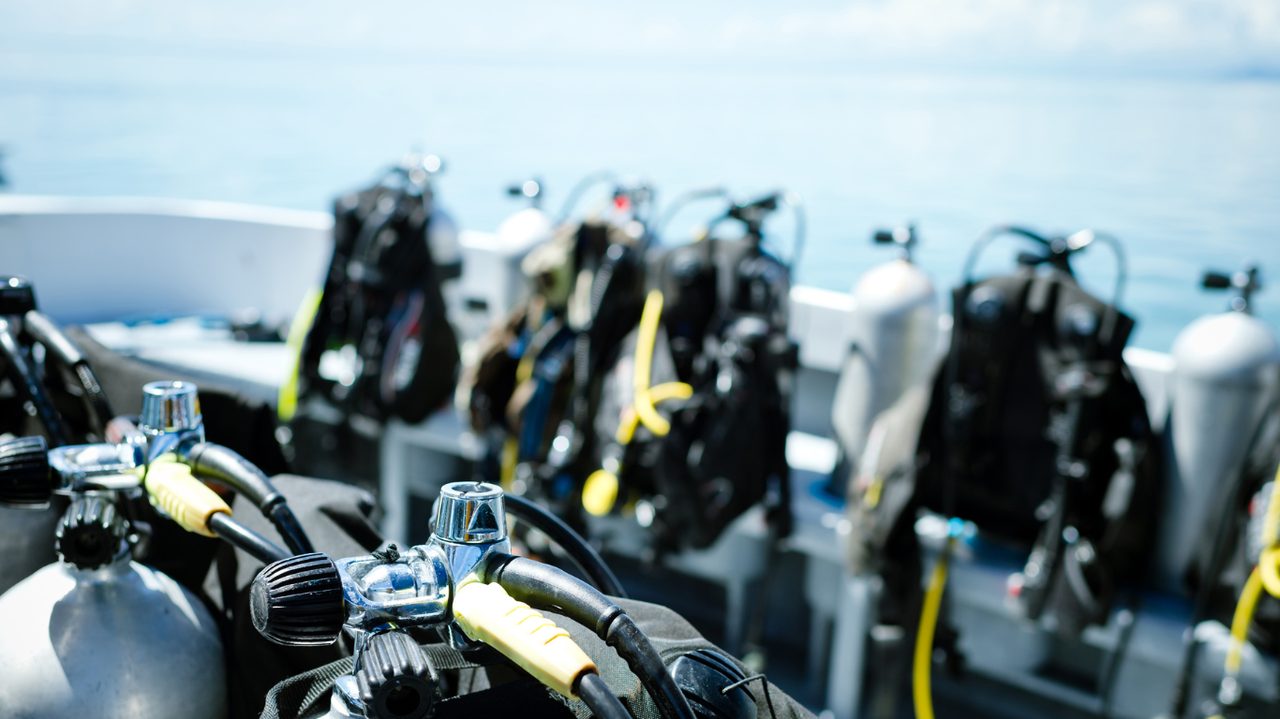
Your equipment is your life support in an environment where you cannot breathe. Each part has a function, a working principle and a reason it is the way it is. Whoever understands their gear chooses better, dives more safely and spots problems earlier. This topic explains not only what each item is, but above all how and why it works.
The goal is that you understand your equipment rather than merely operate it. That makes you a better buyer (you know what you pay for and what you need), a safer diver (you recognise when something isn't working right), and a more competent divemaster (you can explain and advise). Equipment you understand, you rightly trust; equipment you only operate, surprises you.
Buy, rent or borrow? Beginners often rent, which is fine for learning. But the items that touch your body (mask, wetsuit) and set your safety (computer, and in time regulator and BCD) are the first worth owning: a well-fitting mask and a trusted computer directly improve your comfort and safety. Always test borrowed or new gear beforehand (buddy check).
Key concepts
| Part | Function | Key choice |
|---|---|---|
| Mask | Air layer so you can see sharply | Fit, volume, lens |
| Snorkel | Breathe at the surface without using tank air | Yes/no, foldable |
| Fins | Turn leg power into propulsion | Blade vs split, open vs full heel |
| Exposure protection | Insulation against heat loss | Wetsuit, drysuit, thickness |
| BCD | Control buoyancy | Jacket, wing, backplate |
| Tank | Store breathing gas under pressure | Steel vs aluminium, volume, pressure |
| Regulator (1st + 2nd stage) | Reduce tank pressure to ambient | Piston vs diaphragm, balanced |
| SPG / console | Show tank pressure (and more) | Analog vs computer-integrated |
| Dive computer | Calculate depth, time, NDL | Wrist vs console, gas integration |
| DSMB/reel | Visibility and surface signalling | Open/closed, spool vs reel |
| Cutting tool | Free yourself from entanglement | Knife, cutter, shears |
| Light | Restore colour/detail, night diving | Primary vs backup |
Understanding scuba equipment
Mask, snorkel and fins
Mask. The mask creates an air layer in front of your eyes so you can focus (in direct contact with water you see blurred). The most important property is fit: press the mask onto your face without the strap, inhale through your nose, and it should stay put by itself. A lower internal volume is easier to clear and closer to your face (wider field of view); a larger volume gives more air to clear at depth. The lens should be tempered glass. Snorkel. At the surface the snorkel lets you breathe without using tank gas, useful on a long surface swim or waiting for the boat. In current and technical diving many leave it off (entanglement risk, drag); a folding snorkel in your pocket is a compromise. Fins. Fins turn your leg power into propulsion. Two axes of choice: blade versus split (a stiff blade gives powerful thrust and works well with techniques like the frog kick; split fins are easier to kick but less powerful in current), and open heel with a bootie (versatile, warm water to drysuit) versus full foot (lighter, for warm water without a bootie).
Exposure protection
Water removes heat fast, so insulation is essential. Three main categories: the wetsuit (holds a thin layer of water you warm up; neoprene insulates — warm to temperate water); the semi-dry (like a wetsuit but with better seals, less water flushing — cooler temperate water); and the drysuit (keeps you fully dry, insulates with air and undergarments — cold water). Neoprene thickness (e.g. 3, 5, 7 mm) is chosen for temperature, duration and depth (remember neoprene compresses at depth). The drysuit adds a second buoyancy variable and needs separate training. Don't forget the extremities: hood, gloves and boots often decide whether a cold dive is bearable.
The BCD and its variants
The BCD controls your buoyancy via an air bladder you fill with the inflator and empty with dump valves. Three main types: the jacket BCD (the bladder wraps around your torso — stable upright at the surface, simple, popular with beginners and rental; downside: it can "squeeze" you when full and the air sits partly at the sides); the wing (back-inflate) (the bladder sits on your back — better horizontal trim underwater because the air is behind you, but pushes you slightly forward at the surface; popular with advanced and technical divers); and the backplate-and-wing (BP/W) (a modular system with a metal or plastic backplate, harness and separate wing — highly adjustable and stable, the standard in technical and GUE diving, and the metal plate also saves lead). The choice depends on your diving: jacket for simplicity and warm-water recreation, wing/BP-W for trim, cold water and technical ambitions.
The tank
The tank stores breathing gas under high pressure (often 200-232 bar, technical sometimes 300). Two materials, with different behaviour:
| Feature | Steel | Aluminium |
|---|---|---|
| Buoyancy | More negative, even empty | Less negative; often slightly positive when empty |
| Lead needed | Less | More (offsets the positive end) |
| Weight (dry) | Heavier | Lighter |
| Corrosion | Can rust (inside/outside) | Corrodes differently, no rust |
| Use | Popular in cold water/technical | Popular in rental/warm water |
The material and size (e.g. 10, 12, 15 litres) partly set your gas supply and your lead requirement. Every tank has periodic inspections (visual and hydrostatic) and a stamp; never dive with a tank out of inspection.
The regulator: the heart of the system
The regulator is the cleverest piece of gear you carry: it brings the high, dangerous tank pressure down, in two steps, to exactly the pressure you can breathe at your depth. Without that reduction, air at 200 bar would blow into your lungs.
First stage. Sits on the tank and reduces the high tank pressure to an "intermediate pressure", usually about 9-10 bar above ambient. Crucially, that intermediate pressure follows ambient pressure, so you keep the same breathing comfort at any depth. Two constructions: piston (simple, robust, often powerful; the internal mechanism can contact the water) and diaphragm (a membrane separates the mechanism from the water — often more resistant to cold and dirt, popular in the Netherlands as it is less freeze-prone, and easier to make "environmentally sealed"). In addition: balanced versus unbalanced. A balanced first (and second) stage delivers constant breathing comfort regardless of tank pressure and depth; an unbalanced one becomes "harder" to breathe at low tank pressure or great depth. Balanced is more comfortable and common in better regulators. Second stage (mouthpiece). Reduces the intermediate pressure to exactly ambient, and does so "on demand": the valve only opens when you inhale (under-pressure) and closes when you stop. That is why no air flows when you are not breathing. A free flow is exactly this valve staying open, often from cold or a bad adjustment. The octopus is a second second-stage for your buddy.
The regulator is like the pressure regulator on a gas cylinder at home: the cylinder is under high pressure, but the regulator lets the gas out at exactly the low, usable pressure your stove needs. The dive regulator does that in two steps and adapts to your depth.
Instruments and dive computer
The SPG shows your remaining tank pressure via the HP hose — your "fuel gauge". It can be analog or integrated in a computer (wirelessly via a transmitter). The dive computer continuously calculates depth, time and your NDL based on your whole profile, replacing dive tables. Choices: wrist or console model, with or without gas integration, with adjustable conservatism (gradient factors) and a nitrox setting. A computer is now standard safety equipment; many dive with a backup (second computer or depth/time gauge), certainly technically. A compass serves navigation, as a separate instrument or in the console/computer.
Accessories that are safety, not luxury
Some "accessories" are, on certain dives, safety equipment: a DSMB and spool/reel (visibility and surface signalling, standard on current and boat dives); a cutting tool (knife, cutter or shears, worn reachable where lines/nets occur); a light (primary and backup, to restore colour and detail, indispensable on night and wreck dives); a whistle and surface signal (mirror, electronic device, to draw the boat's attention); and a buoy/marker, logbook and spare parts (O-rings, mask strap, spool) — the difference between an aborted and a completed dive.
Scenario. A diver buys a beautiful, expensive regulator but skimps on a DSMB and whistle. After a drift dive in Egypt they drift far from the boat, invisible among the waves, with no way to signal. The cheapest items (a low-cost buoy, a whistle) were more important to their safety than the most expensive. Choose your gear for the dive, not the price.
Real-world examples
The Netherlands (cold, technical-leaning). Drysuit, diaphragm regulators (less freeze-prone), steel tanks or doubles, backplate-and-wing, and often a pony or backup. Heavier, more redundant gear due to cold and poor visibility.
Egypt (warm, recreational). Wetsuit (3-5 mm), jacket or wing BCD, aluminium tanks (rental standard), balanced regulators. Lighter, simpler gear; nitrox-capable computers are popular.
Indonesia (warm, current/macro). Wetsuit, wing for trim, a good light for macro and overhangs, and a DSMB for drift. Split or blade to preference; in current, powerful blades win.
Maldives (warm, drift). DSMB and spool are almost mandatory here, plus a reef hook on some sites. Otherwise light warm-water gear.
Mozambique (Tofo and Vilanculos). At Tofo the diving (offshore reefs, negative entry, sometimes colder upwelling and swell) calls for a reliable balanced regulator, a good DSMB and spool, and often a 5 mm suit rather than a shorty. At Vilanculos lighter warm-water gear usually suffices for the shallower dives, with attention to visibility (a light) around the sandbanks. In both cases: choose your gear for the real conditions, not for "it's the tropics".
Common mistakes
| Mistake | What goes wrong | How to avoid it |
|---|---|---|
| Buying/borrowing a poorly fitting mask | Leaking, water in the mask | Test the fit without the strap (suck on) |
| Wrong neoprene thickness for the dive | Hypothermia or overheating | Choose for temperature, duration and depth |
| Ignoring tank material for lead | Too heavy/light, especially at the end | Recalculate lead for steel vs aluminium |
| Unbalanced regulator at depth/low pressure | Harder breathing when it gets tense | Choose balanced for deep/cold diving |
| Piston regulator in icy water | Increased freeze/free-flow risk | Diaphragm/sealed regulator in cold water |
| "Saving" on DSMB/whistle | Invisible to the boat after a drift | Treat them as safety equipment |
| Diving with a tank out of inspection | Unsafe, prohibited | Check the inspection stamp/date beforehand |
| Not testing new/borrowed gear | Surprises underwater | Test and do the buddy check |
Pro tips
- Invest first in what touches your body and sets your safety: a well-fitting mask, a trusted computer, and in time your own regulator and BCD.
- Choose your regulator for the environment: balanced for deep, and diaphragm/sealed for cold water.
- Match your BCD to your diving: jacket for simplicity/warm, wing or backplate-and-wing for trim, cold and technical.
- Recalculate your lead when you change tank material (steel vs aluminium) and suit.
- Treat DSMB, whistle and cutting tool as safety equipment, not extras.
- Check your tank's inspection dates and always test new/borrowed gear beforehand.
Frequently asked questions
Why does a regulator have two stages, and what does each do? The first stage (on the tank) reduces the high tank pressure (~200 bar) to an intermediate pressure of about 9-10 bar above ambient. The second stage (the mouthpiece) reduces that to exactly ambient and delivers air "on demand", only when you inhale. So you breathe comfortably at any depth.
What is the difference between a piston and a diaphragm regulator, and when do you choose which? In a piston the mechanism can contact the water; robust and often powerful. In a diaphragm a membrane separates the mechanism from the water, more resistant to cold and dirt. In cold water (freeze risk) you choose a diaphragm/sealed regulator.
Why do you often need more lead with an aluminium tank than with steel? An aluminium tank is less negative and becomes slightly positive when nearly empty at the end of the dive, while steel stays more negative. With aluminium you offset that with extra lead so you can hold your safety stop at the end.
What is the difference between a jacket BCD and a wing/backplate-and-wing? In a jacket the bladder wraps your torso (stable upright at the surface, simple). In a wing/BP-W the bladder sits on your back, giving better horizontal trim underwater, the standard in technical diving; a backplate also saves lead.
Name three accessories that are safety equipment on certain dives, and why. DSMB/spool (visibility and surface signalling after a drift), cutting tool (freeing yourself from entanglement), and a light (colour/detail, indispensable on night/wreck dives). A whistle/signal belongs too.
Summary
Your equipment is a system of parts, each with a function, a working principle and a reason. Mask, snorkel and fins let you see and move; you choose them for fit and your type of diving. Exposure protection (wetsuit, semi-dry or drysuit) you choose for temperature, duration and depth, mindful of the extremities. The BCD controls buoyancy and comes in variants: jacket for simplicity and warm water, wing and backplate-and-wing for trim, cold water and technical diving. The tank stores gas under high pressure; steel is more negative (less lead), aluminium becomes slightly positive at the end (more lead), and every tank must be within inspection. The regulator is the heart: the first stage reduces tank pressure to an intermediate pressure above ambient, the second stage to exactly ambient and delivers air only on demand; you choose piston or diaphragm (diaphragm/sealed for cold water) and preferably balanced for comfort at depth and low pressure. The SPG and dive computer are your fuel and depth gauges, and accessories like a DSMB, cutting tool, light and whistle are, on the right dive, safety rather than luxury. The core: understand your gear, choose it for the real conditions, and test everything beforehand.
The 10 things every diver should know by heart
- Your gear is life support; understand how it works, don't just operate it.
- Four items keep you alive: Tank, Regulator, BCD air and Computer/timing.
- The regulator reduces in two stages to ambient pressure and delivers air on demand.
- Choose your regulator for the environment: balanced for deep, diaphragm/sealed for cold.
- Steel is more negative (less lead); aluminium becomes slightly positive at the end (more lead).
- Jacket for simplicity/warm; wing or backplate-and-wing for trim, cold and technical.
- Choose exposure protection for temperature, duration and depth; don't forget the extremities.
- A well-fitting mask and a trusted computer are the first items to own.
- DSMB, cutting tool, light and whistle are safety on the right dive, not luxury.
- Only dive with an inspected tank and always test new/borrowed gear beforehand.