
Physics & Physiology
Scuba Diving Basics
The foundation of safe scuba diving — pressure, buoyancy, the golden rule of never holding your breath, how your gear works together, and the diver mindset.
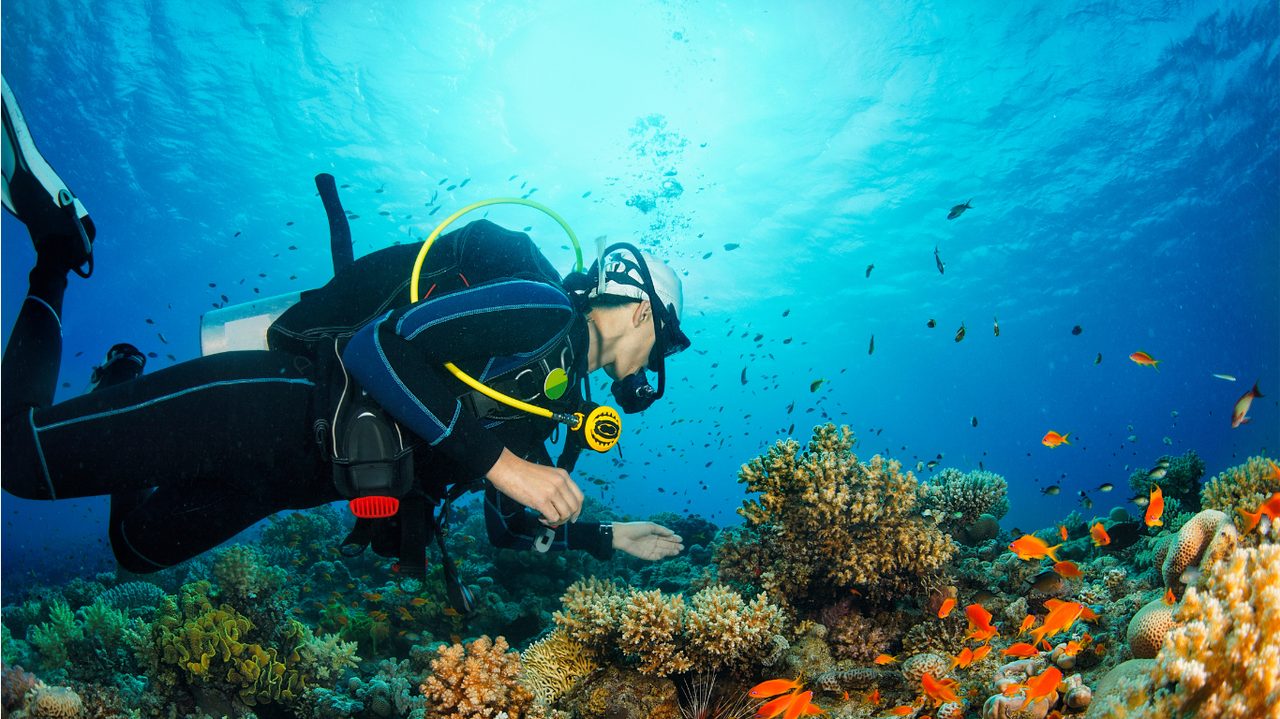
Scuba diving is the art of temporarily existing, as a land animal, in an environment your body was never designed for. You have no gills, you do not naturally float at the right depth, and your senses behave differently underwater. Yet, once you understand why the rules exist, diving is one of the safest adventure activities there is. The accidents that do happen are almost never the result of bad luck, but of a chain of small decisions that each seemed reasonable at the time.
This foundational guide covers the base on which everything else rests: what happens to your body as you descend, why you must never hold your breath, how the main pieces of equipment work together, and the mental habits that separate a diver from someone who simply "has a tank on their back". Where an entry-level course tells you what to do, this guide wants you to understand the underlying causes. That is exactly the difference between a certified diver and one who aspires to become a divemaster or instructor: one follows the procedure, the other understands it and can explain it to someone else.
Why "why" matters. A diver who only memorises rules freezes the moment a situation deviates from the textbook. A diver who understands the cause can improvise. Example: the rule "never hold your breath" is a consequence of Boyle's Law. Anyone who understands that law immediately also understands why a freediver ascending is fine, but a scuba diver holding their breath is not — same depth, different outcome, and the difference is in the physics, not in a rule.
Key concepts
Learn these terms well now; it saves confusion later.
| Term | Short definition | Why it matters |
|---|---|---|
| Absolute pressure | Total pressure on your body: water pressure + air pressure above the surface | Determines how much gas you breathe and dissolve into your body |
| Bar / ata | Pressure unit. 1 bar ≈ atmospheric pressure at sea level. In seawater, ~1 bar is added per 10 m | The working unit of almost everything underwater |
| Buoyancy | The upward force water exerts on you | Determines whether you sink, hover or rise |
| Positive / neutral / negative buoyancy | You rise / you hover / you sink | Neutral is the goal while diving |
| BCD | Buoyancy Control Device: the vest that controls your buoyancy | Your "swim bladder" |
| Regulator | Reduces the high tank pressure to ambient pressure so you can breathe normally | Delivers breathable air at any depth |
| SPG & depth gauge | Measure remaining tank pressure and your depth | Your two most important "fuel and altitude" gauges |
| Dive computer | Continuously calculates your allowed dive time from depth and time | Replaces dive tables and accounts for your whole profile |
| No-decompression limit (NDL) | The time you may stay at a depth without mandatory decompression stops | The boundary of recreational diving |
| Buddy | Your dive partner, with whom you form a team | Your first and fastest backup system |
| Equalising | Relieving pressure differences in your ears and sinuses | Prevents pain and ear injury while descending |
Understanding the fundamentals
Pressure: the engine behind everything
Above water you live under roughly 1 bar of atmospheric pressure — the weight of the entire atmosphere above your head. It feels like nothing because you have been used to it your whole life. Water, however, is far heavier than air: every 10 metres of seawater adds about 1 bar.
| Depth (seawater) | Absolute pressure | Comparison |
|---|---|---|
| 0 m (surface) | 1 bar | Normal, on land |
| 10 m | 2 bar | Twice surface pressure |
| 20 m | 3 bar | Three times |
| 30 m | 4 bar | Four times |
| 40 m (recreational limit) | 5 bar | Five times |
Notice that pressure changes fastest in relative terms just below the surface: from 0 to 10 m the pressure doubles; from 30 to 40 m it rises by only 25%. This is why most pressure-related problems (ear pain, lung over-expansion) happen in the top 10 metres. Remember that well.
Think of a carton of milk. At the top there is barely any pressure; at the bottom the whole column of milk pushes down. Water works the same way, but with you as the "bottom". The deeper you go, the more column presses on you.
Boyle's Law and your air spaces
Your body contains air spaces: lungs, middle ears, sinuses, and sometimes air under a filling or in your digestive tract. Your mask and BCD also contain air. Boyle's Law states: if the pressure doubles, the volume of a gas halves, and vice versa.
While descending, the air in these spaces is compressed. Your middle ears and sinuses therefore need topping up — that is equalising. If you don't, the pressure pulls your eardrum inward: painful, and it can rupture. While ascending, the reverse happens: the air expands. This is the core of the single most important safety rule in all of diving.
The golden rule: never hold your breath
The most important rule in scuba diving: always keep breathing, never hold your breath, and ascend slowly.
Why? Underwater you breathe air that has been compressed to the pressure at your depth. At 10 m you breathe air at 2 bar. If you ascend to the surface (1 bar) while holding your breath, that air wants to double in volume according to Boyle's Law. Your lungs cannot cope. The result — pulmonary barotrauma — can occur from just a few metres of depth and is life-threatening: gas can enter your bloodstream (arterial gas embolism).
As long as you keep breathing normally, the expanding air simply escapes through your airway and nothing happens. This is exactly why freedivers, who don't breathe compressed air but descend on a single breath from the surface, can ascend safely: on the way back their lungs simply return to their original volume, no more.
Did you know? Lung over-expansion injury can occur on an ascent from little more than 1 metre if you fully hold your breath. Dives don't need to be deep to make this deadly, which is why instructors drill this rule from the very first pool session.
Buoyancy: sinking, hovering, rising
Archimedes' principle explains why you float: an object experiences an upward force equal to the weight of the water it displaces. If you are heavier than the water you displace, you sink (negative). Lighter, and you float (positive). Exactly equal, and you hover (neutral).
A diver changes their buoyancy in three ways: weight belt or trim weights (fixed negative, to offset the positive buoyancy of your wetsuit and lungs); the BCD (fine adjustment by adding or releasing air); and your lungs (inhaling and exhaling changes your volume and therefore your buoyancy). Experienced divers steer their final centimetres purely on breathing.
The goal during a dive is neutral buoyancy: you hang effortlessly still, don't touch the bottom (protecting the reef), and waste no energy. It is the hardest basic skill and gets its own dedicated topic (Trim and Buoyancy).
The basic equipment and how it works together
Your equipment is one system, not a set of separate items. A simple way to understand it:
The core: the regulator converts the dangerously high tank pressure, in two steps, into air you can breathe at exactly ambient pressure. That is why breathing at 30 m feels as natural as at the surface — the air you receive is at the same pressure as the water around you. This "breathing at ambient pressure" is also precisely why you consume air so much faster at depth: each breath contains more molecules.
The mask creates an air layer so your eyes can focus (in direct contact with water you see blurred). Fins convert leg power into propulsion. The dive computer continuously tracks how long you may stay. Together they form a chain in which each part has a backup or complement — that redundancy thinking is the common thread of safe diving.
The diver mindset
Technique is half; attitude is the other half. Four habits distinguish good divers: they are methodical (they know before entering how deep, how long, which way, and when to turn — "plan the dive, dive the plan"); calm (almost any underwater problem is manageable if you stop, breathe and think — panic is the common denominator in accidents); buddy-focused (they watch their buddy as closely as themselves); and honest about limits (the best divers say "no" or "let's turn around" — no dive is ever worth forcing).
Real-world examples
The Netherlands (Zeeland / Grevelingen lake). Cold, sometimes murky water and a thick drysuit. Here you notice immediately how crucial buoyancy is: a drysuit adds a lot of air (and positive buoyancy), and that air migrates as you change position. Beginners sometimes "rocket" up because the air runs to their feet. The basics — ascend slowly, keep breathing, actively manage buoyancy — apply on literally every dive here.
Egypt (Red Sea, Hurghada / Marsa Alam). Warm, clear, salty water with abundant visible life. Ideal for practising the basics, but the ease is deceptive: excellent visibility makes people descend deeper than planned ("that turtle must be just a little deeper"). Here you practise discipline: check your computer and depth gauge regularly, not your eyes.
Indonesia (Bali, Nusa Penida). Known for current. The basics matter extra here: neutral buoyancy and calm breathing determine whether you enjoy a relaxed drift dive or fight the water and burn through your air.
Maldives. Atoll diving with tidal currents that drive the reef life. Good buoyancy prevents you from being pushed onto coral.
Mozambique (Tofo and Vilanculos). At Tofo you often dive offshore reefs (such as Manta Reef) from a RIB via a "negative entry" — straight down, no time at the surface — to avoid drifting in the swell. That requires your basic skills to be automatic: clearing your mask, equalising and controlling buoyancy while already descending. Vilanculos, gateway to the Bazaruto Archipelago, offers calmer, shallower dives that are ideal for practising those same basics before you take on Tofo's current. Both places make concrete why this topic is about "automatic mastery" and not about "being able to recite".
Common mistakes
| Mistake | What goes wrong | How to avoid it |
|---|---|---|
| Holding your breath while ascending | Lung over-expansion injury, potentially fatal | Always keep breathing; exhale audibly if needed |
| Equalising too late | Ear pain, possible eardrum injury | Equalise early and often, starting at the surface |
| Descending/ascending too fast | Barotrauma, increased decompression risk | Ascend at max ~9-10 m/min; follow your computer |
| Over-weighting | You constantly fight negative buoyancy and burn air | Do a proper weight check at the surface |
| Under-weighting | You can't stay down, especially at the end (light, empty tank) | Weight check accounting for a near-empty tank |
| Not checking SPG/computer | Unexpectedly out of air or beyond NDL | Fixed check rhythm: every few minutes |
| Losing sight of your buddy | No help when a problem arises | Stay within reach; agree who navigates |
| Not testing new/borrowed gear | Surprises underwater | Buddy check before every dive, no exceptions |
Scenario. You descend quickly in Hurghada behind your guide. At 6 m you feel pressure in your right ear, but you want to keep up with the group and dive on. At 9 m pain shoots through your ear. Now what? Stop, ascend a few metres, let the pressure ease, and calmly try to equalise again. If it won't clear without pain, the dive is over — a ruptured eardrum keeps you dry for weeks. The mistake wasn't at 9 m, but in not equalising early enough at 2 m.
Pro tips
- Equalise at the surface and on the first metre, before you feel pain. Equalising must stay ahead of the pressure, not react to it.
- Breathe slowly and deeply rather than fast and shallow. That lowers your air consumption and keeps you calm — breathing and the nervous system are linked.
- Set your computer conservatively when you are tired, cold or dehydrated. Your body is not an "average model" then.
- Take your weight check seriously. With the right amount of lead you hover at eye level with empty lungs and a near-empty tank.
- Stow your octopus well, in the "triangle" between chin and lower ribs, so your buddy finds it immediately.
- Make your buddy check a ritual, not a formality. Most underwater "surprises" were preventable on the surface.
Frequently asked questions
Why must a scuba diver never hold their breath while ascending, when a freediver can? The scuba diver breathed compressed air at depth; on ascent that air expands (Boyle's Law) and can rupture the lungs (lung over-expansion injury). The freediver took a single breath at the surface; underwater it was compressed, and on the way back it only returns to its original volume, so there is no over-pressure.
How much absolute pressure does a diver experience at 30 m in seawater? 4 bar. 1 bar of atmospheric pressure at the surface plus 1 bar per 10 m of water (3 bar at 30 m) = 4 bar absolute.
What is neutral buoyancy and why aim for it? You displace exactly as much water as you weigh, so you neither rise nor sink and hang still. It saves air and energy, protects the reef and gives control.
What are the five steps of the BWRAF buddy check? BCD, Weights, Releases, Air, Final check (also remembered as "Begin With Review And Friend").
I feel ear pain at 5 m and can't equalise. What should I do? Stop descending, ascend a few metres to reduce the pressure, and gently try to equalise again. If it won't clear painlessly, end the dive. Never push deeper against the pain.
Summary
Diving works because your equipment lets you breathe breathable air at ambient pressure while you actively manage your buoyancy. Absolute pressure increases by about 1 bar per 10 m, and that change is strongest just below the surface — where most problems occur. The most important rule follows directly from physics: always keep breathing and ascend slowly, because held air expands on ascent and damages your lungs. Equalise early and often. Your equipment is one coherent system in which the regulator brings high tank pressure down to ambient pressure in two steps, and your BCD, weights and lungs together determine your buoyancy. Beyond technique, mindset — planning, staying calm, watching your buddy and respecting your limits — makes the difference between a certified diver and a true diver. Everything that follows builds on this foundation.
The 10 things every diver should know by heart
- Never hold your breath while diving. Always keep breathing, especially while ascending.
- Ascend slowly (max ~9-10 m/min) and make a safety stop where possible.
- Pressure rises ~1 bar per 10 m; the biggest relative change is just below the surface.
- Equalise early and often, starting at the surface; never dive on through ear pain.
- Aim for neutral buoyancy and control it with BCD, weights and breathing.
- Do a serious weight check; not too much and not too little lead.
- Know your dive plan: max depth, max time, direction and turn point (on pressure and time).
- Check your SPG and computer regularly; never end up unexpectedly out of air or beyond the NDL.
- Always do the buddy check (BWRAF) and stay with your buddy during the dive.
- Stay calm and respect your limits; stopping or turning around is always the right choice when it doesn't feel right.